

Gallery Tour
Mitte Nord
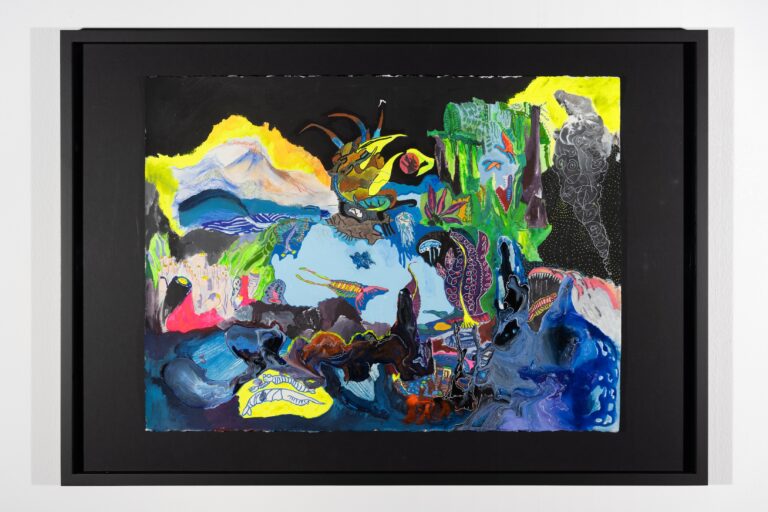
Anne Duk Hee Jordan
The End Is Where We Start From, 2024
Acrylic and pigment pencils on paper
56 x 76 cm
Courtesy of the artist and alexander levy, Berlin
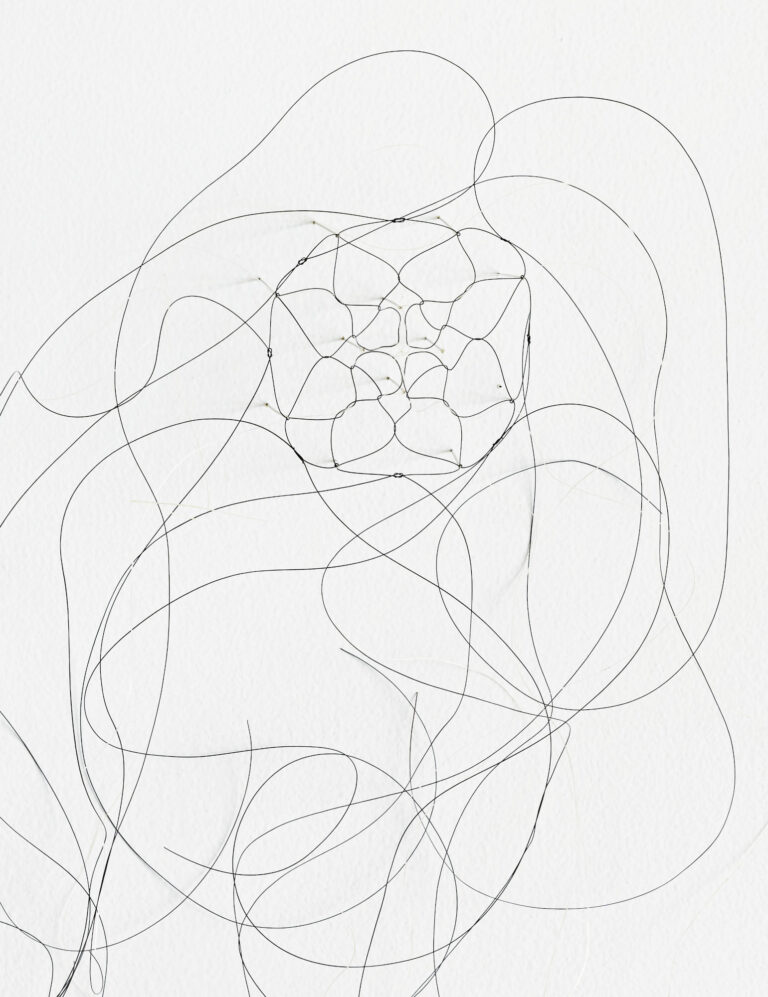
Christiane Löhr
Kleines Haarnetz (Little Hair Net), 2019
Horse hair, needles
ca./approx. 35 x 20 x 15 cm
Courtesy of the artist and Galerie Levy, Berlin
The tour begins at its westernmost point: in Moabit, where alexander levy and the Levy Galerie share an address. Anne Duk Hee Jordan, showing at alexander levy, has built a practice around multidimensional, immersive worlds populated by kinetic sculptures and robot-like creatures. Having studied under Olafur Eliasson at the “Institut für Raumexperimente”, Jordan draws her themes from the animal and plant kingdoms, landscape ecology, technology and philosophy. Her work engages with impermanence, resilience and the relationships between humans and non-humans within ecosystems — always with humor, however serious the subject. The works on view center around weather — its extremes intensified by the climate crisis — and the remarkable ways in which living beings of all kinds find ways to adapt.
Christiane Löhr, showing at the Levy Galerie, shares Jordan’s fascination with the extraordinary forms produced by animals and plants. The sculptor works with animal hair — most often from horses — alongside plant matter such as stems, blossoms, burrs and seeds, assembling these into delicate sculptures and installations. The exhibition also features drawings as well as three-dimensional works.
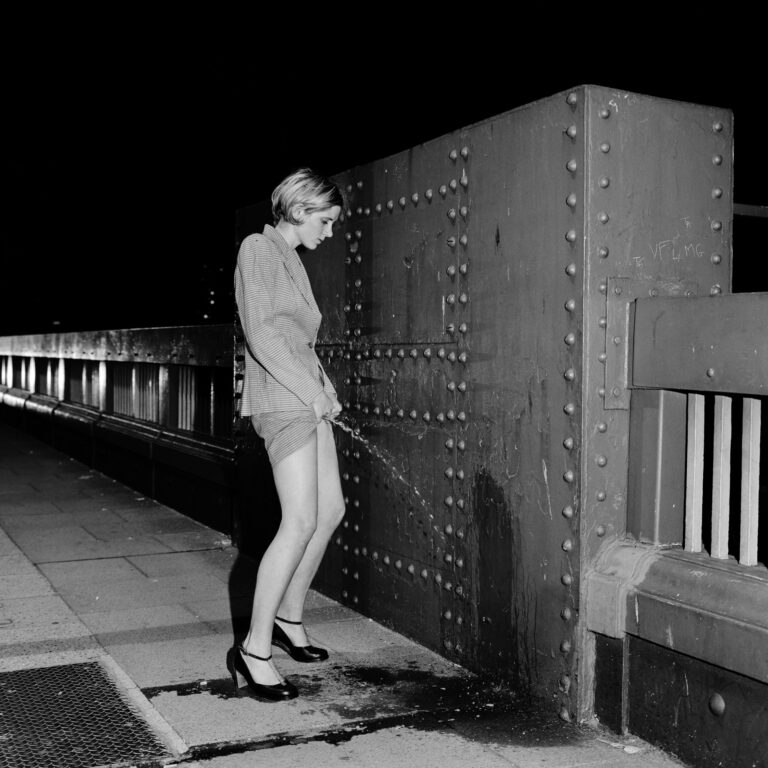
Sophy Rickett,
Vauxhall Bridge 2, 1995,
(from the ‘Pissing Women’ series)
Courtesy the artist @galerieneu
A few kilometers to the east, the route continues with a group exhibition at Galerie Neu. Counter City takes as its premise that cities are never neutral landscapes — that the design and use of public space reflect the power structures embedded in patriarchal societies. Curated by Juliette Desorgues, the show brings together historical works by G.B. Jones, Sophy Rickett and Anita Steckel with new pieces by Hannah Quinlan & Rosie Hastings and Reba Maybury. Among the highlights: Sophy Rickett’s photographic series “Pissing Women” from the 1990s, in which women in sharp business attire relieve themselves across London’s Financial District in the way one would only expect of men.
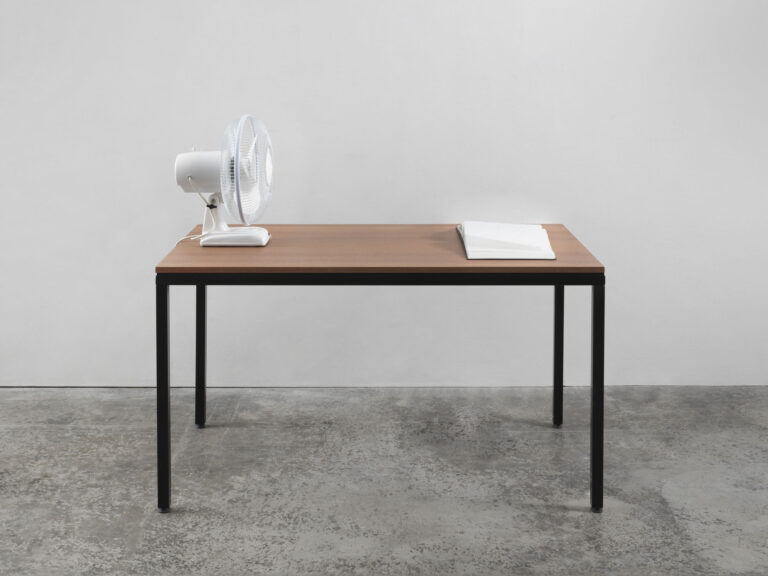
Shilpa Gupta,
100 Hand-Drawn Maps of Germany, 2007-2025
Table, fan, book
124 x 122 x 60 cm.
© Shilpa Gupta. Courtesy the artist and neugerriemschneider, Berlin
Photo: Jens Ziehe, Berlin
Around the corner at neugerriemschneider, Renata Lucas installed a fountain in the gallery’s courtyard for Gallery Weekend 2015 — something many visitors will still remember. For “Fontes e sequestros,” she had cast segments of the basins from three of Berlin’s historic fountains and slotted them together. Eleven years on, she returns with a new sculpture that directly refers to that earlier work. It is part of the group exhibition perceptual territories — cut, split, layered, in which pieces by Shilpa Gupta and Haegue Yang likewise sharpen the senses. Gupta presents, among other works, “100 Hand-Drawn Maps of Germany” — maps drawn by 100 residents of Germany, which a desk fan idly leafs through. Yang shows three of her “Sonic Half Moons”: rotating sculptures assembled from metal bells, perfectly spherical like small planets, with trailing chains of chimes that sound at the slightest movement.
Also at neugerriemschneider, Jorge Pardo presents his twelfth solo exhibition with the gallery. The Cuban-American artist’s paintings emerge from a deep engagement with key works by the post-minimalists John Chamberlain, Felix Gonzalez-Torres, Donald Judd, Brice Marden and Joel Shapiro. Pardo takes their defining characteristics, distorts and estranges them, reworks them through paint and printmaking until they become unrecognizable, then reassembles them into something entirely new. What interests Pardo is the act of looking itself — the way we receive and process works of art. Hanging light sculptures further destabilize spatial perception, while sculptural speakers fill the rooms with multidimensional arrangements of interwoven musical pieces.
At the gallery on Christinenstraße, creatures of a different kind take over. In Hugh Lofting’s children’s book “Doctor Dolittle” — from which Pae White has borrowed her exhibition title — the “pushmi-pullyu” is a mythical animal with a head growing from each end of its body. The animals that populate White’s artistic universe are drawn from reality, yet in their larger-than-life scale they have an almost fantastical quality. Butterflies rendered as if seen through a magnifying glass were made in collaboration with the indigenous Wixáritari people of western Mexico, using traditional yarn painting techniques. Crabs and snails, meanwhile, appear not only on Jacquard tapestries but also on ceramic reliefs.
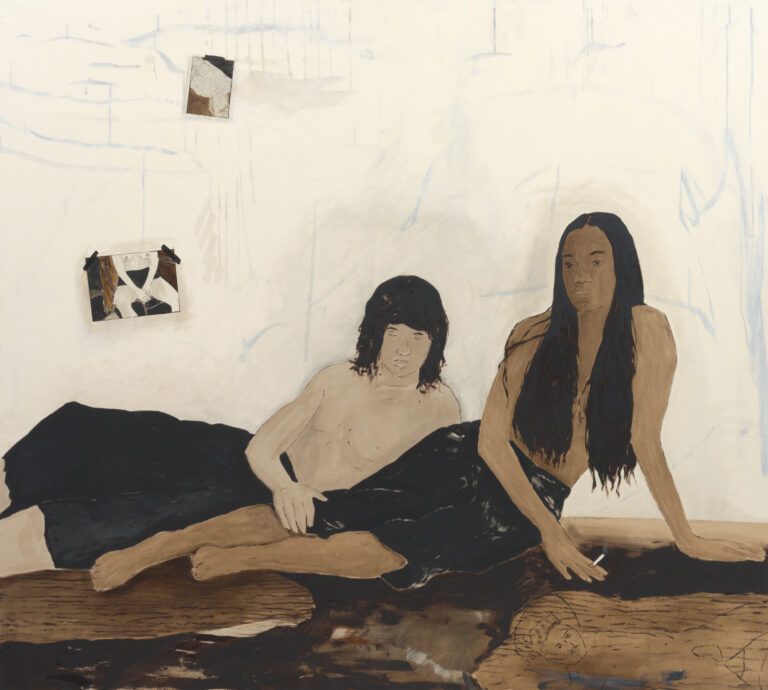
Brett Charles Seiler
MY BOYFRIEND AND HIS BEST FRIEND (WILLEM AND CHARITY), 2025
Bitumen and wall paint on canvas
200 × 180 cm
Courtesy Galerie EIGEN + ART Leipzig/Berlin
Photo: Georg Brückmann
At Galerie EIGEN + ART on Auguststraße, Brett Charles Seiler stages tender encounters between his “occasional lovers.” Seiler has lived in Cape Town since completing his art studies, but was born in Zimbabwe, a country where same-sex acts remain criminalized. His paintings focus on male bodies — their desires and insecurities — shown alone, half-dressed and self-possessed, or caught in moments of quiet intimacy. The work has a poetic, nostalgic quality, loose and spontaneous in its handling, with small found objects, flea market discoveries among them, tucked into the surface. Text fragments appear throughout, recalling the kind of scrawl found on the walls of public restrooms.
EIGEN + ART Lab, the gallery’s project space for emerging art, presents work by UdK graduate Nils Ben Brahim — paintings that take a hyperrealist aim at the artist himself and the world he inhabits.
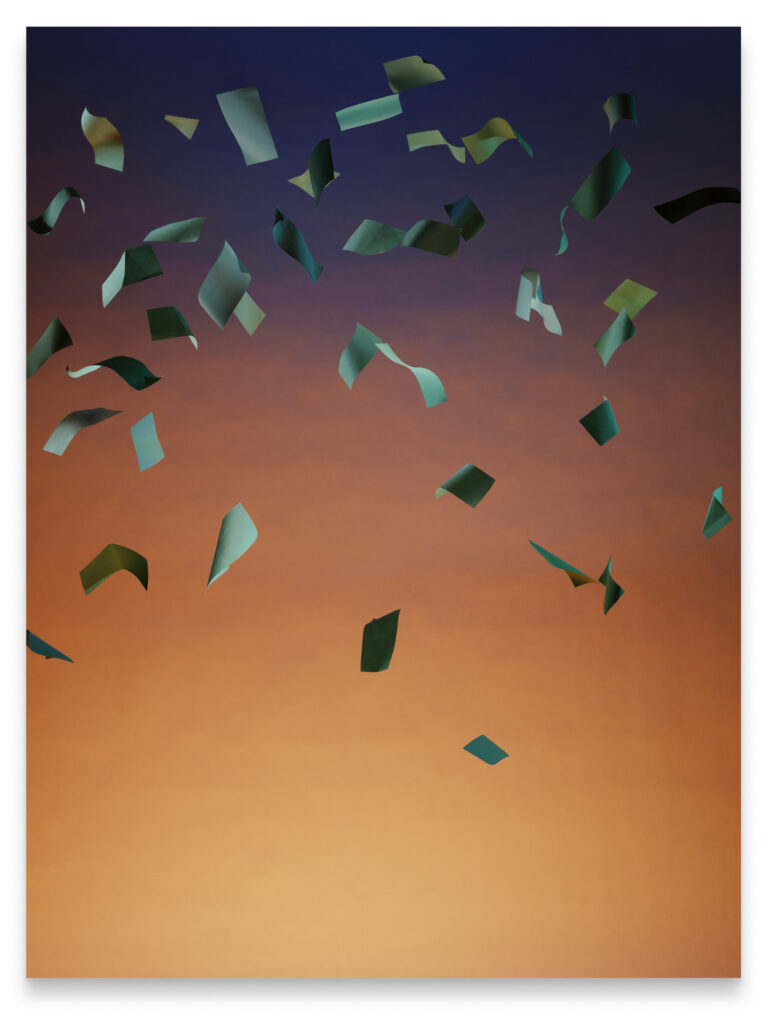
Thomas Demand
Money, 2025
UV-Print on copper
85 × 64 cm
© Thomas Demand, VG Bild-Kunst, Bonn
Courtesy Sprüth Magers
Thomas Demand, showing at Sprüth Magers, needs little introduction. The Munich-born, Berlin-based artist — born in 1964 — built his reputation on a photographic practice that plays with image and representation. He meticulously reconstructs press photographs, or images otherwise burned into collective memory, from paper and cardboard, only to photograph them in turn. For Gallery Weekend, he focuses on a new technique: printing small-format images onto copper. The question of how visual perception can be manipulated remains central. Some of the works show forms found in nature; others draw on material generated by artificial intelligence.
Paintings of dusky industrial landscapes and enigmatic animal imagery await at Robert Elfgen’s exhibition. Born in the Rhineland in 1972 and now living in a remote village in Brittany, Elfgen creates immersive total environments in which floor and wall works are woven together with objets trouvés into symbolically charged dreamscapes. He paints on wood in thin layers, repeatedly sanding back his motifs so that the grain of the wood emerges and becomes part of the image itself, appearing like wisps of fog or the troubled surface of water. These are combined with sculptural works made from sandblasted glass panels set in handmade wooden frames, which both connect the elements and structure the space.
The gallery’s ‘Window’ has been taken over by Dominica Publishing, a temporary boutique set up by California-based artist Martine Syms. More than an exercise in the aesthetics of consumer culture, it functions as an actual shop, with artworks, merchandise and publications available to buy.
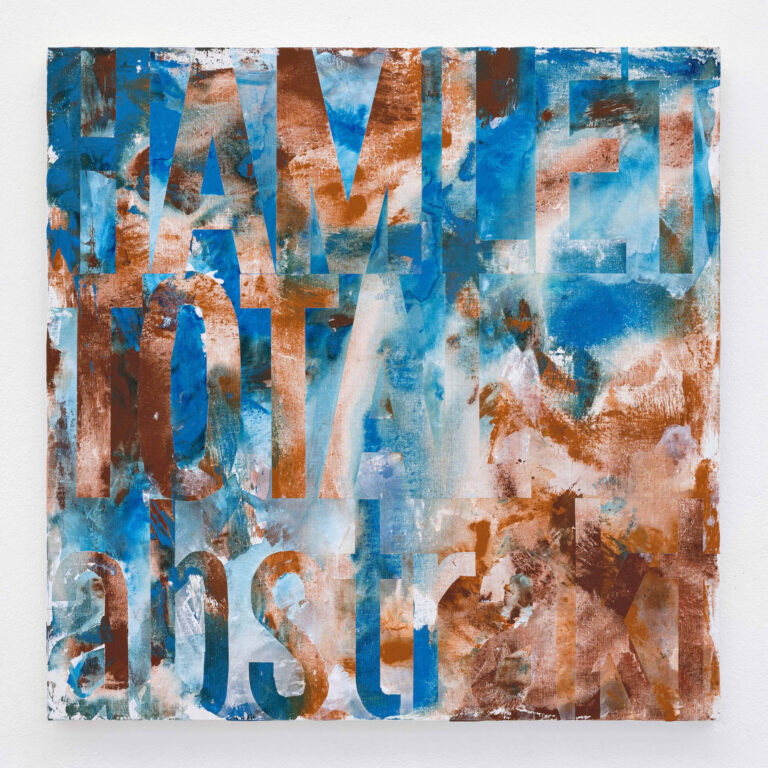
Heimo Zobernig, untitled (2025)
Acrylic, canvas
100 x 100 cm
Courtesy: the artist and Galerie Nagel Draxler Berlin/Cologne/Meseberg
From there, it’s a straight shot to one of the city’s gallery hubs: Rosa-Luxemburg-Platz. Galerie Nagel Draxler has been here for years, and for Gallery Weekend presents new works by Heimo Zobernig. The Austrian artist — who has been connected to the gallery since its founding in Cologne in 1990 — resists classification across his conceptual practice. Here, he lines up deceptively convincing Ikea shelving units cast in aluminum. Next to them, paintings in which he records the exhibition title in carefully measured lettering: Hamlet total abstract. The tragic Danish prince serves as a reference point for Zobernig — both in Shakespeare’s original and in Heiner Müller’s adaptation, “Hamletmaschine” — as does 1977, the year Zobernig moved to Vienna to begin his studies at the Akademie der Bildenden Künste, the same year Ikea arrived in the city.
In the facing cabinet at Nagel Draxler, Huang Rui turns to 1989 — a year that proved fateful for both Germany and China. One of the key figures in early contemporary Chinese art, he has been circling these events for some time. His 2009 book “1989 — 365 Art Days in China and Germany” traced that year through the lens of art and its place in collective memory in both countries. In the new exhibition, he presents books drenched in ink: unreadable, consumed from within.
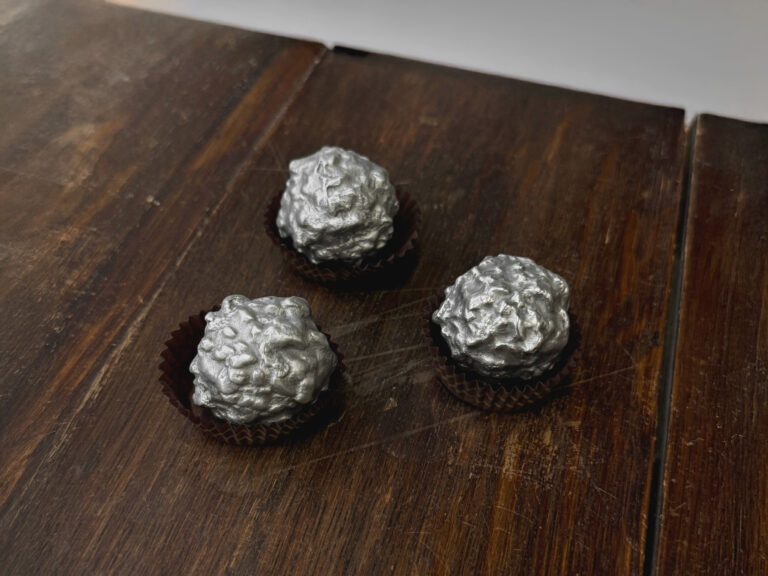
Shinoh Nam
Untitled (detail), 2026
Ferrero Rocher cast in aluminium
Courtesy of the artist and Mountains, Berlin
Shinoh Nam builds architectural fragments from hand-polished steel, charred wood, glass and industrial foam. Precisely constructed as they are, the works read more like ruins, remnants of structures long since fallen or never quite finished. Form, for Nam, is never innocent, it shapes, constrains and acts upon the people who move through it. His installations and sculptures pick at its assumptions, at the dogmas and norms built into the very idea of a building. Nam, born in Seoul in 1993 and later a master student of Monica Bonvicini at UdK Berlin, was already on view in a group exhibition at Mountains earlier this year. For Gallery Weekend, the gallery — participating in the Perspectives sector — opens his first solo show.
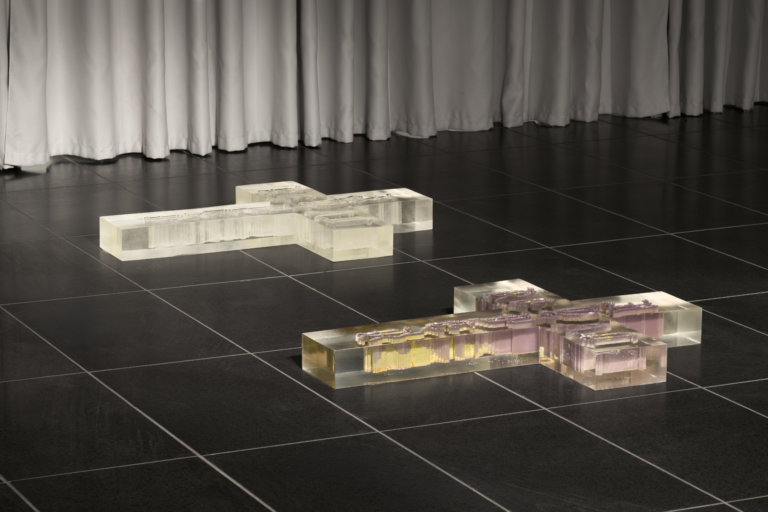
Jiyoon Chung,
Hyperreal, 1.0, 2026 & Hyperreal, 0.0
Epoxy resin, graffiti extracted with solvent
79 x 101 x 10 cm
Courtesy of the artist and Anton Janizewski, Copyright Brian Kure
Also from South Korea is Jiyoon Chung, showing just next door at Anton Janizewski (Perspectives). Earlier this year, she presented her solo exhibition Dead End at Politikens Forhal in Copenhagen, examining the heightened security structures that followed a series of terrorist attacks in European cities during the 2010s. Her first Berlin show shares the same title and continues that investigation through a site-specific installation, though the focus has shifted to the current intensification of security policies, in which the search for social solutions seems to have all but disappeared from the conversation. Using visual triggers, Chung probes what she calls the “Crisis-Ordinariness” of our time: a condition in which crisis is no longer experienced as a temporary state of exception, but simply as everyday life.
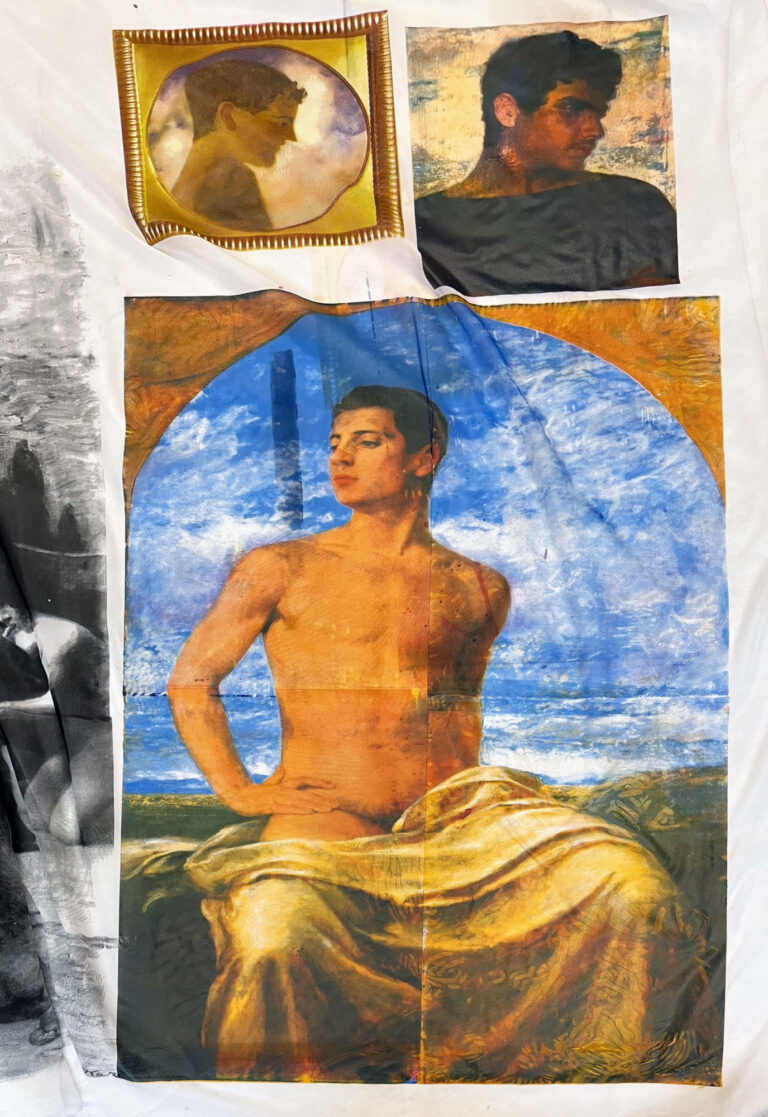
Philipp Gufler
Imitationen von Paul, 2026
Screen print on fabric
Courtesy BQ, Berlin. Photo Roman März
For Philipp Gufler, queer cultural memory is not a given, it has to be actively recovered. In Imitations of Paul, on view at BQ, the Munich- and Amsterdam-based artist turns to the painter Paul Hoecker (1854–1910), a co-founder of the Munich Secession who withdrew from public life at the end of the nineteenth century following homophobic rumors surrounding one of his religious paintings, and whose life and work have largely been forgotten. Through screen-printed textile works and ceramics, Gufler — himself a founding member of the Paul Hoecker research group at “Forum Queeres München” — moves through Hoecker’s history and archive, spinning biographical traces into narratives of his own.
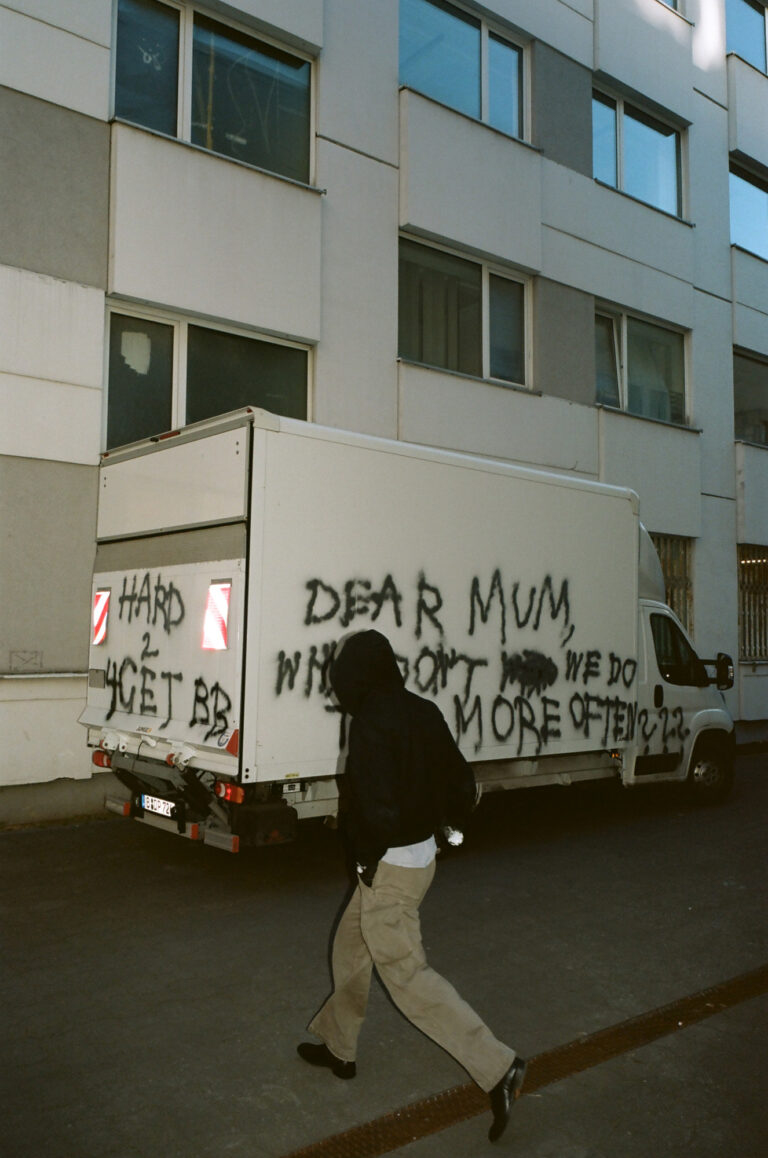
© Monty Richthofen,
HARD 2 4GET, 2026
Photo, Lukas Städler
Courtesy DITTRICH & SCHLECHTRIEM, Berlin
Monty Richthofen seems to have taken to heart the idea that Gallery Weekend extends beyond gallery walls and out into the city itself. The artist, known for poetic and wry texts applied in scratchy handwriting to canvases, building facades and human skin, has chosen a rather more mobile surface for his show with DITTRICH & SCHLECHTRIEM. For HARD 2 4GET, he has sprayed an entire fleet of vehicles with sentences and text compositions informed by his research into unofficial inscriptions on military equipment. The opening performance launches at Rosa-Luxemburg-Platz, close to the gallery, with further temporary interventions planned for Ernst-Reuter-Platz, the Siegessäule and Strausberger Platz.
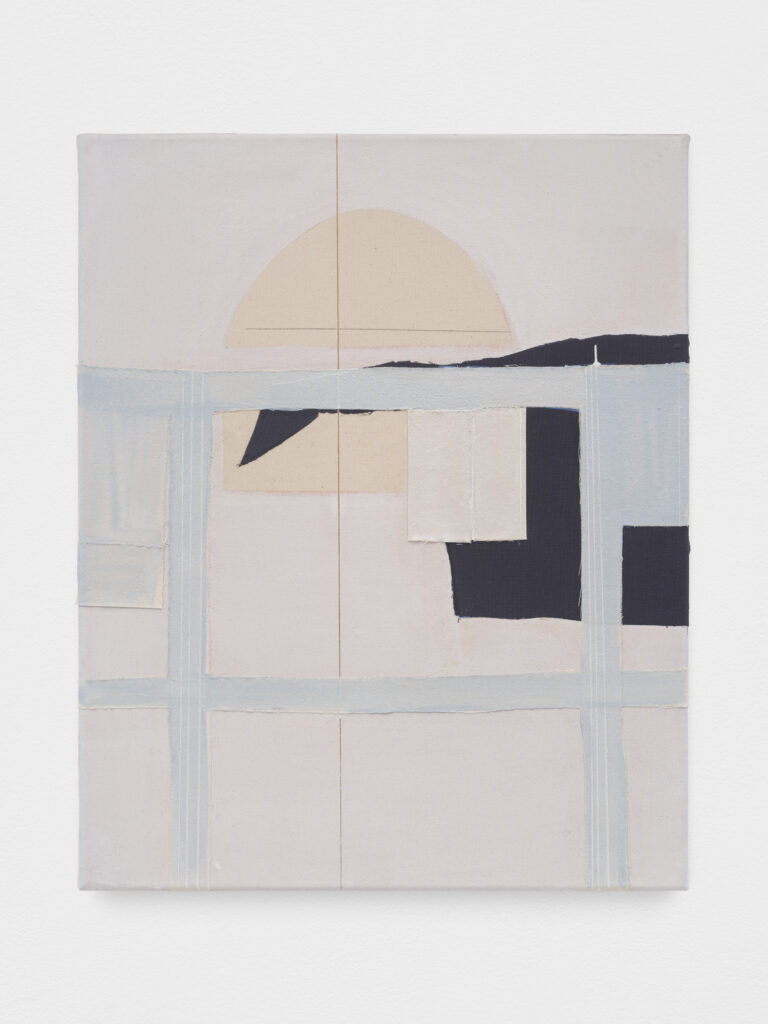
Marieta Chirulescu
Untitled, 2024
Glue pigments and canvas on canvas
50 x 40 cm
Photo: Trevor Good
Courtesy the artist and Plan B Cluj, Berlin
Strausberger Platz has been home to Galeria Plan B since 2023, when the gallery opened across two floors of the socialist-classicist “Haus Berlin” — space enough for the new works by Marieta Chirulescu. In abstract paintings held in quiet, muted tones, the artist, born in 1974 in Sibiu, Romania, works across painting, digital manipulation, collage and printmaking. Layer by layer, she builds up her canvases, adding paint and different types of fabric, building up images only to question, revise and ultimately undo them.
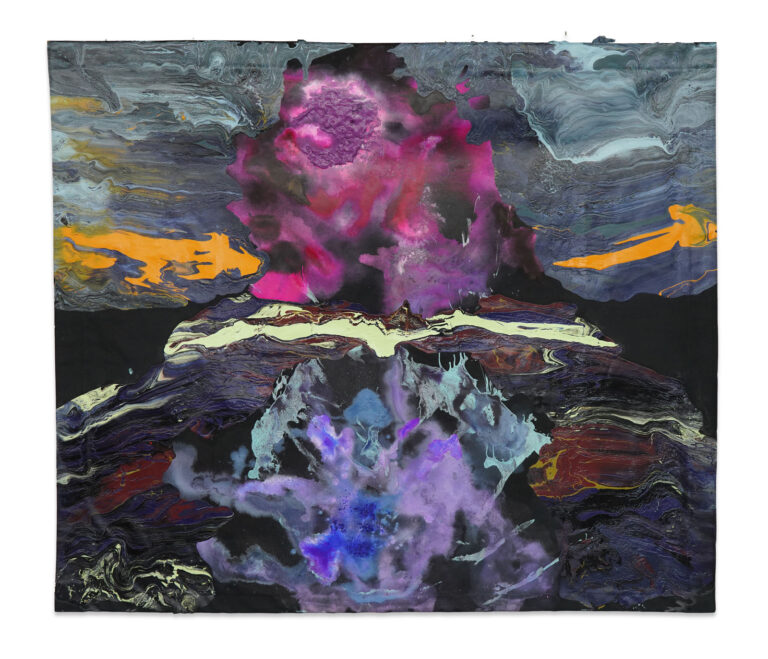
Rodney McMillian
As Below, 2024-2026
Acrylic and latex on canvas
152.4 x 182.9 cm
Courtesy: the artist and Capitain Petzel, Berlin
Photo: Josh Vasquez
A short walk away, Capitain Petzel offers a first glimpse through its glass front of sculptures and paintings by Los Angeles–based artist Rodney McMillian. Born in 1969 in Columbia, South Carolina, McMillian works primarily with discarded consumer goods such as blankets, tarps, carpets, and furniture, which he reconfigures into sculptural forms. Through these materials, he probes the darker undercurrents of the American way of life and the structural inequalities that shape it. Material and method are inseparable in his practice. The way he cuts, folds, and stitches these objects becomes a language for addressing Black lived experience, as well as questions of class, race, gender, and broader socioeconomic conditions. In his “Black Paintings,” McMillian uses black fabric or vinyl as a ground, draping and sewing it into layered compositions that extend into three dimensions. While these works echo Abstract Expressionism on a formal level, their charge is unmistakably political. The exhibition also features a new film by the artist.