Counter City
With works by Cosima von Bonin, Jana Euler, Pippa Garner, Hannah Quinlan & Rosie Hastings, G.B. Jones, Klara Lidén, Reba Maybury, Sophy Rickett, Anita Steckel, Lena Tutunjian, curated by Juliette Desorgues
1 MAY until 4 JUL 2026
Opening – 1 MAY 2026, 6-9 pm
‘Architecture must be thought of as a system of representation’1
Beatriz Colomina
If architecture is understood as a representational system, the metropolis emerges as one of its most pervasive expressions. As a form of representation shaped by the societies that construct it, the built environment embeds and consolidates their underlying social structures. In a Western context, where these structures are organised through systems of patriarchal power and control, the city becomes a primary site where gendered power relations are materially inscribed and spatially reproduced.
It is within this critical framework that the group exhibition Counter City situates itself. At a moment marked by the resurgence of far-right politics, of intensified violence within the public arena that further displaces already marginalised communities, the stakes of this spatial order are increasingly visible. Bringing together artists across generations, the exhibition presents practices that expose, unsettle and reconfigure these conditions. Informed by intersectional feminist thought—attentive to gender non-conformity, sexuality, race, and class—it proposes a provisional genealogy.2
What binds these positions is a shared impulse to reclaim space, to ‘counter’ the city as it is given, and to imagine it otherwise. Through acts of appropriation and disruption, the works presented construct a ‘counter city’: a space-time of subversion that contests the logics of capital accumulation, hierarchical planning, and patriarchal normativity that define the Western metropolis. Echoing the radical French group the Situationist International’s dérive—a mode of accelerated, playful, movement through urban space intended to fracture the linear logic of the capitalist city—they take hold of its streets with a sharp, satirical bite, working both within and against its structures.
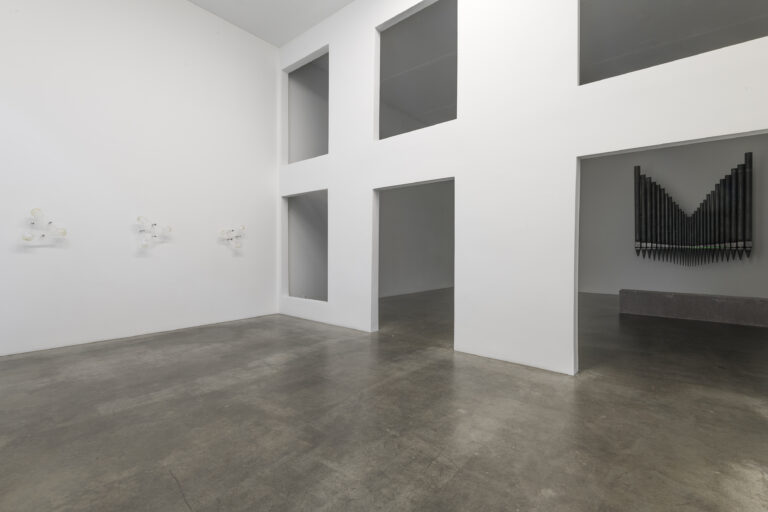
At the centre of the exhibition stands Deeskalationstraining (Shark Lock) (2007) by German and Cologne-based artist Cosima von Bonin. Through sculpture, textiles, sound, video, and performance, von Bonin probes and destabilises social conventions. Here, a metallic structure—part gate, part enclosure—frames a shark pool. The gate hangs open. The shark, an absent yet palpable emblem of predatory force, haunts the space, looming over the surrounding works. The structure remains conspicuously incomplete, creating a division that remains suspended, unresolved. The work May & June 1 + Smoke (CvB & Michel Würthle) (2008-2010) shifts register, as a solitary streetlamp—leaning, anthropomorphised—idly smokes a cigarette, its neon plume drifting into the surrounding space, introducing a note of languid defiance and quiet absurdity that subtly reclaims the urban environment.
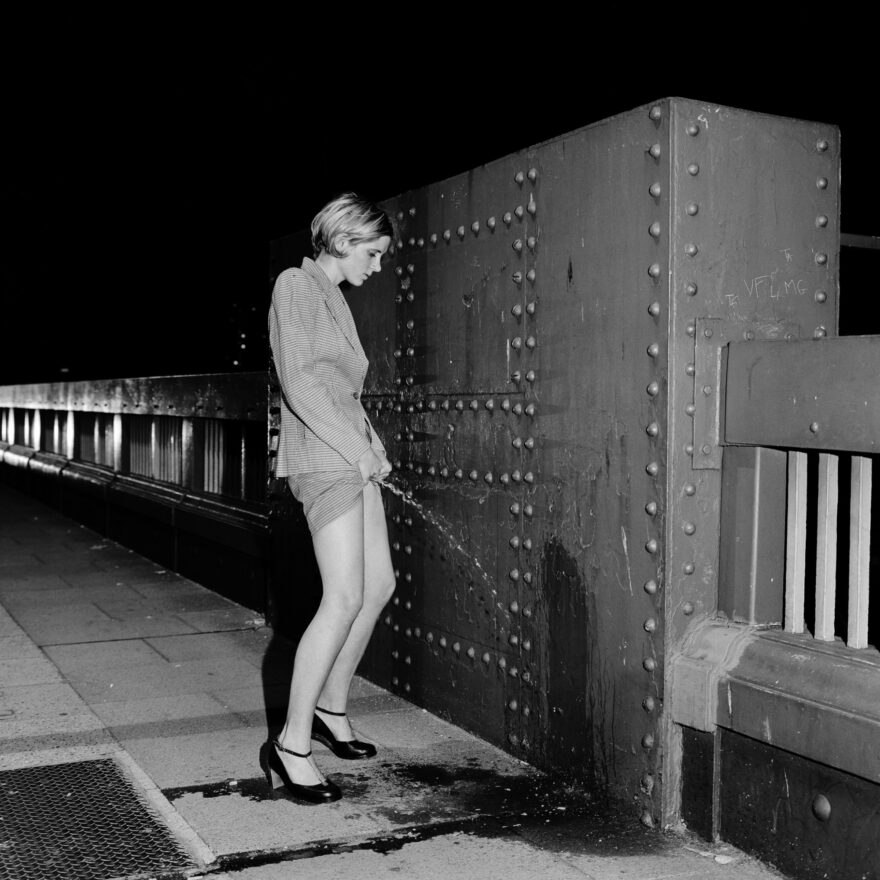
A series of photographs by British London-based artist Sophy Rickett whose wider practice includes photography, video installation and text, inhabits the very structure of urban space. Titled Pissing Women (1995), the series presents herself and friends urinating, standing up in public sites of power across London, from Vauxhall Bridge and the MI5 building to Old Street, the symbolic core of the capitalist city. The gesture is blunt and exacting—a reclamation of public space, a defiance of institutional power, and a reversal of gendered codes of public behaviour.
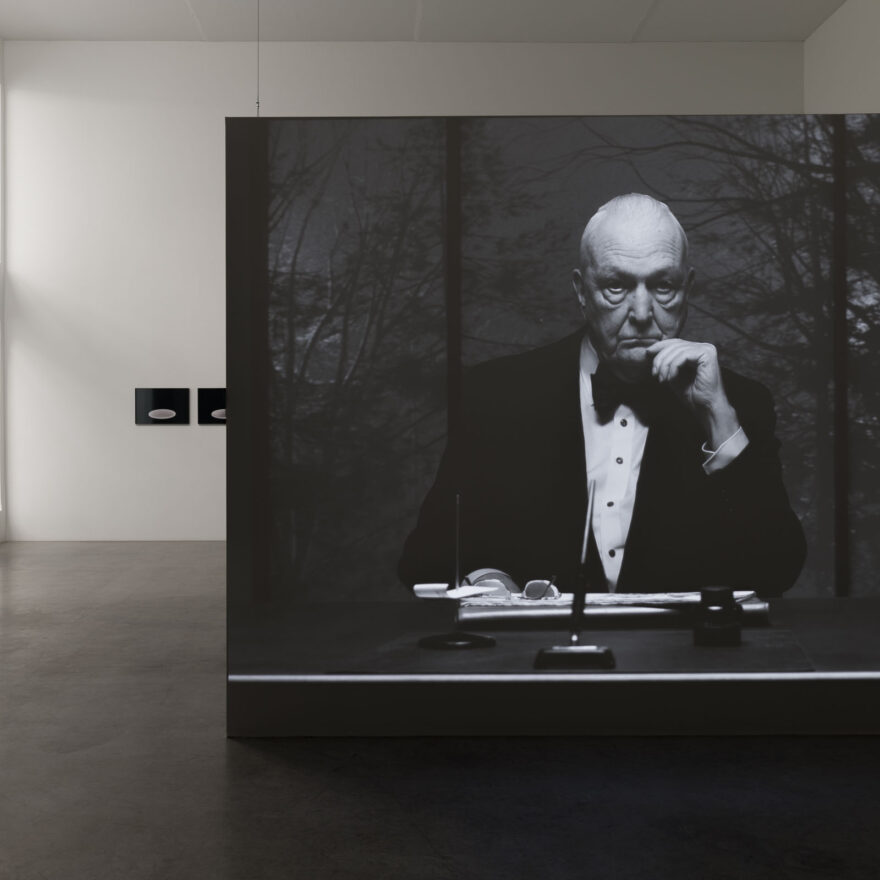
Corporate space comes under sharper scrutiny in Future Man! (1987), a photographic series by American artist and designer Pippa Garner. Working across sculpture, drawing, and performance, Garner’s practice is marked by subversive, often humorous critiques of gender norms, consumer culture, and mass production. Here, she inhabits and distorts the figure of the corporate subject where tailored suits are surgically modified, exaggerated, and worn in staged encounters. Produced in the early stages of her transition, the series reflect on traditional binary codes of corporate masculinity, which are here not simply represented but warped from within.
This logic of appropriation and reversal is found in the work of British-Pakistani artist, writer and political dominatrix Reba Maybury. Across painting, sculpture, and performance, her practice centres on sex work and its embedded power structures. In the series of paintings From Paris with Love (2022), Reba Maybury turns to 19th-century Paris, revisiting Henri de Toulouse-Lautrec’s Medical Examination (1894), where partially naked sex workers—central to the emerging capitalist city—are lined up for inspection. Using paint-by-numbers kits, she delegates the act of reproduction to her submissives. Through this calculated infantilisation, authorship and power are reversed, reframing Lautrec’s voyeuristic, violent staging of women’s oppression through the lens of contemporary sex work.
The city’s contours are represented and toyed with in a watercolour drawing titled Greetings from Frankfurt (2018) by German, Frankfurt and Brussels-based artist Jana Euler whose practice comprises painting and sculpture through which she explores representation and identity in a digital and image-saturated era. Here, the looming erect building of the European Central Bank in Frankfurt—a phallic emblem of capitalism—dominates the frame, while a cast of figures circulates around it in ambiguous, unruly play, unsettling the authority the structure seeks to impose.
A similar engagement with the architecture of the city as a site of power runs through the work of American artist, satirist and political activist Anita Steckel. Through painting, photomontage, collage and sculpture, Steckel’s work mobilises erotic imagery to confront power relations based on gender, sexuality and race. As a member of the Fight Censorship Group—alongside artists such as Judith Bernstein, Juanita McNeely, and Joan Semmel—he championed the liberation of sexual representation. The works shown here from the 1970s cast the city—specifically New York, where she lived and worked—as a charged terrain in which power and violence are actively confronted, opposed and subverted through the assertion of her identity as a Jewish woman.
This fraught urban landscape is also inhabited in the work of London-based artist Lena Tutunjian. Working across installation and video, her practice probes the conditions of contemporary capitalism. In the video work she_stays_underground (2017), the city of London becomes a libidinal space, a network of circulation where gendered bodies are continuously coded and consumed. Filming across the city’s underground system, Tutunjian exposes how the visual economy of the metropolis scripts desire, embedding gender bias within its surfaces and flows.
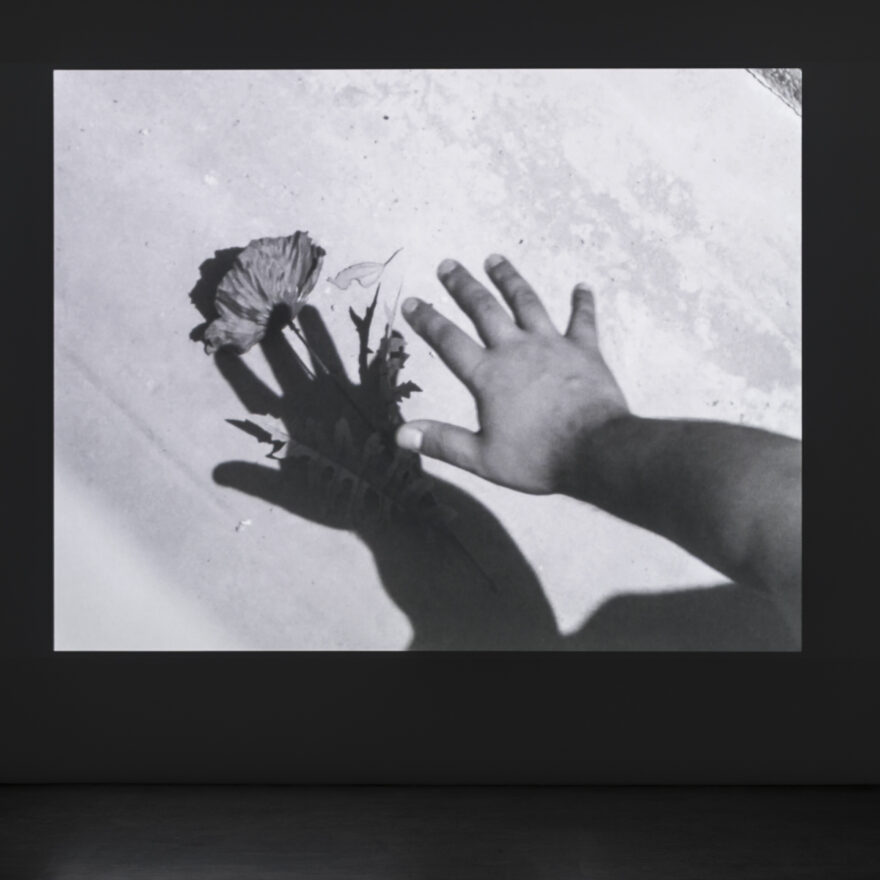
This cinematic intervention in urban space continues in the work of Swedish and Berlin-based artist Klara Lidén, whose practice spans installation, sculpture and video, which she mobilises to engage the city’s architectural fabric as a structure of control and exclusion. In the video work titled Verdebelvedere Exit (2024) presented here, she wedges her body through the walls of various buildings sites across the city of New York. The gesture is subtle yet forceful, as the queer body interrupts and punctures the rigid surfaces of the urban environment, momentarily short-circuiting its logic from within.
A similarly insurgent use of the camera drives the filmic work of Canadian artist and filmmaker G. B. Jones. A key figure of the queercore movement of the 1980s and ’90s, Jones works across drawing, zines, photography, and film to centre queer subjectivities in defiance of dominant normative culture. Her films extend this ethos through raw, abrasive narratives of desire and rebellion, in which protagonists seize the city—most often Toronto, where she lives and workoccupying and disrupting its spaces as an act of refusal.
The city re-emerges as a site of tension, recast as a constructed scene in the work of London-based British artists Hannah Quinlan & Rosie Hastings. Working across painting, drawing, video, performance, and installation, the duo engages with queer identity through the politics of public space. Using the traditionally monumental medium of fresco, The Conquest (2023) stages a scene of public violence, and collective mobilisation. Here, public space becomes a site not only of conflict, but of resistance.
Across a wide range of media and strategies, the artists in this exhibition approach the city as a contested site, one in which power and control—the key instruments of patriarchy—are exerted, negotiated and resisted. At its core lies a struggle over gendered power dynamics, inscribed, performed, and enforced through the structures and surfaces of the urban environment.
In tracing these fault lines, the works do not simply expose such dynamics but actively push against them, prying open spaces of interruption, refusal, and reconfiguration. In doing so, alternative modes of inhabiting space begin to take shape; at once embodied, incisive and satirical. Together, they offer tools to understand, navigate and reimagine the shifting, charged terrain of the Western metropolis.
_______________
1 Beatriz Colomina, Sexuality & Space, (New York: Princeton Papers on Architecture, 1992), p. ii
2 A long list of authors has informed my research and thinking including Sara Ahmed, Jack Halberstam, Leslie Kern, Katherine McKittrick, Gill Valentine to name a few.
Sophy Rickett,
Vauxhall Bridge 2, 1995,
(from the ‘Pissing Women’ series)
Courtesy the artist