

Sara Cwynar
Elephant
6 NOV until 19 DEC 2026
Elephant is a project by Sara Cwynar, on the occasion of the artist’s fellowship at the American Academy in Berlin. On view will be new videos, photographs and a drawing.
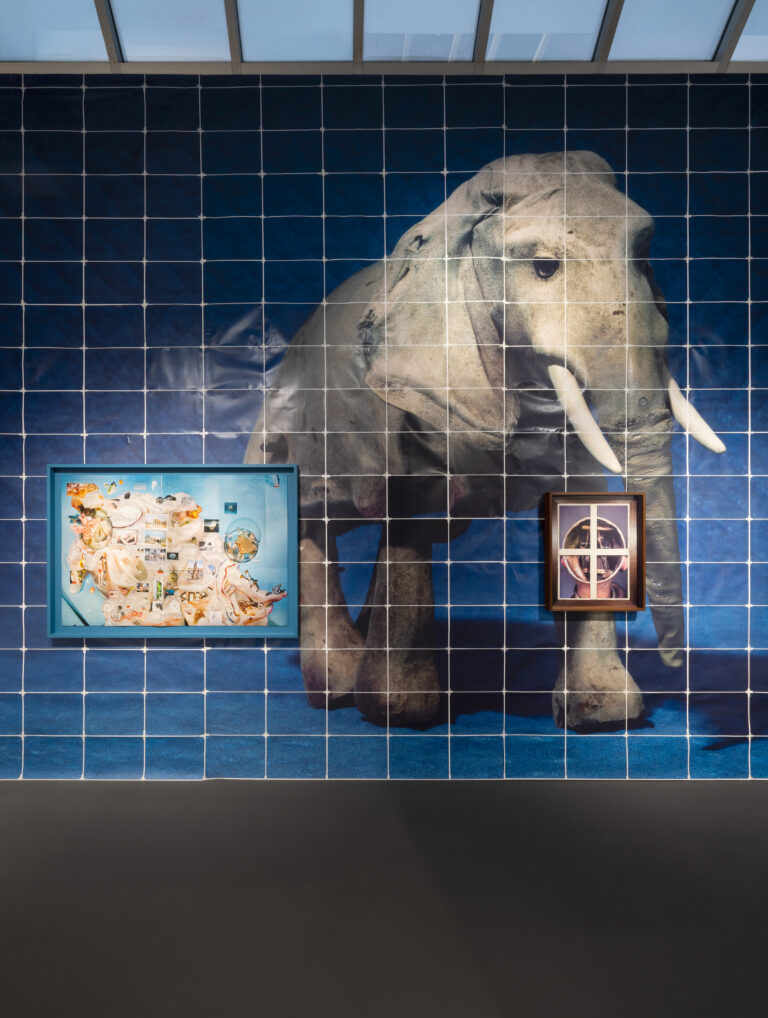
Left:
Sara Cwynar
The Disturbed Slumber II, 2026
Ink, pastel and paper collage on archival pigment print in custom screen printed frame
101.6 x 152.4 cm (unframed)
115,2 x 166,5 x 6,5 cm (framed)
Right:
Sara Cwynar
Automaton 1, 2026
Archival pigment print in wood frame
76,2 x 61 cm (unframed)
78,2 x 63,2 x 7,5 cm (framed)
Exhibition view:
Sara Cwynar, Elephant,Esther Schipper, Berlin, 2026
Courtesy the artist and Esther Schipper, Berlin/Paris/Seoul
Photo © Andrea Rossetti
Cwynar’s films and photographs employ a mix of analogue collage, digital modifications and cinematic techniques to create works with a distinct aesthetic, a dense mix of historical references, found images, and traces of contemporary image worlds. Her process includes photographs that are themselves photographed, arranged in real life with everyday objects, re-photographed and filmed or put into motion. The effect closely resembles a kind of visual free association floating in your head — what thought can feel like.
For her presentation at the gallery, she draws on a project concerning automatons. A small elephant from the late 19th century recurs as symbolic presence. In the anachronistic wound-up toy, a wide web of references coalesces: the object speaks of colonialism and the culture of extraction, its mechanism to industrialization, outsourced labor and automatization, which has brought us to the current developments of AI. With halting steps, the tiny toy becomes a melancholic symbol of the enormous scale of cultural currents that began to form the present a long time ago.
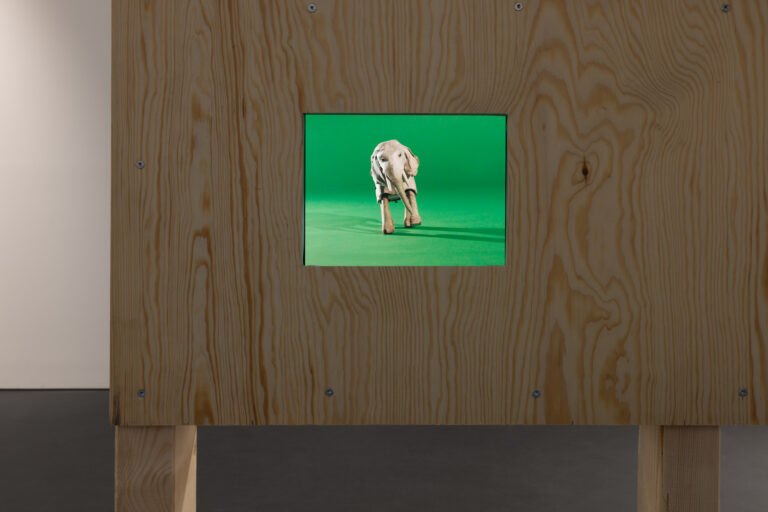
Sara Cwynar
Personal Elephant, 2026
Single channel digital video (color, silent)
Duration: 0:42 min (loop)
Exhibition view: Sara Cwynar, Elephant,Esther Schipper, Berlin, 2026
Courtesy the artist and Esther Schipper, Berlin/Paris/Seoul
Photo © Andrea Rossetti
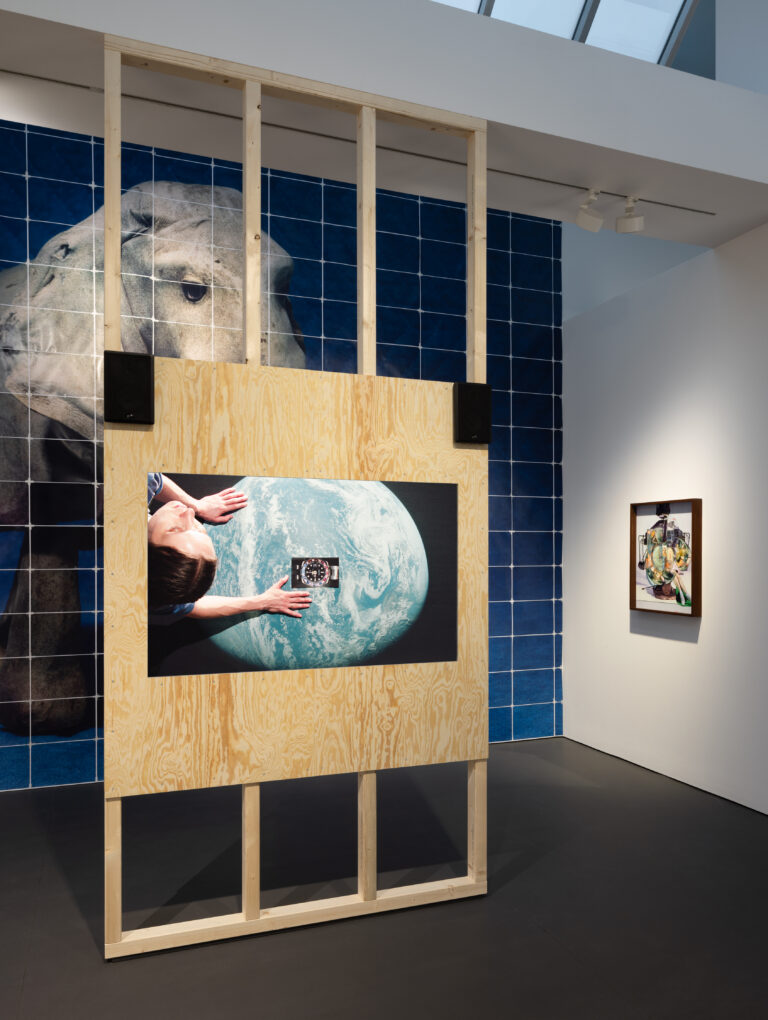
Exhibition view: Sara Cwynar, Elephant, Esther Schipper, Berlin, 2026
Courtesy the artist and Esther Schipper, Berlin/Paris/Seoul
Photo © Andrea Rossetti
Cwynar’s new film is loosely inspired by the famous 1968/1977 film Powers of Ten by designers Charles and Ray Eames. She reworks its educational approach into an associative sequence of found images, collage, animation, and live-action footage, moving across scales, genres, shapes, colors, and formats. From a mosquito, we travel to Mount Everest and the deepest part of the ocean, from cobalt mines to someone holding an iPhone. Cwynar’s film moves rapidly from the micro to the macro, destabilizing any sense of scale, intentionally confusing the spectator. The insistent slippages of scale in Cwynar’s new works draw on philosopher Timothy Morton’s concept of the hyperobject. The term describes entities or phenomena, such as global warming, that are so widely distributed across time and space that we cannot perceive them in their entirety. We encounter them instead through their effects on our daily lives.
The film’s monitor is installed on a wooded wall which leaves its back exposed. It is here that we encounter an iPad screening the short video of the Elephant automaton. This promise of revelation by opening the back of the wall finds an analogy in the four photographs on view. Cwynar took images of automata she found in the archive of the New York Public Library Picture Collection— still a largely analogue affair—and uses them as foundation for her collages, layering found and AI-generated images and placing objects on them to create an effect similar to the distortion of a lens. What it is we are looking at, is at first confusing: Re-photographed sections of existing photographs, mixed with other images, the back of a frame superimposed. The frisson of having access to an otherwise hidden view is an illusion.
Cwynar’s works on paper are akin to conceptual notes, with images, drawing, and collage. The drawing on view expands the research and connects the threads that run throughout the exhibited film. The enlarged image of a small figurine of a woman disturbed in her sleep becomes the holder for this information, inscribed with handwritten notes, as objects and images are superimposed. All objects, images or logos are chosen for their connection to the artist’s research about environmental decay, philosophy & human understanding of scale, the long trajectory of industrialization into an AI economy.
Jenny Brosinski
Make A Wish
6 NOV until 19 DEC 2026
We are happy to present Make A Wish, an exhibition by Jenny Brosinski with all new paintings. This will be the artist’s first solo exhibition with the gallery following the announcement of her representation in September.
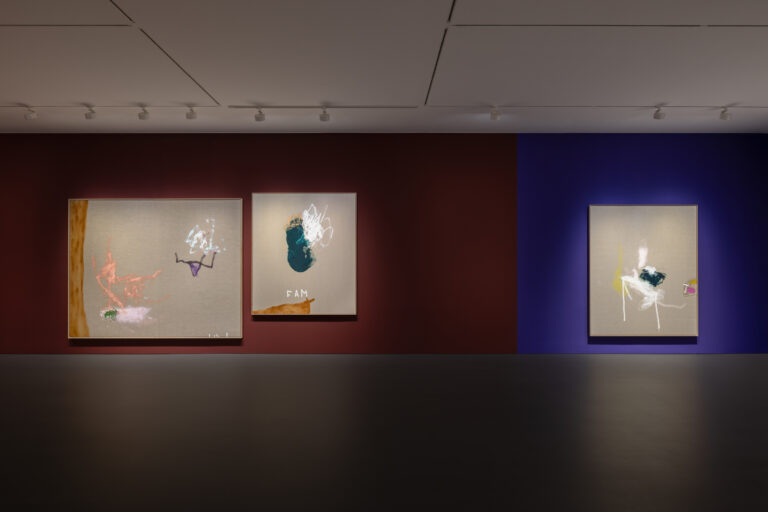
Jenny Brosinski,
Make A Wish,
Esther Schipper, Berlin, 2026
Courtesy the artist and Esther Schipper, Berlin/Paris/Seoul
Photo © Andrea Rossetti
Jenny Brosinski’s paintings are cool, serious, and at times funny, but also fragile and moving. How can all of this be true at the same time? This is why the artist chose to be a painter: The medium allows her to accommodate these different qualities in a single work. The surface holds several decisions taken over time, giving them a silent stage. The individual steps that make up the painting – a circle of blue, an apparition in white, a cross in red – are clearly visible; you can trace every move. There is no attempt to take away what has been done. There is hardly any painting, you would almost say, considering the limited amount of elements that form the composition and the generous space around the motifs. There is a constellation of lines, and colors. In this theater of reduction, each step carries the weight of a main act.
The open, blank canvas remains visible in every work, and you cannot help but think about a clean slate, both as a background and as a metaphor. Yet the surface is not hard white; the fabric is slightly beige, gray, or brown. It is unprimed and shows the traces of its material production. On this empty field, every painting appears to articulate a new beginning, the birth of color, a statement in a few forms. Yet, in terms of art history, such a new start is hardly possible. Brosinski came to work in the 2010s in a field where many stylistic and conceptual approaches were available, none of them dominant. A silly cartoon could be just as valid as an existential color-field painting or some scribbles suggesting a morse code from the soul. Brosinski took a mix of such elements to articulate her own path. Dialogue with existing positions was and still is a part of that journey, and requires precision in seeing what is akin and what is different. She appreciates the open space around a motif, like in Martha Jungwirth’s paintings, but not the fast, expressive brushstroke. She likes the sensibility of Cy Twombly’s handwriting but is not looking for a mythological context. Thus, her work has developed as an act of differentiation. Objectively, there was no clean slate at all, rather a dense field of positions, which makes it all the more interesting that her work is nevertheless able to evoke such a fresh feeling.
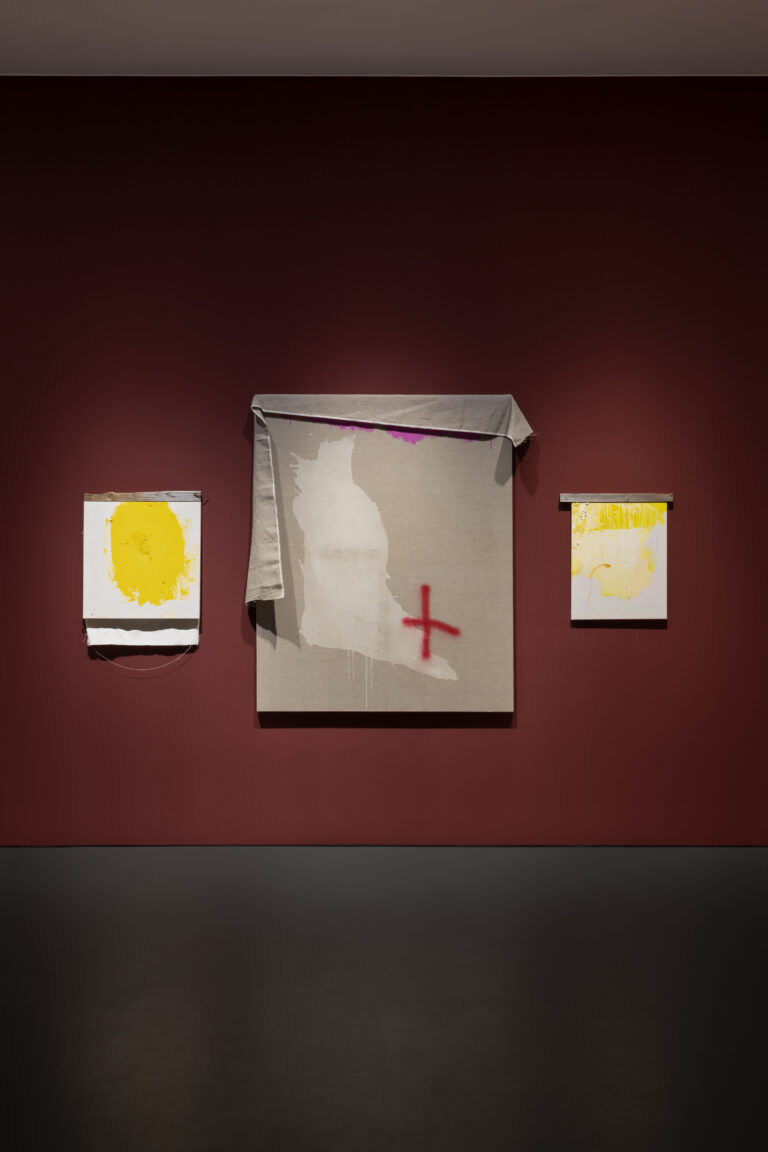
Jenny Brosinski, Make A Wish, Esther Schipper,
Berlin, 2026
Courtesy the artist and Esther Schipper, Berlin/Paris/Seoul
Photo © Andrea Rossetti
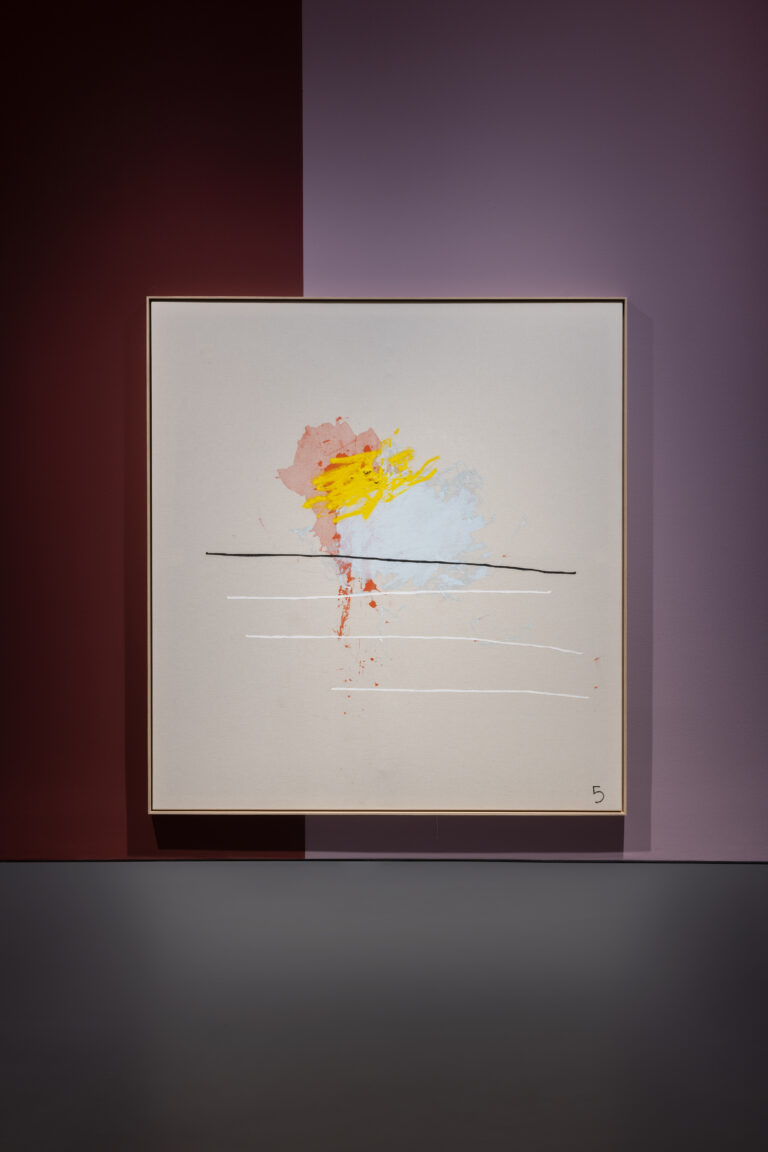
Jenny Brosinski
like water off a duck‘s back, 2026
Oil and oil stick on canvas
183 x 168 cm (unframed)
186,2 x 171,2 x 5,5 cm (framed)
Jenny Brosinski, Make A Wish, Esther Schipper,
Berlin, 2026
Courtesy the artist and Esther Schipper, Berlin/Paris/Seoul
Photo © Andrea Rossetti
Whether the artist takes a motif that can be faintly recognized or not (is that a bird, a drone, a pair of eyes, a table?), the point is that all motifs have been looked at with an abstracting eye, and they come to us in a reflected, modified way. A lot of the shapes have an organic feel – they could be human, animal, or plantlike. But – and this is relevant – the artist does not finish the sentence that she starts, in terms of form or identities. She does not go in detail about the character of a fragment. Basically, she treats a figure in the same way that she treats a dot or color field. The painting is about the co-existence of such fragments, some with and some without human traits. Abstraction is not just a style here, but also an operational aspect of painting, paving a way in the work which enables the viewer to connect the dots and find coherence between disparate parts.
The paintings are on alert; they always look a little tense. They are not unlike human beings. They speak to the viewer in terms of energy and presence. We meet with them, have encounters in a short glimpse, read gestures before words are spoken. The titles give an additional entrance to the paintings, maybe a less obvious path that you had not yet taken: It’s always teatime, Flying Cow, or I wouldn’t bother. The title sets a tone or suggests pinning down an image or story. Serious and casual, precise and loose, the paintings keep sending different signals that do not necessarily match. Their visual language, with scratches and wipes has a streetwise quality that makes them accessible and immediate. Yet they also aim for the temple of high art, where gestures are weighed, balances are checked, and paintings only pass the test if they keep the grace of form intact over a longer stretch of time.