

Dieter Roth
Eine Buchverzweigung – Die Solothurner Paneele von 1976
30 OCT until 19 DEC 2026
Opening – 30 OCT 2026, 6–9 pm
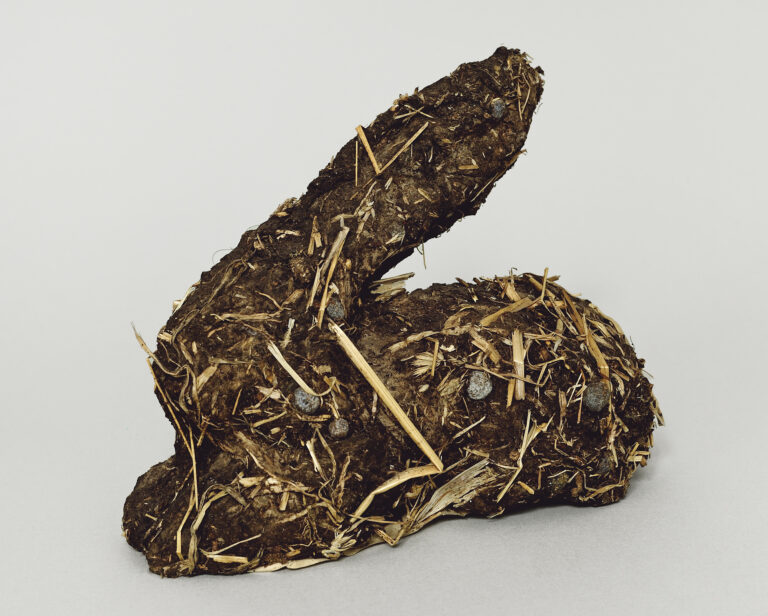
Dieter Roth, Karnickelköttelkarnickel, 1972, straw, rabbit droppings, 18 x 9,5 x 14 cm. Courtesy of the Ahlers Collection, and LEVY, Berlin
The Branching Paths of Dieter Roth’s Poetry
by Dr. Dirk Dobke
Dieter Roth (1930–1998) is one of the most versatile and influential artists of the twentieth century. He worked in media as diverse as painting, sculpture, printmaking, music, multiples, installation, film, and even jewellery design. Before the young Dieter Roth decided to leave secondary school in Solothurn to become a graphic designer, a step that opened the door to the visual arts, it was language, and poetry in particular, that played the central role in his life. As a teenager, he wrote poems, only to later place them all on a small wooden raft, set them alight and adrift letting them burn down a river into the great beyond. His youthful poetry thus disappeared forever, but his dream of becoming a writer remained.
Roth had a remarkable command of language, at times displaying an almost overwhelming eloquence. Writing and poetry remained of great importance to him throughout his life. Few artists have been able to describe their own work with such precision as Dieter Roth. His poems rapidly developed into experimental art forms, while the titles of his visual works sometimes became poems in their own right. Still young and living in Solothurn, he initially embarked on a career in the visual arts. He painted, made prints, and created sculptures within the circle of the Zurich Concrete artists, which also included Max Bill. In the late 1950s, he published his first text-based works associated with Concrete Poetry in the form of artist’s books.
In 1956, Roth left Switzerland and became a nomadic artist, maintaining studios around the world. In 1966, he was invited to take up a teaching position in Providence, USA. There, he made what was, until then, a radical departure in his artistic practice: he turned to food goods, perishable materials, as an artistic medium. For Roth, the artwork was no longer merely a finished object to be contemplated; it became a process in itself.
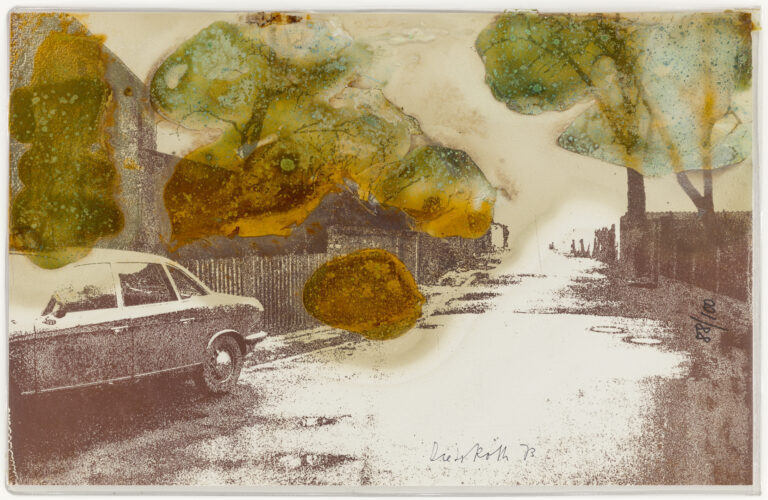
Dieter Roth, In Oelper scheperts (Braunschweiger Landschaft mit Käsebäumen), 1973, processed cheese, printed using the hand-offset process, dark brown on white cardboard, in a PVC sleeve, 31,3 x 48,5 cm. Courtesy of the Ahlers Collection, and LEVY, Berlin
Dieter Roth, Eine Buchverzweigung (Solothurner Paneele, Part 1 of 71), 1976, pages of Dieter Roth’s 8 Scheisse Book series, mounted on plywood, 218 x 105 cm. Courtesy of the Ahlers Collection, and LEVY, Berlin
Roth also used the workshops at the college in Providence to produce and publish a collection of his most recent poems in book form for the first time. He gave the volume the somewhat disconcerting title Scheiße – neue Gedichte von Dieter Rot (Shit – New Poems by Dieter Rot). What might initially seem like a provocation was, in his view, more of a precautionary measure: following the logic that if something already bears such a negative title, nobody can subsequently disparage it any further…
The poems in this volume formed the basis for a dozen further collections. In each successive volume, Roth reworked and transformed them anew: the texts were altered, expanded, or even destroyed. Each volume thus became a further reworking of its predecessor. In this way, Roth also turned poetry into an ongoing literary process, analogous to his art, which decomposed and underwent continuous transformation. Nothing was permanent; everything was in a state of becoming and decay—and for Roth, literature was no exception.
He called the first volume of revisions Noch mehr Scheisse (Even More Shit). This was followed by DIE GESAMTE SCHEISSE (THE COMPLETE SHIT), later Die DIE VERDAMMTE SCHEISSE (The THE DAMNED SHIT) and Die die Die DIE GESAMTE VERDAMMTE KACKE (The the The THE COMPLETE DAMNED CRAP), along with further titles of a similar kind. The revisions were accompanied by drawn illustrations, which in turn gave rise to an extensive, independent series of etchings. Some of the book covers became artworks in their own right. All the volumes were issued signed and numbered, as is customary with artists’ editions.
This series of books was made possible by Roth’s longstanding friend and publisher Hansjörg Mayer. Among other projects, Mayer also co-published the Gesammelte Werke series with Roth. Through this series, Roth pursued the ambition of publishing his entire artistic output in book form.
In 1976, the Kunstmuseum Solothurn invited the city’s long-forgotten son to present an exhibition devoted exclusively to his poetry. Roth dismantled the bindings of his poetry volumes and mounted the individual pages on 71 display panels. The SCHEISSE poetry series was presented alongside the volume MUNDUNCULUM and his works from the POETRIE/POETEREI series.
Roth unfolded his poetry in space, transforming the “branching book” into a museum installation—in a manner that probably no poet before him had ever attempted. With this complex and comprehensive survey, he brought the chapter of poetry as an independent artistic practice within his oeuvre to a close.