

Pae White
pushmi-pullyu
1 MAY until 8 AUG 2026
Opening – 1 MAY 2026, 6-9 pm
At Christinenstrasse 18 – 19, 10119 Berlin
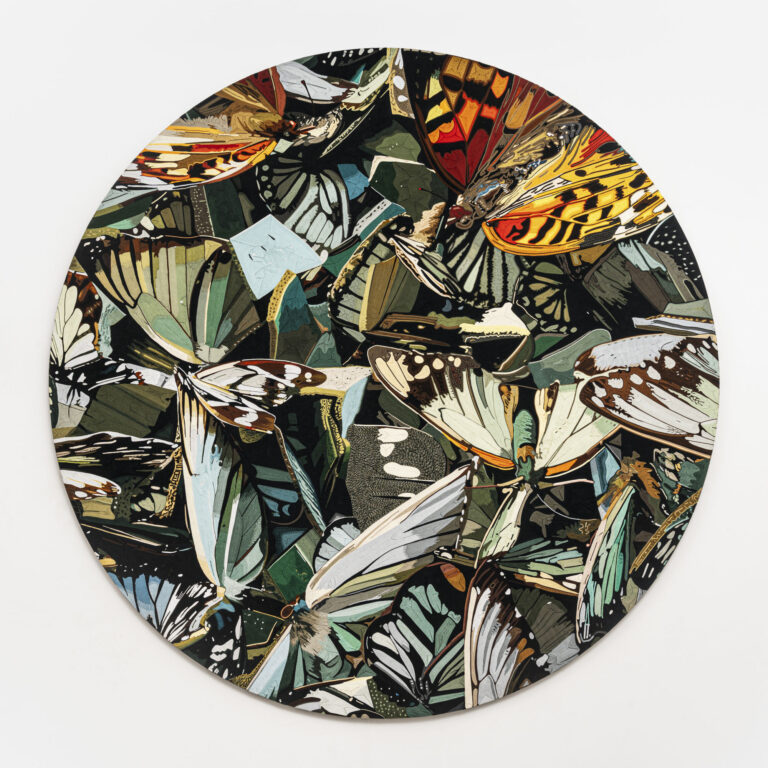
Pae White,
Untitled, 2026,
cotton and resin on panel,
⌀ 150 cm.
© Pae White.
Courtesy the artist and neugerriemschneider, Berlin.
Photo: Santiago Vega, Guadalajara.
pushmi-pullyu, Pae White’s seventh solo exhibition with neugerriemschneider, features a flourishing cosmos of creatures including crabs, snails, flies, butterflies and other bugs, molded in resin-encased thread, textile in relief or resplendent ceramic. These new works grow from White’s career-long investigation of tradition-rich materials and legacies of craft, and her predilection for expanding their possibilities. Here, bringing together indigenous handwork, Jacquard weaving and experimental technologies, she places her subjects under a magnifier, creating magnetic scenes that invite conscious inquiry of the worlds from which they are culled. Assembling the conditions for introspection, these works are pedestals for the underobserved: Beings seen in fleeting glances or hidden from view are held, savored and brought into focus, heralded as wonders – sources of revelation.
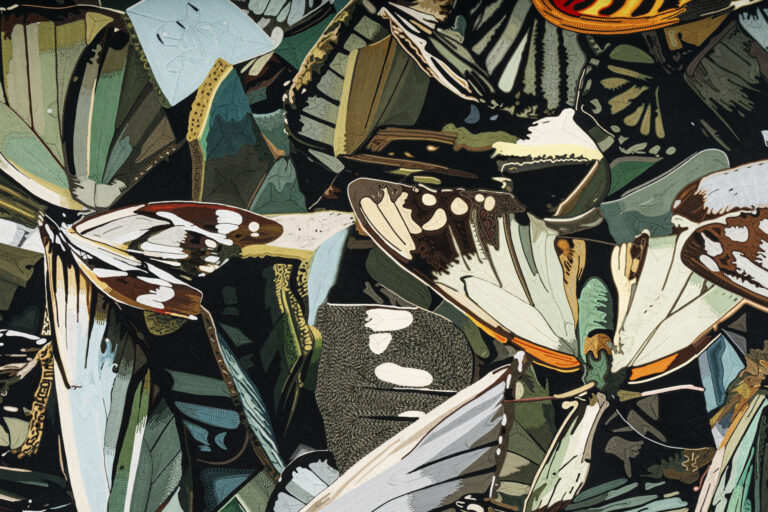
Pae White,
Untitled (detail), 2026,
cotton and resin on panel,
⌀ 150 cm.
© Pae White.
Courtesy the artist and neugerriemschneider, Berlin.
Photo: Santiago Vega, Guadalajara.
In her practice, White seizes upon an inquisitive impulse to capture the splendor of the ephemeral. In an increasingly fragile present, her act is a radical one, slowing and concentrating attention, imparting her fascination with the minutiae and the monuments of the world around her. Spotlit by the artist’s transformative gestures, everything from tendrils of smoke and crumpled foil to popped corn, glistening water and passing time are placed before the looking glass, their properties and connotations cast in new frameworks. Dualities are integral to these operations, coming to light as inverted hierarchies, propulsive negotiations between craft and technology, and navigations of at-odds expectations. Opposing, often arbitrary systems of value assigned to techniques or objects are regularly upended as White explores the quotidian, tweaking perception and, with it, the multifaceted act of seeing.
pushmi-pullyu, named after the fantastical double-sided, two-headed animal from Hugh Lofting’s “Doctor Dolittle” books, evokes in White a bewildering infinitude – an unexpected subversion of the social and material order that irrevocably impacts how a being and that around it is viewed and communicated with. This inclination features in White’s series of digitally assembled arrays of butterflies, realized as Wixárika yarn compositions, on view here. Employing a method pioneered by the indigenous Wixáritari people of western Mexico, these studies in intricacy see countless cotton threads laid atop a resin-covered wooden panel. Traditionally used in service of mythological or shamanistic scenes, this practice here continues White’s investigation of the natural world, overlapping and flattening her butterflies akin to an entomologist’s pinned specimens. White and the Wixáritari craftspeople with whom she collaborates enter measured exchange as their approaches and propensities meld – as in all partnerships that have shaped her work from its outset – and their apprehensions of what textiles can achieve become manifest. These yarn works leverage the constitution of their materials to tease out detailed depictions, seeing threads spun from a palette of colors give rise to a distinct tonal depth and structural complexity witnessed fully only on close inspection. These tableaux suspend time, holding it still in the pursuit of pensive understanding.
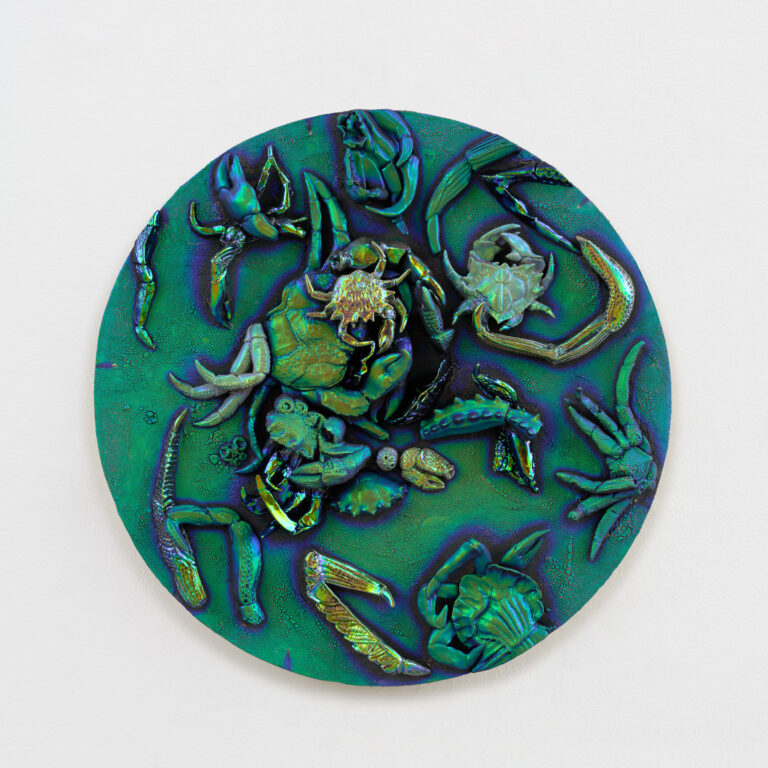
Pae White,
CRXABS VI, 2026,
particle vapor deposition on glazed ceramic,
⌀ 53.3 x 10.2 cm.
© Pae White.
Courtesy the artist and neugerriemschneider, Berlin
Also central to this operation are the results of White’s extensive research into the sculptural potential of textiles, expanding the medium into a third dimension. At the base of these tapestries stand backgrounds in dynamic, vibrational, multicolor monochromes. Enlarged wildlife imagery, detailed and amplified, takes shape as its contours and features are made voluminous as a reaction to heat applied in a fabrication process developed, much like the yarn works of pushmi-pullyu, in tandem with highly skilled artisans. A relief erupts, urging a once two-dimensional facet of her practice into a spatial, architectural realm. This gesture grows as her works hang suspended, inviting them to be viewed in the round. With this comes discovery, as the reverse of each work, typically kept concealed, is revealed, along with the tapestry’s skeletal underpinnings and drawing-like linework. The weaving’s mechanisms and history too come to light: Crafted at extraordinary scale on a Jacquard loom, the punch card-fed origins of which laid the groundwork for modern computing, White’s textiles tell an alchemical story of imagemaking and analysis.
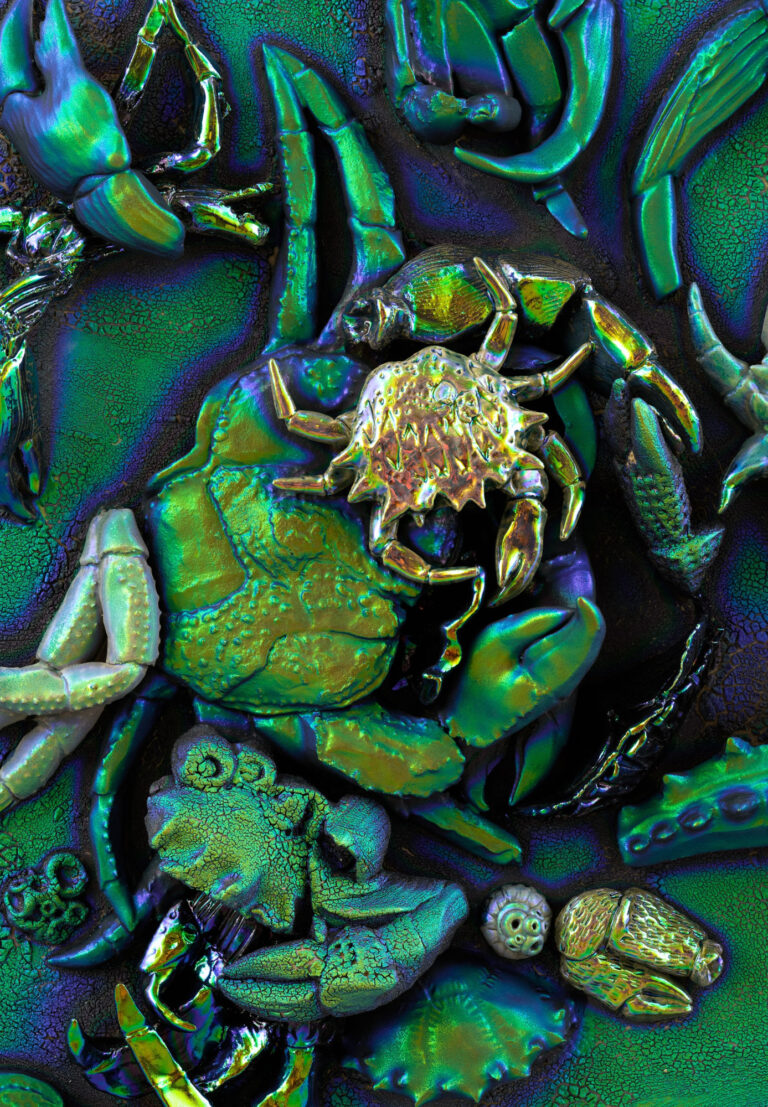
Pae White,
CRXABS VI (detail), 2026,
particle vapor deposition on glazed ceramic,
⌀ 53.3 x 10.2 cm.
© Pae White.
Courtesy the artist and neugerriemschneider, Berlin
These subjects reappear broken, stacked and strewn in a new series of intimately sized ceramic tiles in relief. Huddled within a composition’s bounds, White’s fragmented protagonists intertwine. When arranged around its circular – and thus unending – perimeter, they frame negative space that allows her media to take center stage. The works’ otherworldly, uncanny sheen is the product of coating by physical vapor deposition, or PVD – a highly laborious, aerospace-grade finishing method in which a compound, placed under high heat and pressure, is brought to transform from a solid to a gas and back again. When the glaze is deposited in a microscopically thin layer on White’s ceramics, it possesses an internal structure reconfigured such that it acts as a prism, breaking light into its component parts in an effect that shifts restlessly with viewing angle, refusing resolution. Its coloration, paired with textured, earthy subglazes, resists definition, its iridescence evoking the natural shimmer of abalone shells and conjuring synthesized visions of the future.
The yarn compositions in pushmi-pullyu were realized in collaboration with Wixárika artisans of Jalisco, Mexico: Guillermo López Carrillo, Carlos Eduardo Castro de la Cruz, Santa Bárbara Nayarit, Érika de la Cruz Montoya, Zulma Daniel Salas, Isaías Sotero Carrillo and Claudia López de la Cruz, led by Manolo Castro Montoya. The exhibition’s tapestry works were developed and fabricated in collaboration with the TextielLab, the professional workshop of the TextielMuseum, Tilburg, Netherlands.
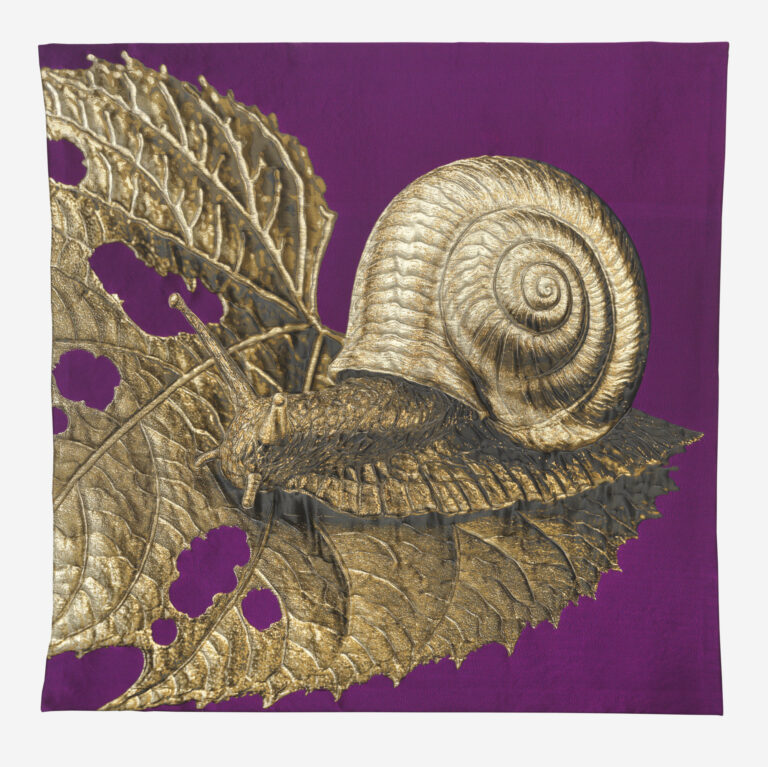
Pae White,
Untitled, 2026,
cotton, lurex,
312 x 330 cm.
© Pae White.
Courtesy the artist and neugerriemschneider, Berlin.
Photo: Jens Ziehe, Berlin.
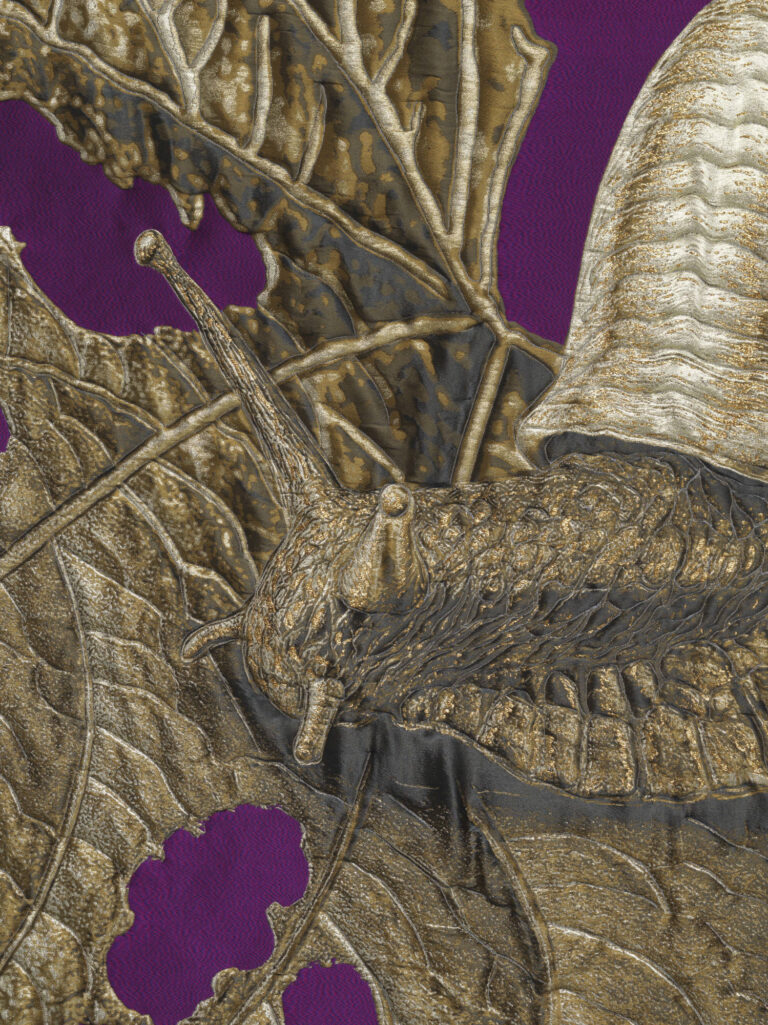
Pae White,
Untitled (detail), 2026,
cotton, lurex,
312 x 330 cm.
© Pae White.
Courtesy the artist and neugerriemschneider, Berlin.
Photo: Jens Ziehe, Berlin.
Pae White (b. 1963) has been the subject of solo exhibitions at museums and institutions, including Plataforma de Arte Contemporáneo, Guadalajara (2025); the San José Museum of Art, San José (2019); Saarlandmuseum, Moderne Galerie, Saarbrücken (2017); MAK – Österreichisches Museum für angewandte Kunst / Gegenwartskunst, Vienna (2013); Langen Foundation, Neuss (2013); South London Gallery, London (2013); The Power Plant Contemporary Art Gallery, Toronto (2011); Art Institute of Chicago, Chicago (2011); Saint Louis Art Museum, St. Louis (2010); Hirshhorn Museum and Sculpture Garden, Washington, D.C. (2007); Manchester Art Gallery, Manchester (2006); and Hammer Museum, Los Angeles (2004). White lives and works in Los Angeles.
Jorge Pardo
1 MAY until 20 JUN 2026
Opening – 1 MAY 2026, 6-9 pm
At Linienstrasse 155, 10115 Berlin
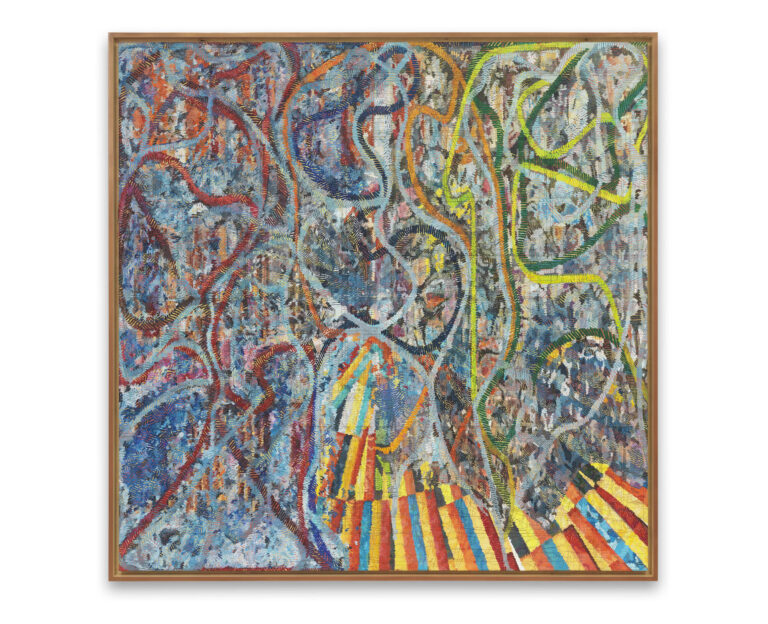
Jorge Pardo,
Untitled, 2026,
inkjet print, oil and engraving on canvas, birch plywood, acrylic,
193.5 x 193.5 cm.
© Jorge Pardo.
Courtesy the artist and neugerriemschneider, Berlin. Photo: Jens Ziehe, Berlin
In his 12th solo exhibition with neugerriemschneider, Jorge Pardo continues his ongoing experimentation with modes of sculpting, combining, transposing and filtering, channeling a wealth of source material to new paintings, sculptural loudspeakers playing a densely populated soundtrack and a series of suspended light works. With these paintings, Pardo curates and distills the history of postminimalist practice, digitally layering its yield, fashioning new compositional tools in the process. Deployed like paint, ink, clay or steel, the photographic is here cast as a medium in and of itself, becoming a means of extracting depth from fused imagery. Manipulated views of works by John Chamberlain, Felix Gonzalez-Torres, Donald Judd, Brice Marden and Joel Shapiro are transformed to texturally rich composites of motif and technique, first printed, then painted over and laser-engraved until nearly unrecognizable.
At the center of Pardo’s approach lies the pursuit of eccentric formal structures – a concentration that suffuses his sculpture, installations, works on paper, ceramics and architecture, and questions the very act of looking, complicating and reconfiguring it. How a work is apprehended and the ways in which it can influence its own conditions of reception are of primary importance to the artist. The legacy of postminimalism looms in this negotiation as its eschewal of previously established rules, and its willingness to test limitations, pushing them to their brink, lays the footing for Pardo’s investigations.
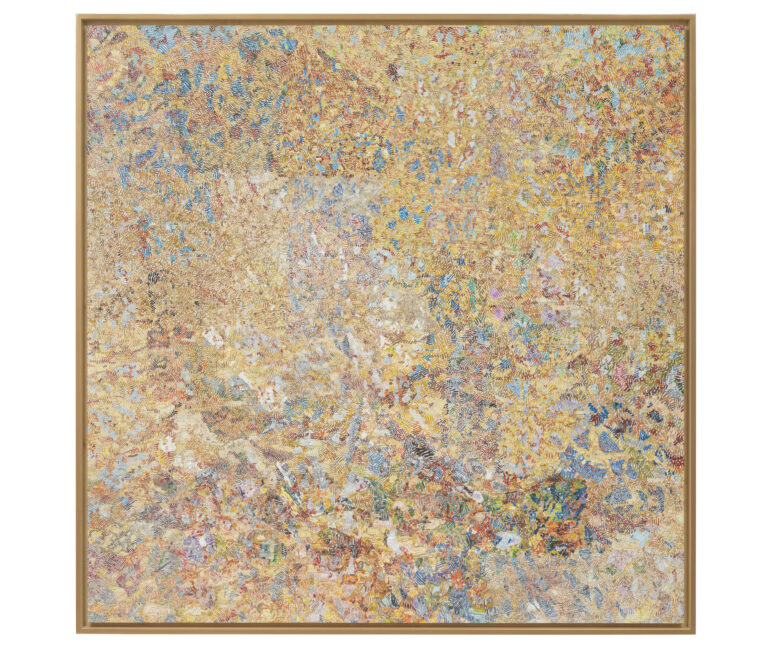
Jorge Pardo,
Untitled, 2026,
inkjet print, oil and engraving on canvas, birch plywood, acrylic,
193.5 x 193.5 cm.
© Jorge Pardo.
Courtesy the artist and neugerriemschneider, Berlin.
Photo: Jens Ziehe, Berlin
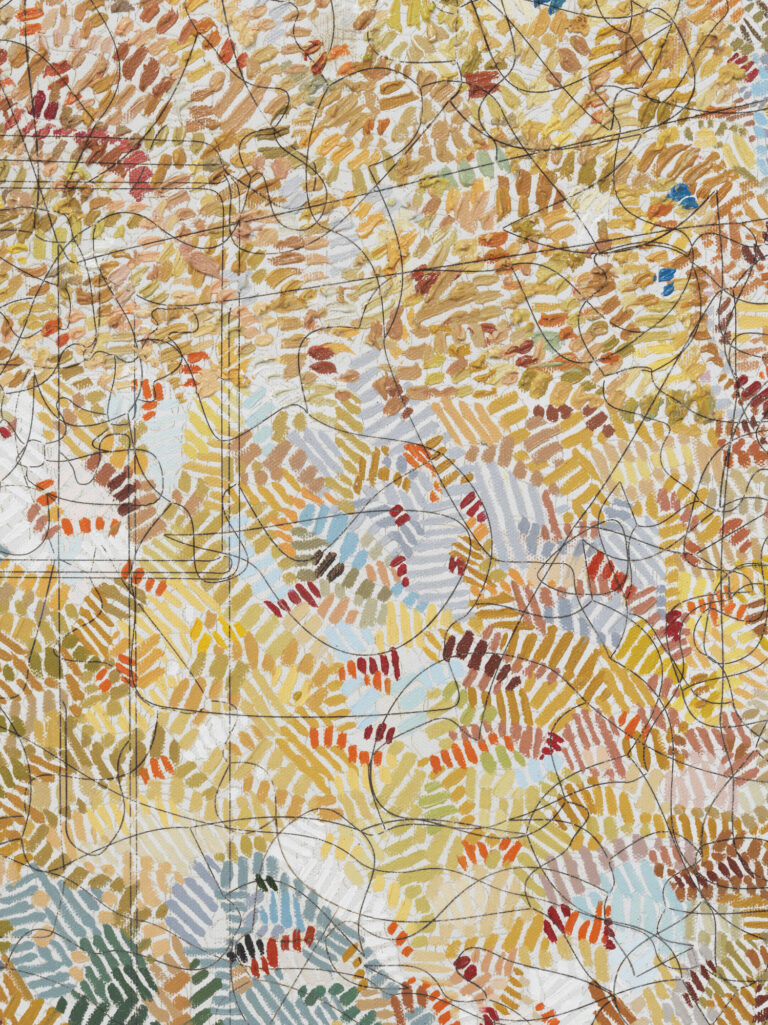
Detail of Jorge Pardo,
Untitled, 2026,
inkjet print, oil and engraving on canvas, birch plywood, acrylic,
193.5 x 193.5 cm.
© Jorge Pardo.
Courtesy the artist and neugerriemschneider, Berlin.
Photo: Jens Ziehe, Berlin
Rooted in this art-historical inquiry, Pardo’s paintings each begin with a concise slate of images picturing artworks by his five protagonists. From this cast – one that has left an indelible mark on Pardo’s own practice – a digital composite assembles. Views outlining a crucial period within American artistic production, superimposed and opaque, distorted, rotated and rescaled, enter a unique relation with one another, their values and gestures interwoven. Printed onto canvas, these gatherings become both primer and guides for Pardo. Applied atop these impressions in fine, linear motions, oil paints mine history as they associate with the joined depictions beneath – not only echoing, but entering conversation with them. As gaps between built-up dashes of pigment reveal each foundational print in measured doses, Pardo asks what it means for a composition to take shape, and how color and form enter a space of play. Digital reproduction meets manual interpretation as each component becomes more than itself, interacting and taking on new life. In scales monumental and intimate, the works determine how they are to be seen, dictating the distance at which their nearly pointillist interventions visually coalesce to vibrational fields expanding over spectral underpinnings.
Sculptural loudspeakers accompany these paintings and act as their didactics, emitting a series of songs played simultaneously in layered arrangements. Much like the related canvases, these compositions bring their sources to the point of merger as melodies weave into and out of one another until inseparable. Internal structures mingle and a new, noisier piece emerges – one that evaluates modes of reproduction and the interpretive bent of their systems. 3D-printed grilles adorn the fronts of the speakers’ cabinets, perforated with a liquefied pattern envisioning boundaries made fluid. Suspended sculptures further develop Pardo’s engagement with illumination, flooding the exhibition in light transformed through its layers of ceramic and PETG. Reflective cores mirror the presentation from above, transforming it along their undulations, making reality plastic and shaping a new lens through which to view the world. In both bodies of work, Pardo counters the tangible, albeit elusive imagery of his paintings with the distinctly immaterial: sound and light. He challenges permanence and his media’s abilities to make themselves felt, heard and seen, to pervade and to be present.
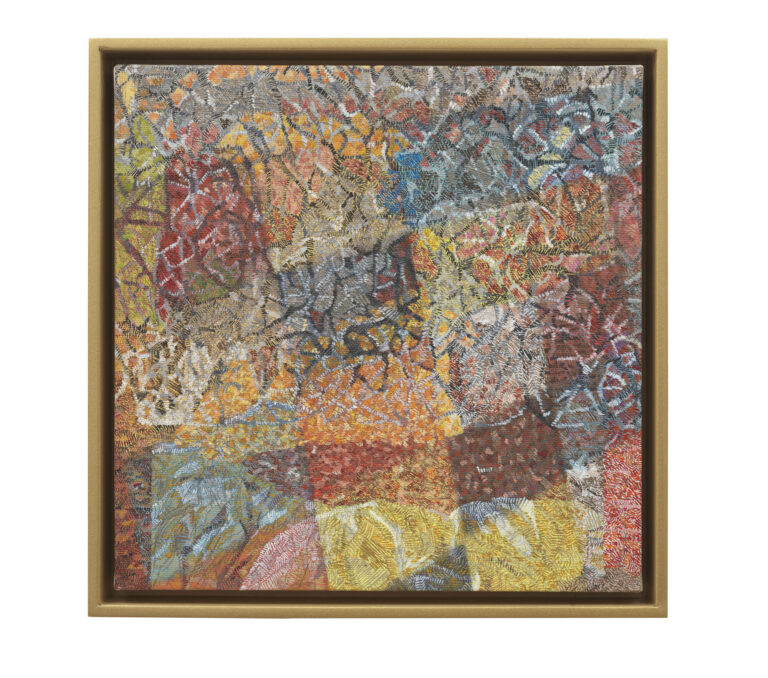
Jorge Pardo,
Untitled, 2026,
inkjet print, oil and engraving on canvas, birch plywood, acrylic,
27.5 x 27.6 cm.
© Jorge Pardo.
Courtesy the artist and neugerriemschneider, Berlin.
Photo: Jens Ziehe, Berlin
Jorge Pardo (b. 1963) has been the subject of international solo exhibitions and special projects including those at Plataforma de Arte Contemporáneo, Guadalajara (2025); SCAD Museum of Art, Savannah (2023); Museum of Art and Design, Miami Dade College, Miami (2021); Pinacoteca do Estado de São Paulo, São Paulo (2019); Musée des Augustins, Toulouse (2014); Irish Museum of Modern Art, Dublin (2010); Museum of Contemporary Art, North Miami (2007) and Dia Art Foundation, New York (2000). The artist participated in the 57th Venice Biennale, Venice (2017) and the Havana Biennial, Havana (2012). His large-scale installations include Folly, University of Houston, Houston (2023); Untitled (Café), Neue Nationalgalerie, Berlin (2021); L’Arlatan, Arles (2018); Tecoh, Yucatán (2006 – 2012); Latin American Art Galleries, Los Angeles County Museum of Art, Los Angeles (2008); Untitled (Restaurant), Paul-Löbe-Haus, German Bundestag, Berlin (2002); Untitled, Kunstsammlung Nordrhein-Westfalen, K21, Düsseldorf (2002); 4166 Sea View Lane, Museum of Contemporary Art, Los Angeles (1998) and Pier, Skulptur Projekte Münster, Münster (1997). Pardo lives and works in Mérida, Mexico.
perceptual territories - cut, split, layered
With works by Shilpa Gupta, Renata Lucas & Haegue Yang
1 MAY until 15 AUG 2026
Opening – 1 MAY 2026, 6-9 pm
At Linienstrasse 155, 10115 Berlin
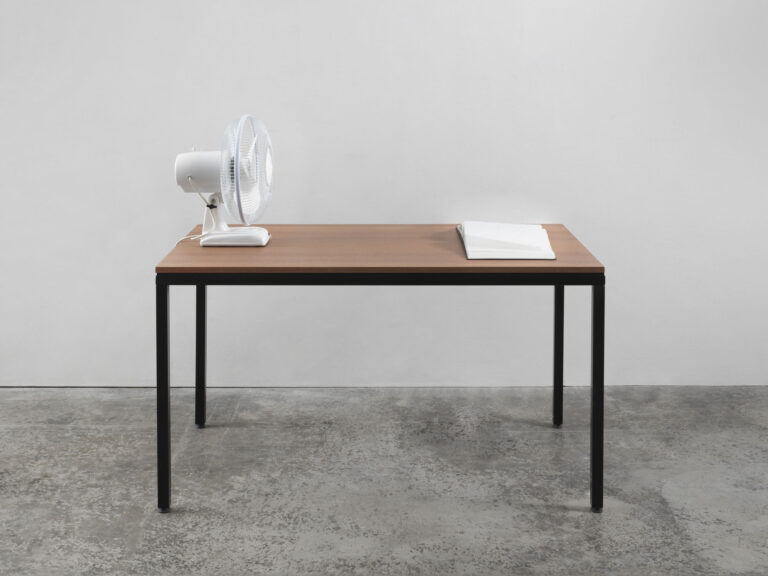
Shilpa Gupta,
100 Hand-Drawn Maps of Germany, 2007-2025,
table, fan, book,
124 x 122 x 60 cm.
© Shilpa Gupta.
Courtesy the artist and neugerriemschneider, Berlin.
Photo: Jens Ziehe, Berlin
perceptual territories – cut, split, layered features works by Shilpa Gupta, Renata Lucas and Haegue Yang that deconstruct prevailing narratives of reality using historical, political and subjective precedents. Subverting geometry, fragmenting the quotidian and navigating sound through form, the three artists prompt modes of sight and movement that ground a viewer in time and space. Together, they shape resonant encounters that cast the world in new light.
In her multi-disciplinary practice, Shilpa Gupta explores power structures, social stratification and shared histories, investigating how these forces mold nations, cultures, identities and understandings of self-determination. With 100 Hand-Drawn Maps of Germany (2007 – 2025), the artist presents Germany’s approximated outline as drawn from memory by 100 of its residents. The recollected contours, compiled in a sketchbook, lie opposite an oscillating table fan. Its bound pages blow in its wind, flipping at random in a gesture that highlights the arbitrary nature of borders and their bearing on the collective consciousness of a population. The artist’s Untitled (2012) sees a fragmented knife separated and reconstituted along a curve in a representation of repression’s futility, while the 21 glasses – the topmost of which is truncated – of her Untitled (2024) stack to match her height. Its elements nested within one another, the work becomes a reflection on fragility and precariousness, on presence and emptiness, and on stability and vulnerability.
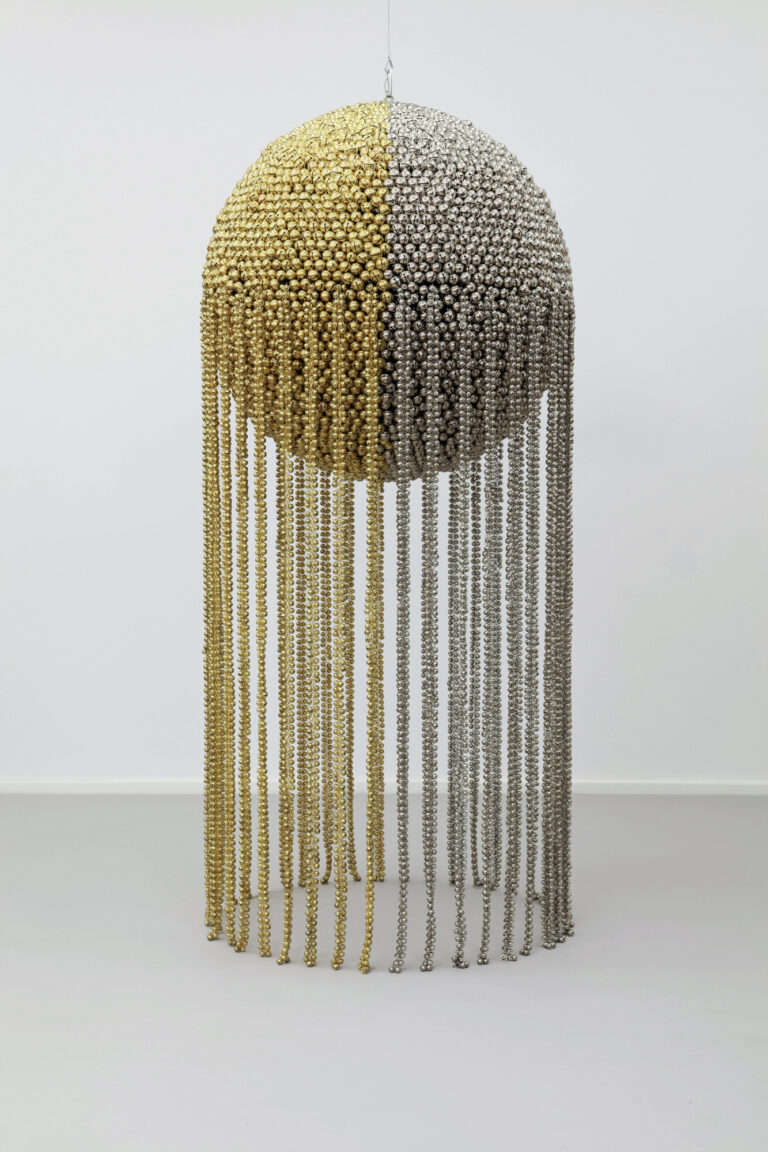
Haegue Yang,
Sonic Half Moon Type III – Large Light #22, 2015,
powder-coated steel frame, powder-coated metal grid, steel wire rope, brass and nickel plated bells, metal rings,
187 x 84 x 84 cm.
© Haegue Yang.
Courtesy the artist and neugerriemschneider, Berlin.
Photo: Taro Furukata
Renata Lucas’ work bears witness to the built environment’s impact on societies and its individuals, exposed through the artist’s subtle interventions in architectural space. Her work evasive topography (2026) builds upon her installation fontes e sequestros (fountains and sequestrations), which was on view in neugerriemschneider’s courtyard for the duration of her 2015 exhibition at the gallery. For this project, Lucas appropriated fragments of three historical fountains from throughout Berlin, placing them in relation to create a complex of overlapping segments. The connections forged by this new composite found metaphorical echo in the gallery’s interior where three drains, set within its floor, unearthed the venue’s material history. The work in perceptual territories – cut, split, layered translates this arrangement to a sculptural object that realizes the drain’s original site-specific references anew. The segmented circle reappears in Lucas’ quadroquadro (círculo) (2024), its frame enigmatically offset in tandem with the form that it encases. Lucas’ Bicho-faca (2026) is a reverential nod to Lygia Clark’s 1960s Bicho works: ones that invite their viewers to fold and rearrange them to new forms. Lucas takes up this approach, rendering Clark’s aluminum fragments as stainless-steel knives conjoined and hinged at their blades. A navigation of splitting and transposition emerges, entering conversation with Gupta’s segmented knife.
Haegue Yang leads an artistic practice that considers the present through the lens of multisensory histories, manifesting as collages, sculptures and installations. Crafted using objects from the everyday to the ritualistic, her works conjure conversations between the hidden and the visible, the mysterious and the malleable. Works from Yang’s Sonic Half Moons series (2014 – ongoing) on view comprise suspended spheres, their surfaces coated in brass and nickel-plated bells that descend from their circumferences in cascading columns. They take on figural, spiritual presences, confronting a viewer both physically and, when spun, acoustically, as their chained chimes ring out in evocations of shamanistic practices.
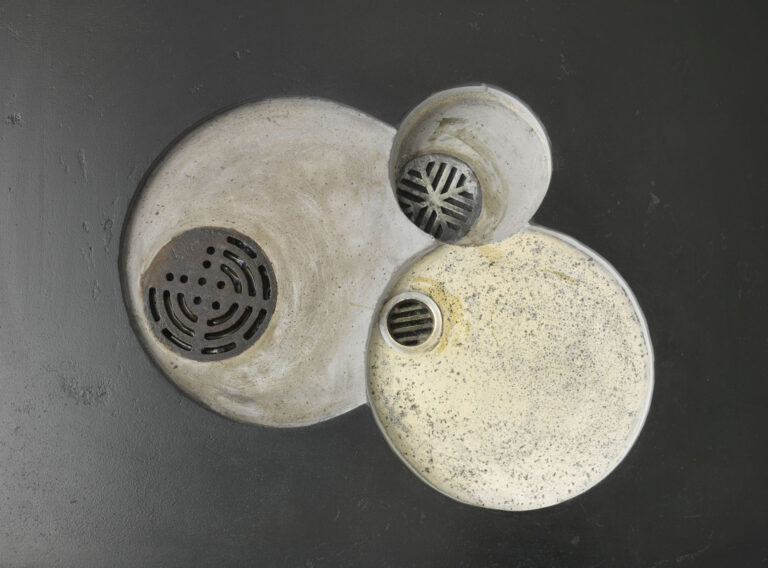
Renata Lucas,
evasive topography (drains), 2016,
cement, gritstone, concrete, cast iron, steel, stainless steel,
7 x 97 x 63 cm.
© Renata Lucas.
Courtesy the artist and neugerriemschneider, Berlin.
Photo: Jens Ziehe, Berlin
The work of Shilpa Gupta (b. 1976, lives and works in Mumbai), Renata Lucas (b. 1971, lives and works in São Paulo) and Haegue Yang (b. 1971, lives and works in Berlin and Seoul) has been featured in solo exhibitions at international biennials, museums and institutions, appearing in 2026 in solo presentations at Hamburger Bahnhof – Nationalgalerie der Gegenwart in Berlin (Gupta), Dortmunder Kunstverein in Dortmund (Lucas) and at MOCA Grand Avenue in Los Angeles and Dia Beacon in Beacon, New York (Yang).