

David Claerbout
Repose
11 SEP – 24 OCT 2026
Opening – 10 SEP 2026, 6–10 pm
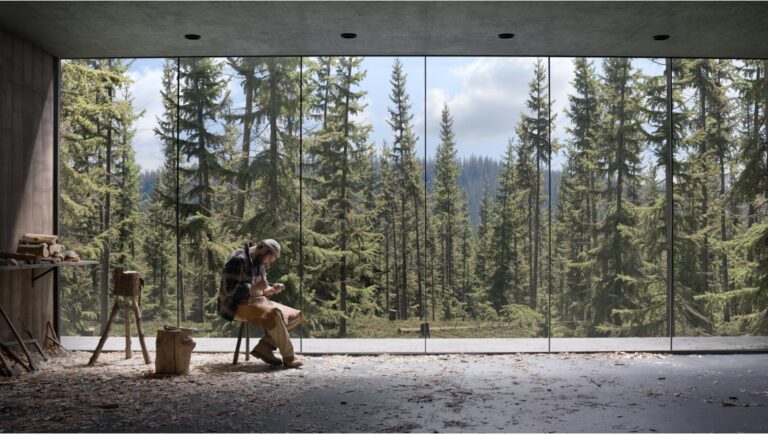
David Claerbout, Repose, Esther Schipper, Berlin 2026
Still: David Claerbout, The woodcarver and the forest, 2025
Single channel 4K HD video
Courtesy the artist and Esther Schipper, Berlin/Paris/Seoul
Still © David Claerbout
David Claerbout © VG BildKunst, Bonn, 2026
Esther Schipper Berlin is pleased to present a solo exhibition by David Claerbout, the artist’s second with the gallery. Under the title Repose, the exhibition presents four works shown for the first time in Berlin: The woodcarver and the forest, 2025, Birdcage, 2023, Backwards Growing Tree, 2023, and Eagle Eye, 2026. Alongside the videos, a number of works on paper will be exhibited.
All films on view explore our relationship to nature and the way we have learned to see the world around us. In The woodcarver and the forest we watch a woodcarver whittling down wooden blocks to create one spoon after another; the act appears almost meditative, until we realize every gesture comes at a cost: outside his window, the forest is slowly being reduced to the objects he creates. The lush gardens of a stately home portrayed in Birdcage become the site of a violent eruption, shifting the scene (and viewer) from apparent peace to a state of tension and fear. In Eagle Eye, a bald eagle lies awake but immobilized on an operating table, reversing our familiar association of the eagle as a symbol of strength. Backwards Growing Tree portrays a solitary tree in the Italian countryside, digitally reconstructed and observed over five years. By reversing its natural growth, Claerbout disrupts our sense of time. Repose continues the artist’s long-standing engagement with time and duration. Three of the works – Eagle eye, The woodcarver and the forest and Backwards Growing Tree – unfold over several hours or even several years. These extreme durations introduce a real-time component, aligning the passage of film time with that of the visitor. In doing so, Claerbout brings film time closer to biological time: time that unfolds at the pace of living processes and largely escapes our notice. It is an uneventful, psychologically inefficient film time, one that offers little for the eye to grasp and runs counter to our visual culture, which conditions us to seek constant stimulation and reward.
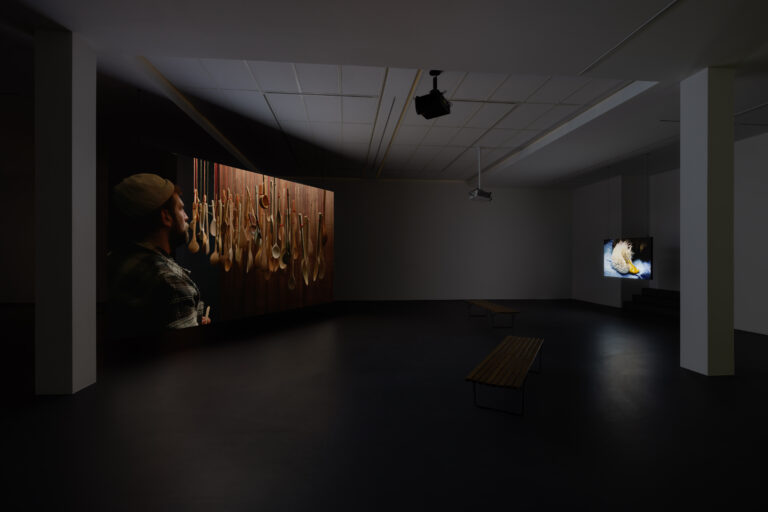
Left:
David Claerbout
The woodcarver and the forest, 2025
Single channel 4K HD video installation, color, stereo audio, b/w photographic prints
Duration: 24 h 51 min
Dimensions variable
Right:
David Claerbout
Eagle Eye, 2026
Single-channel video, color, silent
Duration: 7 h 30 min
Dimensions variable
Exhibition view: David Claerbout, Repose, Esther Schipper, 2026
Courtesy the artist and Esther Schipper, Berlin/Paris/Seoul
Photo © Andrea Rossetti
David Claerbout © VG BildKunst, Bonn, 2026
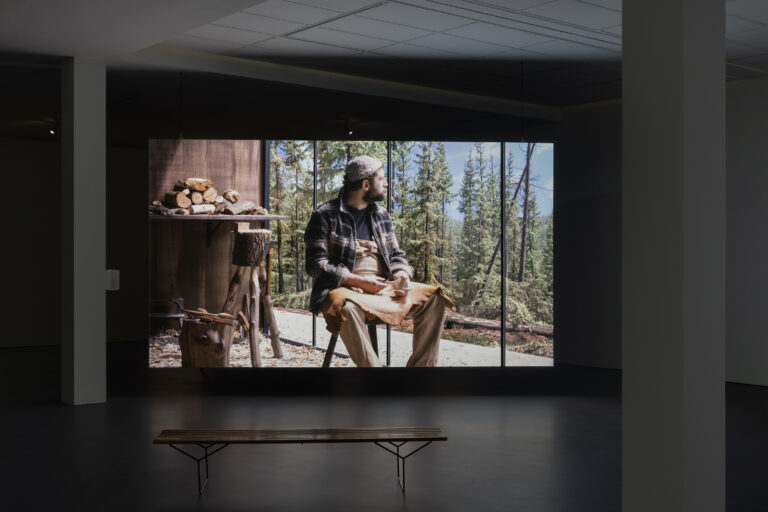
David Claerbout
The woodcarver and the forest, 2025
Single channel 4K HD video installation, color, stereo audio, b/w photographic prints
Duration: 24 h 51 min
Dimensions variable
Exhibition view: David Claerbout, Repose, Esther Schipper, 2026
Courtesy the artist and Esther Schipper, Berlin/Paris/Seoul
Photo © Andrea Rossetti
David Claerbout © VG BildKunst, Bonn, 2026
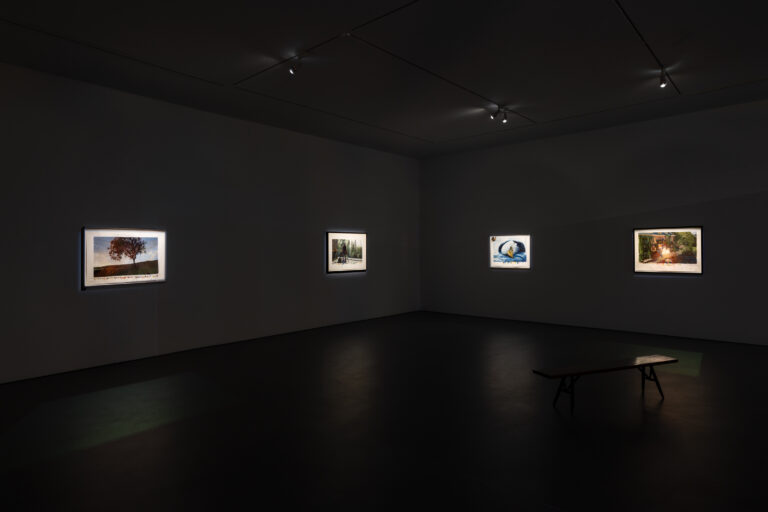
Exhibition view: David Claerbout, Repose, Esther Schipper, 2026
Courtesy the artist and Esther Schipper, Berlin/Paris/Seoul
Photo © Andrea Rossetti
David Claerbout © VG BildKunst, Bonn, 2026
The drawings on view all relate to the video works. An integral part of Claerbout’s practice, each of the artist’s projects is accompanied by a small number of drawings that function as a mix of preparatory studies, notes from the production process, and more conceptual reflections. They are not simply sketches for the films, but a way of thinking through them, translating the complexity and temporality of the video works onto paper through light and color studies and techniques of sequencing and montage.
Rather than partaking in a romanticized idea of nature, the exhibition questions our way of seeing the world around us. Inverting the standard order of what catches our attention and what is considered background, the artist has us focus on what usually remains peripheral or tuned out in human vision. Instead of concentrating on a single event, the viewer experiences multiple processes at once. Thus, Claerbout’s works challenge the single, fixed gaze of the camera and approximate a way of seeing that is more attuned to our being in the world and our physiology: human perception is never singular, but emerges through contesting sensations perceived by two eyes, two ears, and two hemispheres, resulting in countless impressions which together offer multiple ways of encountering the world.
Brought into conversation in a darkened space, Repose invites us to contemplate scenes of both destruction and regeneration, potential danger and enduring beauty. Claerbout’s works draw on new technologies to create the effect of hyperreality, a theme that has characterized the artist’s oeuvre long before digital and AI-generated images became ubiquitous. His images suggest an awareness of their status as representations, alerting viewers to the uncertain boundaries between the technical and the organic, between artifice and nature. Our perception, to Claerbout, lives at the intersection of these realms, in the constant negotiation of what we see and what we believe.
Tuan Andrew Nguyen
Fire Sermon
11 SEP – 24 OCT 2026
Opening – 10 SEP 2026, 6–10 pm
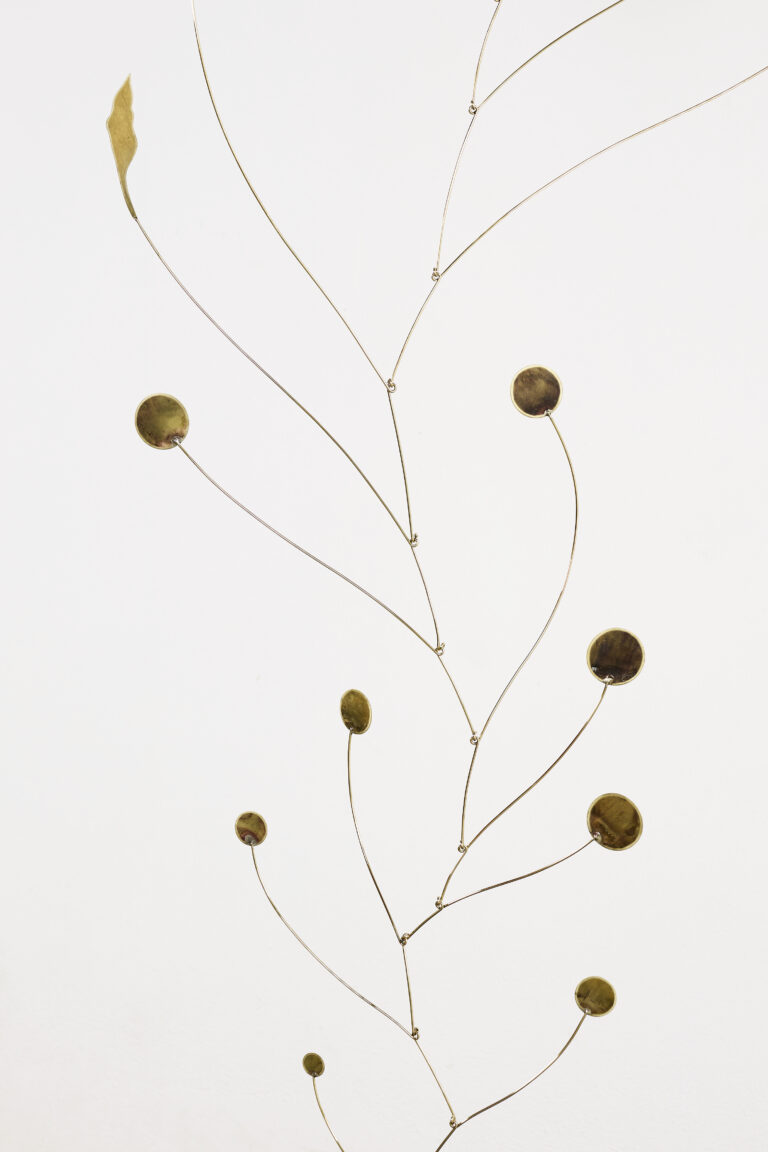
Detail:
Tuan Andrew Nguyen
Parrot‘s Beak / Mỏ Két, 2026
Engraved 57 mm brass artillery shell (tuned to E5 at 647.27 Hz), stainless steel cable with attached wooden clapper, pounded brass artillery shells, brass)
265 x 95 x 70 cm
Tuan Andrew Nguyen, Fire Sermon, Esther Schipper, Berlin 2026
Courtesy the artist and Esther Schipper, Berlin/Paris/Seoul
Photo © Chuong Pham
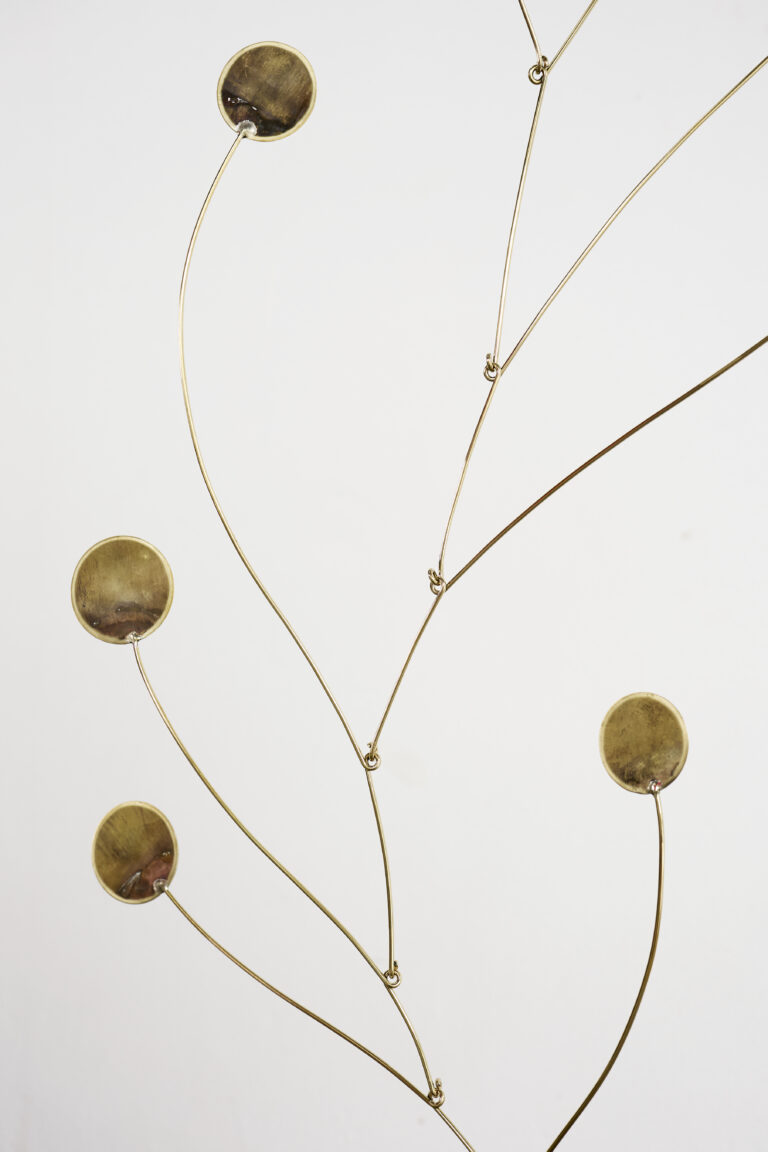
Detail:
Tuan Andrew Nguyen
Parrot‘s Beak / Mỏ Két, 2026
Engraved 57 mm brass artillery shell (tuned to E5 at 647.27 Hz), stainless steel cable with attached wooden clapper, pounded brass artillery shells, brass)
265 x 95 x 70 cm
Tuan Andrew Nguyen, Fire Sermon, Esther Schipper, Berlin 2026
Courtesy the artist and Esther Schipper, Berlin/Paris/Seoul
Photo © Chuong Pham
Esther Schipper Berlin is pleased to present Fire Sermon, Tuan Andrew Nguyen’s first solo exhibition with the gallery. On view will be five new sculptures from the artist’s series of mobiles.
Tuan Andrew Nguyen’s practice explores the critical impact of storytelling across media including video, sculpture, and installation. Grounded in sustained community engagement and extensive research, his work engages with oral narration, material history, genealogies that span continents, and the lingering impact of colonial politics. Nguyen’s cinematic works feature tales of biographical, geographical and temporal entanglements that meld fact and fiction. The artist’s sculptural works are intertwined with his cinematic oeuvre.
The five mobiles on view in Fire Sermon are made from artillery shells salvaged in Vietnam. They take direct inspiration from Nguyen’s 2022 film The Unburied Sounds of a Troubled Horizon, in which a young metal scavenger is ostracized by her mother, who believes that her daughter is possessed because of her strange obsession with making kinetic sculptures out of bomb material. In the film, which is fictional but interweaves true stories from people affected by UXO (Unexploded Ordnance), it becomes clear that the character’s biographical and historical context evokes specific associations: “Aren’t they like the bombings you used to tell me about?” she asks her mother. This story sets her on a journey to turn bombs into bells of healing power.
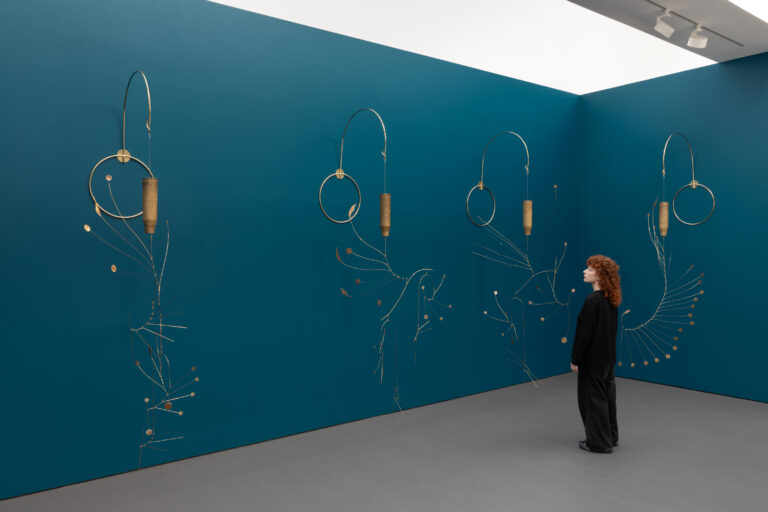
Exhibition view: Tuan Andrew Nguyen, Fire Sermon, Esther Schipper, 2026
Courtesy the artist and Esther Schipper, Berlin/Paris/Seoul
Photo © Andrea Rossetti
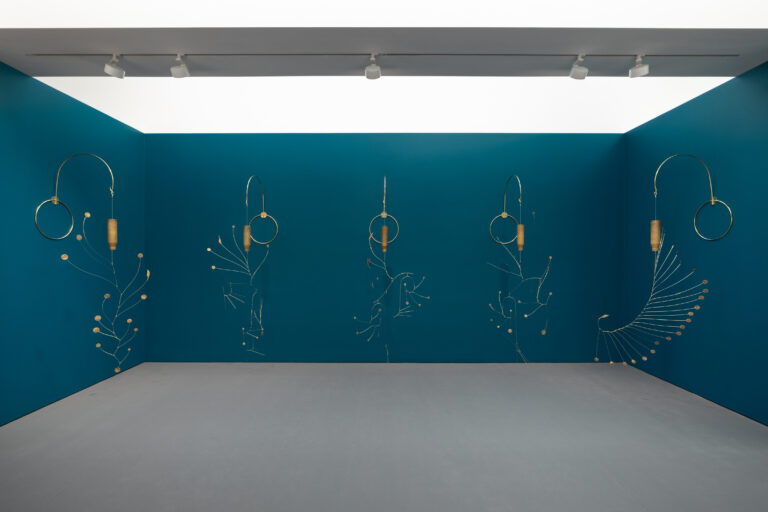
Exhibition view: Tuan Andrew Nguyen, Fire Sermon, Esther Schipper, 2026
Courtesy the artist and Esther Schipper, Berlin/Paris/Seoul
Photo © Andrea Rossetti
Nguyen’s mobiles play on the viewer’s familiarity with Calder’s work to draw us in, then allow us to experience their alienness: At first impression similar—colorful abstract elements, animated by slight movements as they balance gracefully—the centrally positioned artillery shell casings make their otherness immediately clear. The objects’ material history carries a legacy of trauma that reanimates the past and assumes a new life. Nguyen’s use of Calder’s playful visual language also points to the limits of form as an autonomous means of communication. As a leading figure of modernism, Calder’s work came to be associated with US Cold War values and the political neutrality attributed to postwar modernism. Yet, Calder was in fact an active opponent of the Vietnam War, producing anti-war materials and in 1977 turning down the US Presidential Medal of Freedom in protest.
For Nguyen, then, the notion of repurposing materials from the Vietnam War has wider meanings, both historical and spiritual. Unexploded ordnance from the extensive US bombing campaign, which dropped millions of tons of munitions on Vietnam during the war, remains embedded across the country, endangering communities and restricting the safe use of land. Drawing on the tradition of repurposing UXOs in Vietnam into objects for daily use, his transformation into artworks is an act of remembrance and healing. Nguyen’s practice builds on, as he put it, “the power to take something that was meant for destruction, harm, and change it to something that has the possibility to heal.” The artist takes this idea literally, as the central artillery shell casings of each work function as bells, tuned to a frequency associated with healing qualities.
The exhibition’s title, Fire Sermon, refers to the Buddhist Ādittapariyāya Sutta, which describes sensory experience as “burning” with passion, aversion, delusion, and suffering. Liberation is attained through detachment or non-attachment.