

Lucía Koch
New Systems (For Relationships)
11 SEP – 6 NOV 2026
Opening – 10 SEP 2026, 6–10 pm
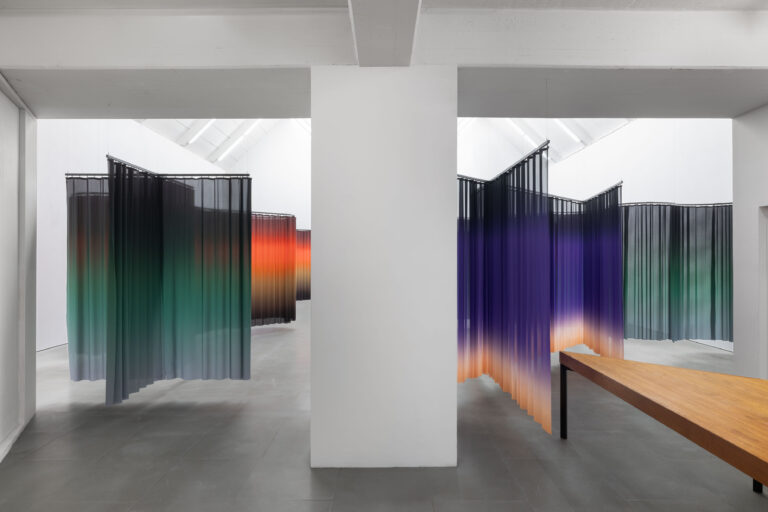
Lúcia Koch, New Systems (For Relationships), exhibition view at carlier | gebauer, Berlin, 2026
Photo:Andrea Rossetti
Courtesy of the artist and carlier | gebauer, Berlin/Maddrid
Lúcia Koch is a Brazilian artist who lives and works in São Paulo. Over the years, she created various bodies of work that co-exist and form an evolving repertoire that is taken by the artist as a source of possible responses to a given context.
In her practice, Koch approaches architecture as a language to be explored. By introducing filters, images, additions or subtle acts of subtraction, she transforms familiar spaces into environments where colour, light and human presence continually reshape the experience of place.
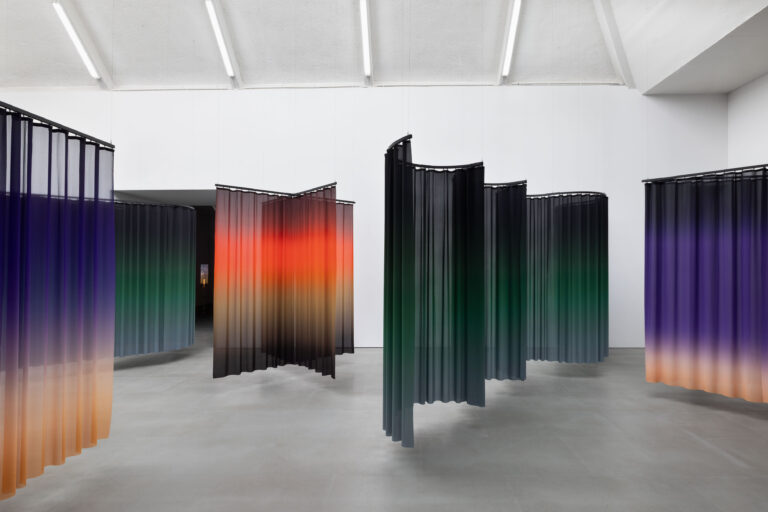
Lúcia Koch, New Systems (For Relationships), exhibition view at carlier | gebauer, Berlin, 2026
Photo:Andrea Rossetti
Courtesy of the artist and carlier | gebauer, Berlin/Maddrid
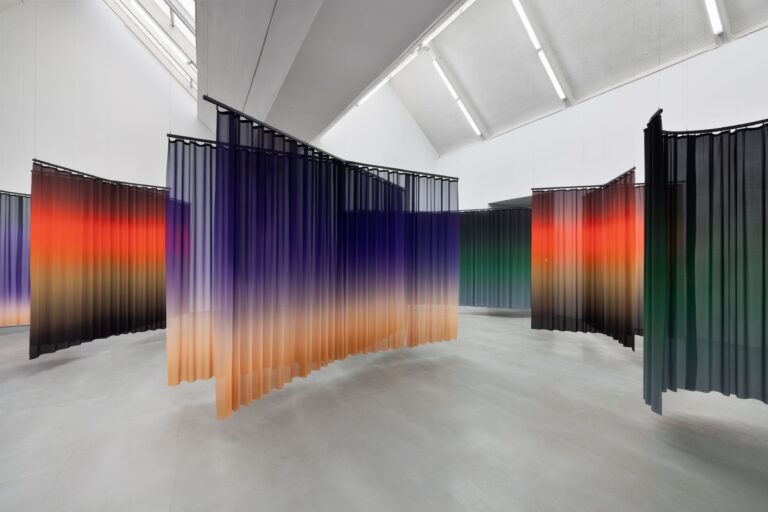
Lúcia Koch, New Systems (For Relationships), exhibition view at carlier | gebauer, Berlin, 2026
Photo:Andrea Rossetti
Courtesy of the artist and carlier | gebauer, Berlin/Maddrid
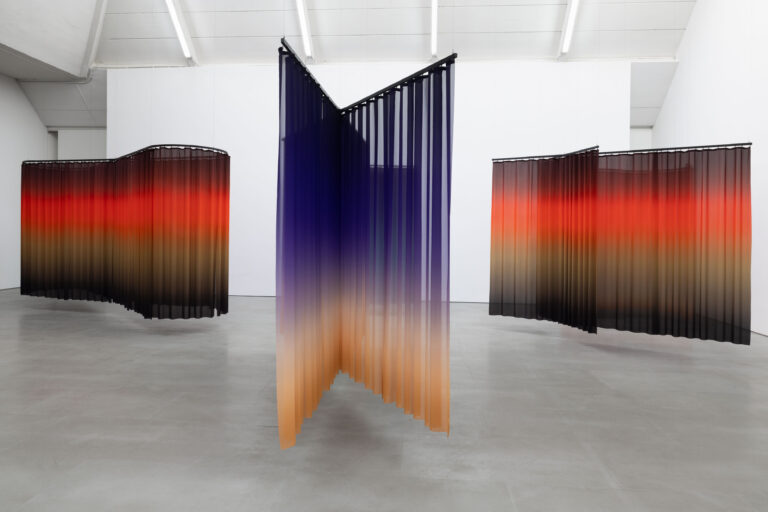
Lúcia Koch, New Systems (For Relationships), exhibition view at carlier | gebauer, Berlin, 2026
Photo:Andrea Rossetti
Courtesy of the artist and carlier | gebauer, Berlin/Maddrid
Since 2022, Koch has been developing “New Systems (For Relationships)”, a body of work centred on autonomous structures that relate more closely to the bodies of viewers than to singular architectural spaces. The works operate with intersubjectivity by acting as communication devices between people. As visitors move through, around and within them, they become part of an ever-changing network of relationships. Every movement generates new constellations of colour, perception and proximity. Like a mathematical equation with infinite variables, each individual brings a unique reality to the work, making every encounter and every possible outcome endlessly renewed.
The pieces are composed by mobile structures with fabric-filters, and the shape of each module combines either curved or straight sections of rails, exercises on topology taking the colours and forms as attributes, as it is in the language of logic-mathematics, the artists mother tongue. The modules can be a symmetric cross formed by four straight lines, or an S shape that reminds us of furniture pieces designed for very formal dating, or two straight lines joining each other to form an acute angle. They can also be combined further into more complex tri-dimensional diagrams like the Infinite, with enclosed areas that can be entered by the viewer.
The works thus obscure and divide the room they are placed in, imposing an almost overwhelming presence of colour. Within these Systems there are three different sets of colour gradients and degrees of transparency, addressing to different moods and ways to be or act in the space.
Since 2010, Koch has produced immersive interventions with fabricated filters, that consist in colour gradients printed on translucent fabrics and installed in curtain rails. Those undulating surfaces give body to the colour transitions, mediating the interactions of viewers with the space and to one another. People can cross or move around the fabric-filters.
In Tumulte (2022), a large-scale intervention at Palais de Iéna in Paris, the artist created a sort of turmoil through a massive installation of layers crossing each other. The fabrics seemed to escape through the windows, giving the impression that they could not be contained by the building. Those pieces outside could be seen as flags, hanging for unknown reasons.
Animal Mirror
with works by Jelena Bulajić, Diego Delas, Cecilia Edefalk, Asta Gröting, Thibault Hiss, Aki Inomata, Julia Kowalska, Lin May Saeed, Pakui Hardware, Paolo Salvador, Sequoia Scavullo, Erik Schmidt, Thomas Schütte, David Zink Yi and Paloma Varga Weisz
11 SEP – 14 NOV 2026
Opening – 10 SEP 2026, 6–10 pm
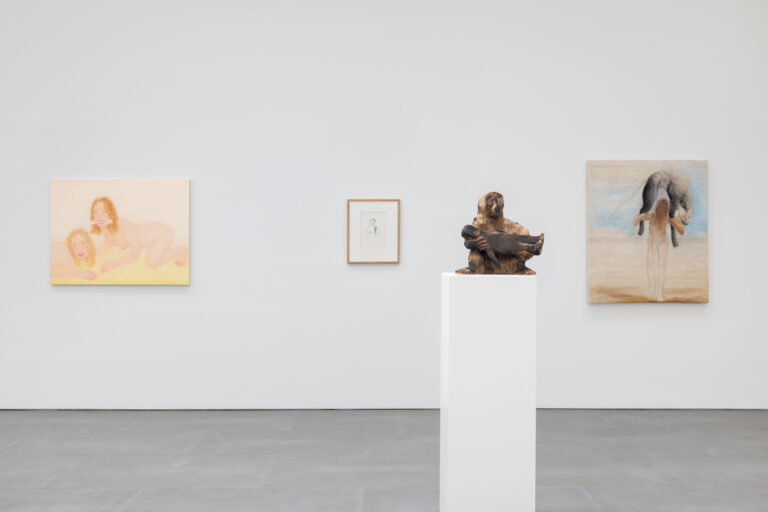
Animal Mirror, exhibition view at carlier | gebauer, Berlin, 2026
Photo: Andrea Rossetti
Courtesy of the artists and carlier | gebauer, Berlin/Madrid
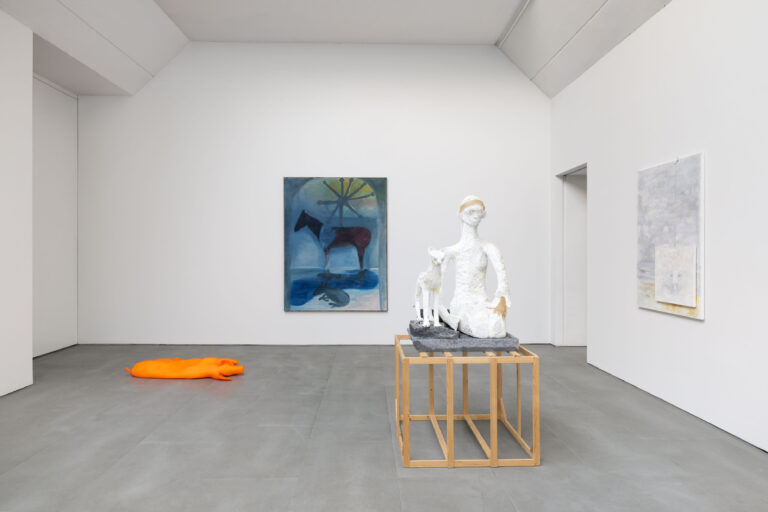
Animal Mirror, exhibition view at carlier | gebauer, Berlin, 2026
Photo: Andrea Rossetti
Courtesy of the artists and carlier | gebauer, Berlin/Madrid
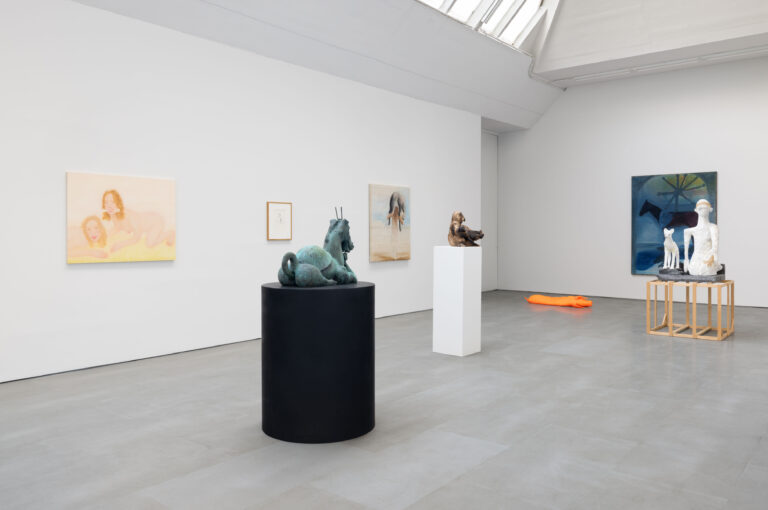
Animal Mirror, exhibition view at carlier | gebauer, Berlin, 2026
Photo: Andrea Rossetti
Courtesy of the artists and carlier | gebauer, Berlin/Madrid
What Looks Back When We Look at Animals
Few relationships are as old, as contradictory, and as unresolved as the one between humans and animals. We share our bed with them and our plate. We worship them and we slaughter them. We search their eyes for an answer they cannot give us, and precisely because of that, we project so much into them. Contemporary art has long recognised this field of tension as one of its central concerns because it allows something to be negotiated that reaches far beyond zoology: our self-understanding as a species, our ethics, our fears, our longings.
The exhibition brings together thirteen artistic positions that approach this relationship from very different directions. Here, the animal appears as companion and confidant as much as source of food and sacrificial creature, two roles that in our culture often lie only a few steps apart, yet are rarely thought together. It appears as cuddly toy and as symbol, charged with meanings drawn from mythology, religion, and folklore, and at the same time as trigger for immediate, barely controllable emotions, affection, disgust, compassion and fear.
At the same time, the exhibition considers the animal as part of a larger ecological and genetic fabric: as a fellow inhabitant of a shared planet, as a participant in a genetic pool to which we are more closely related than everyday understanding often allows. And finally, the most radical question arises: what if the animal is not merely subject matter but the author itself, if animal behaviour, animal movement, and animal intelligence become the actual artistic material?
Aki Inomata literally lets animals co-create, putting human authorship itself up for debate. Lin May Saeed has devoted her sculptural work for years to questions of empathy and liberation in our relationship to animals. PakuiHardware address the body, biotechnology, and the permeability between the organic and the artificial. Asta Gröting and Thomas Schütte approach the animal through physicality, drive, and the grotesque, while Paloma Varga Weisz and Julia Kowalska draw and sculpt hybrid creatures and metamorphoses between human and animal, descendants of a long tradition of fabled beings.
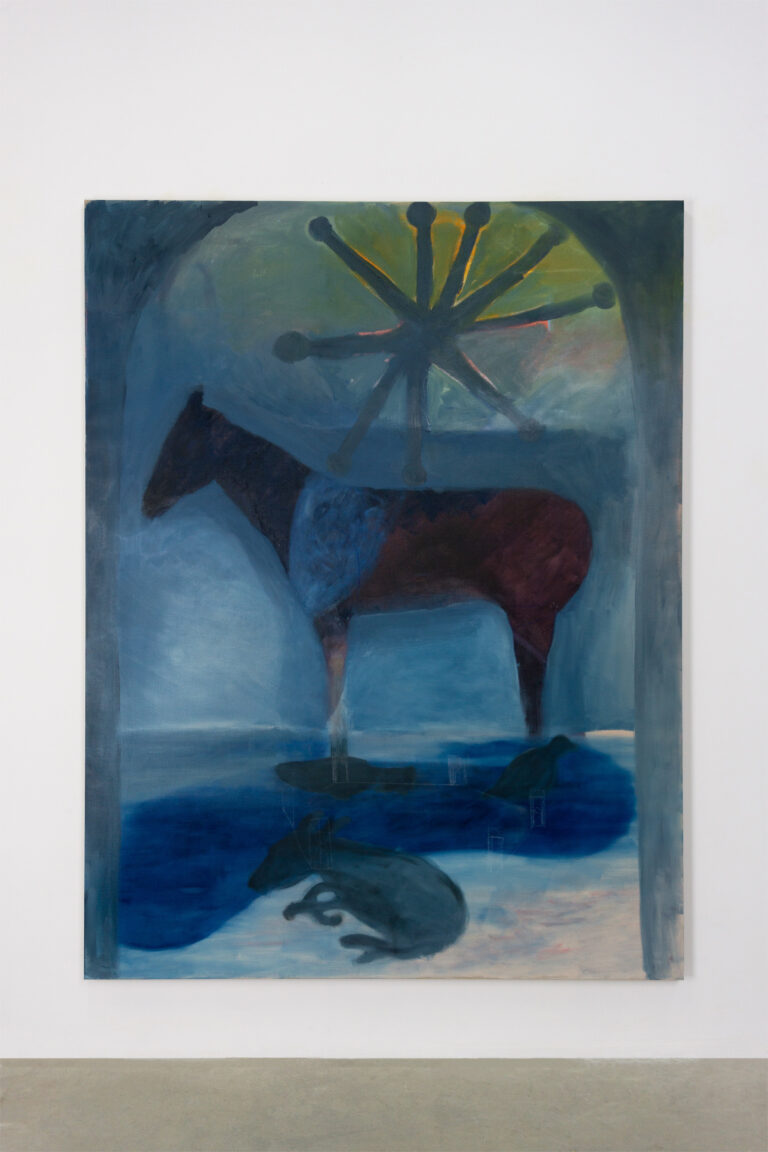
Diego Delas
Atravesarás la noche, 2026
Oil on linen mounted on an infinity aluminum stretcher, and artist frame in ebonized green tea, wine, and linseed oil strip
195 x 150 x 4 cm
Courtesy of the artist and carlier | gebauer, Berlin/Madrid
Photo © Studio Diego Delas
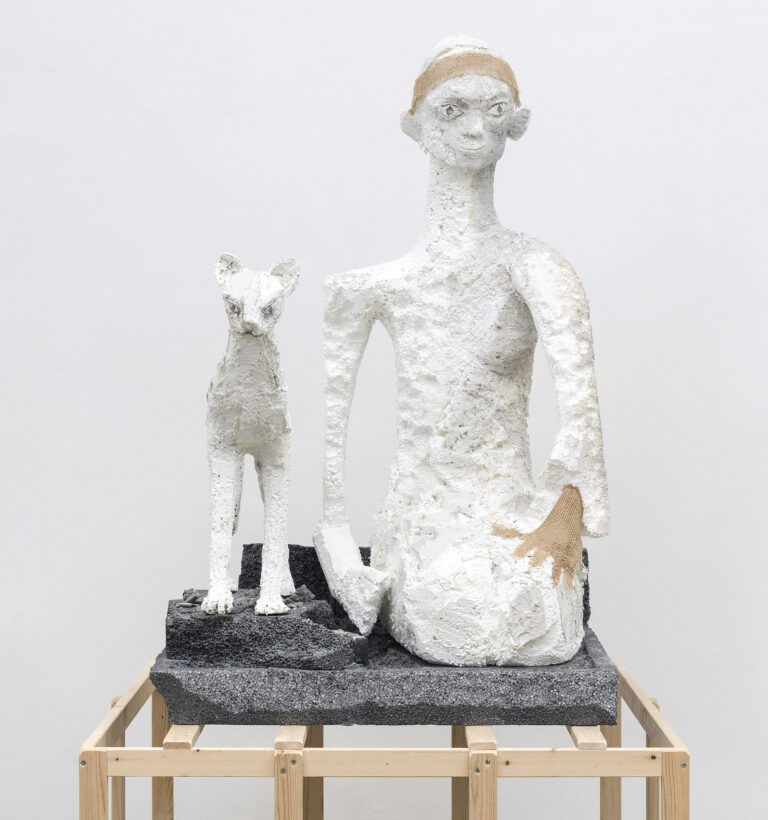
Lin May Saeed
Girl with Cat, 2019
Styrofoam, jute, steel, acrylic paint
107 x 81 x 70 cm
Courtesy of the artist and carlier | gebauer, Berlin/Madrid
Photo © Wolfgang Günzel
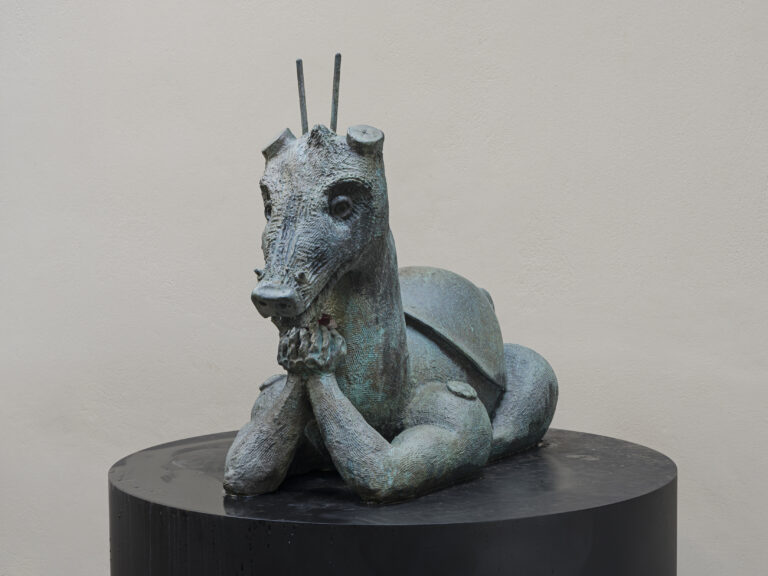
Thomas Schütte
Praying Dog, 2022
patinated bronze, steel
Courtesy of the artist and carlier | gebauer, Berlin/Madrid
Photo © Sebastiano Pellion di Persano
Diego Delas, Sequoia Scavullo, and Paolo Salvador develop, in painting, their own often dreamlike, shifted pictorial worlds in which the animal and the human flow into one another. Thibault Hiss, Jelena Bulajić, and David Zink Yi finally extend the field with sculptural, ceramic, and installative approaches that render the animal tangible as matter, as sound, as presence in space.
What unites these very different positions is their refusal of easy answers. None of the works is didactic, none moralises one-dimensionally. Instead, they open a space in which closeness and distance, tenderness and violence, science and myth are allowed to coexist, as contradictory as our actual relationship to the animal really is.
In the end, what remains is an exhibition about seeing itself: about the gaze we cast upon the animal, and about what comes toward us from within that gaze, an exhibition about looking at animals, and about what looks back.