

Carsten Nicolai
WAVE WEAVE & SONO OBI
12 NOV UNTIL 19 DEC 2026
Opening – 12 NOV 2026, 5–8 pm

Courtesy the artist and Galerie EIGEN + ART
WAVE WEAVE is an essayistic visual investigation into the process of weaving. Rather than approaching weaving solely as a craft or production technique, the film considers the broader relationships that surround it: between technology and material, pattern and information, and between a technical process and the cultural and physical landscape in which it takes place.
These intersections have appeared repeatedly throughout Carsten Nicolai’s work. His practice has long been concerned with patterns, interference, repetition, and systems of visual and acoustic organization, often moving between technological phenomena and structures encountered in the surrounding environment. The term moiré, which has played an important role in Nicolai’s work, itself comes from the history of textiles: originally describing fabric with a watered or wave-like appearance, it later came to designate the optical interference patterns produced by overlapping structures.
This interest also has a biographical dimension. Nicolai grew up in Karl-Marx-Stadt, today Chemnitz, a city and region whose industrial history was strongly shaped by textile production and the technologies associated with it. Textile manufacturing and mechanical engineering profoundly influenced the broader industrial environment in which he grew up. WAVE WEAVE takes these connections as a point of departure, bringing Nicolai’s longstanding interest in pattern, signal, technology, and perception into contact with another textile landscape and tradition.
The film was shot inside the workshops of HOSOO in Kyoto’s Nishijin district, where textiles have been produced for centuries using highly specialized weaving techniques. Founded in 1688, HOSOO continues this tradition while extending its methods through contemporary technologies and digital processes. Nicolai’s camera focuses on the site of production itself: the looms, threads, mechanisms, and repeated movements through which a textile gradually takes form.
Rather than documenting this process conventionally, the film isolates its rhythms and structures. Mechanical movements, shifting threads, and recurring sequences are organized into a precise visual composition. The loom appears not only as a physical apparatus but also as a system for organizing information: individual threads are ordered, repeated, displaced, and combined until a pattern emerges. In this sense, weaving becomes both the subject of the film and a model for the way the film itself is constructed.
A second technological process runs through WAVE WEAVE and connects the filmed image directly to its soundtrack. Throughout his work, Nicolai has repeatedly explored ways of making perceptible phenomena that would otherwise remain invisible, and in particular of giving sound a visual form. Sonography offers a means of translating acoustic information into a graphic image; this image can, in turn, serve as the basis fortranslating visual information back into sound. Sound and image can thus be approached not as entirely separate categories but as different manifestations of related information.
This principle creates two visual layers within the film. The first is the moving photographic image: the workshops, looms, threads, machinery, and physical process of weaving. The second is the visual representation of the soundtrack itself, generated through sonographic analysis. The soundtrack therefore does not remain an invisible acoustic accompaniment to the film but acquires a graphic form of its own.
This graphic image is subsequently transferred into textile. The sonographic representation of the soundtrack becomes the woven structure of SONO OBI. What appears within the film as textile is therefore more than an object observed by the camera: it also contains a visual representation of the sound that accompanies the film.
The film’s different elements are consequently made to correspond with and feed back into one another. The soundtrack becomes visible as a sonographic image; this image becomes a woven textile; the textile enters the photographic image of the film; and the sound from which the process began is heard alongside it. The photographic image and the graphic image of the soundtrack are thus woven together both conceptually and materially.
In this sense, WAVE WEAVE can be understood simultaneously as a film, a sound piece, and an extension of SONO OBI. Weaving is not simply what the film depicts. It becomes its organizing principle: sound, image, notation, textile, and moving image are interlaced until the distinction between representation, material, and source begins to dissolve.
Created in close collaboration with HOSOO, WAVE WEAVE brings together different histories and environments of textile production with Nicolai’s ongoing investigation into sound, perception, signal processing, notation, craft, and technology.
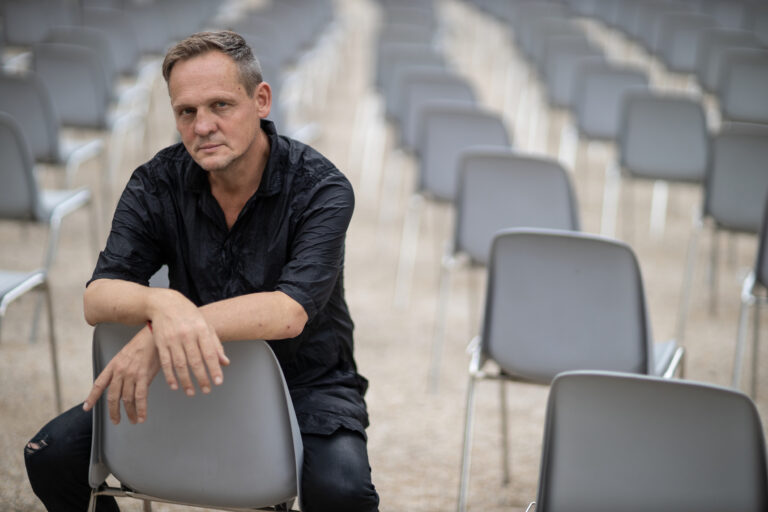
Carsten Nicolai (born 1965 in Karl-Marx-Stadt, Germany) lives and works in Berlin. Inspired by scientific reference systems, Nicolai explores mathematical patterns such as grids and codes, error and random structures, as well as the phenomenon of self-organisation. In doing so, he continually breaks down the boundaries between various artistic genres.
Following his participation in documenta X (1997) and the 49th and 50th Biennale di Venezia (2001 and 2003), his works have been included in important private and public collections and presented in national and international exhibitions in renowned museums and galleries. These include major solo exhibitions at Schirn Kunsthalle Frankfurt (anti reflex, 2005), Neue Nationalgalerie Berlin (syn chron, 2005), Berlinische Galerie (tele, 2018), Kunstsammlungen Nordrhein-Westfalen (parallax symmetry, 2019) and Haus der Kunst München (transmitter / receiver – the machine and the gardener, 2022).
Under the pseudonym Alva Noto, Nicolai is one of the best-known representatives of contemporary electronic music. Concerts have taken him to the Solomon R. Guggenheim Museum in New York, the San Francisco Museum of Modern Art, the Centre Pompidou in Paris and the Tate Modern in London. His various musical projects include collaborations with Ryōji Ikeda, Mika Vainio, Iggy Pop, Blixa Bargeld and Ryūichi Sakamoto. With the latter, Nicolai composed the music for Alejandro González Iñárritu’s Oscar-winning film The Revenant, which was nominated for a Golden Globe, a BAFTA and a Grammy in the Best Original Score category.
Nicolai has received numerous awards and scholarships, including Giga Hertz Prize (2012, with Ryoji Ikeda); Villa Massimo, Rome (2007); Zurich Art Prize (2007); Villa Aurora, Los Angeles (2003); Prix Ars Electronica (2000 and 2001, with Marko Peljhan); Grand Prize Japan Media Arts Festival (2014).
Since 2015, Nicolai has held a professorship for art with a focus on digital and time-based media at the Dresden University of Fine Arts.