

Shannon T. Lewis
A View from Patience Hill
20 JUN until 1 AUG 2026
At Goethestraße 2-3
The painting of Shannon T. Lewis often depicts fragmented bodies, floating limbs, and architectural elements that combine into surreal pictorial spaces. The figures portrayed seem to exist between interior and exterior, present and past, reality and imagination.
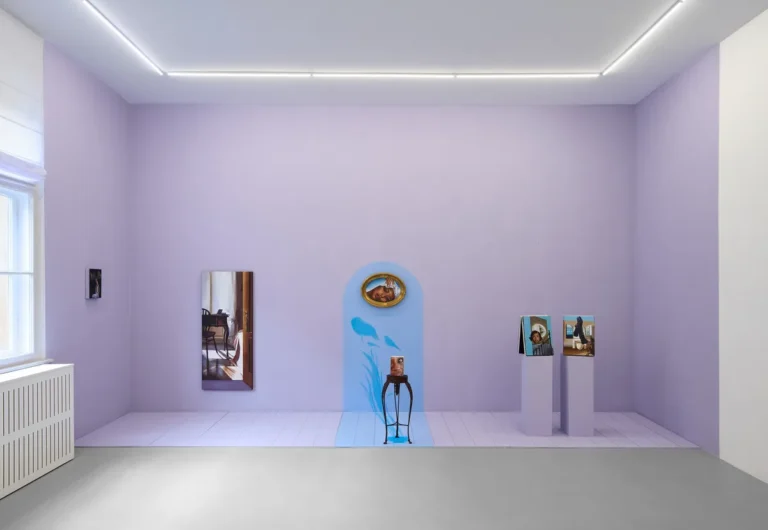
Installation view:
Shannon T. Lewis,
A View from Patience Hill, Wentrup II (2026).
Photo: Matthias Kolb.
Bodies merge with spaces; arms and legs penetrate walls or appear in unexpected places. This creates the impression that the figures are not bound to the physical world. The works open up a space beyond the immediately visible and point toward memory.
Many compositions include windows, doors, passageways, or architectural openings. These can be understood symbolically as portals. The figures move through these transitions and seem to traverse different social, cultural, or psychological spaces: doors as possibilities for transformation and self-discovery. At the same time, they are also doors to other worlds, functioning as metaphors for transgression of boundaries and the interweaving of cultures, identities, and modes of perception.
Central themes include the artist’s own Caribbean family and memory cultures, as well as experiences of migration and diaspora.
Shannon T. Lewis’s painting and Phillip B. Williams’s Ours: A Novel — a comparison
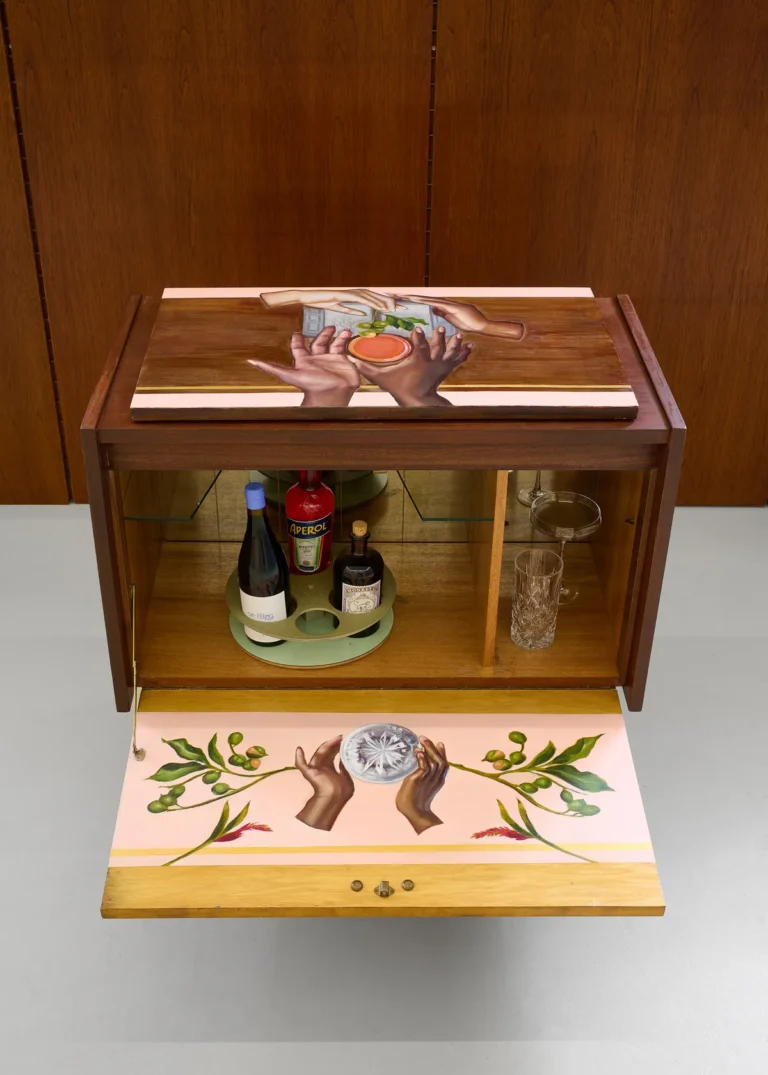
Installation view:
Shannon T. Lewis,
A View from Patience Hill, Wentrup II (2026).
Photo: Matthias Kolb.
Both bodies of work engage with transitions: between past and present, between cultures, and with boundary crossings, both geographical and metaphysical.
Shannon T. Lewis’s images and Phillip B. Williams’s Ours: A Novel emerge from experiences of the Black diaspora. Shannon explores migration, the fragmentation of identity, and belonging. In Ours, Williams creates a community of formerly enslaved people who build an autonomous future outside white society.
Both works transcend the boundaries of realism. Lewis allows bodies to glide through space and time, while Williams envisions an almost spiritual utopia, an alternative society.
Both Lewis and Williams develop aesthetic forms of a Black counter-world. Transcendence enables them to surpass historical limitations. Spirituality functions as a source of knowledge, and in both, memory operates across generations. Williams constructs a transcendent community; Lewis, a transcendent consciousness.
In Williams’ work, magic connects the protagonists with their ancestors. This raises the question of who decides what counts as knowledge. Lewis creates an atmospheric world; characters and objects seem imbued with an invisible force.
Both authors dissolve the linear experience of time and conceive of it as cyclical, particularly when it comes to transgenerational trauma. Cultural studies scholar Tina Campt refers to this as diasporic temporality.
The Black diaspora uses the transmission of stories in oral, visual, or somatic forms as an antidote to transgenerational trauma. Many publications also speak in this context of “cultural resilience” and narrative reevaluation through a shift in perspectives. “My Grandmother’s Hands” by Resmaa Menakem, for example, focuses precisely on this resilience and generational healing.
History is not a thing of the past but remains palpable as a resonance in present-day life.
At the same time, Williams and Lewis are not nostalgic, but rather futuristic. They understand flashbacks as an ongoing means of imagining a future.
Text by Tina Wentrup
Shannon T. Lewis (b. 1981, Toronto) is a Berlin-based Canadian artist of Caribbean descent, whose surrealist paintings form a fantastical world, depicting bizarre imagery alongside uncanny landscapes. The collaged figures storytell and form new structures, between spaces, classes and geographies, fully immersing her audience. Lewis has exhibited in Canada, the U.S., Trinidad, Switzerland, England and Germany. She has a Bachelor of Arts from OCADU in Toronto and a Masters of Fine Arts from Goldsmiths, University of London. In 2025, Lewis was invited as a guest professor for the fall semester at the Universität der Künste in Berlin (Germany) to teach the painting course “Dramaturgy of the Object” in the Bühnebild department.
Blind Spot
With works by Billie Clarken, Aura Rosenberg, Anastasia Samoylova, Britta Thie
20 JUN until 1 AUG 2026
At Knesebeckstraße 95
xxx
„All the world is not, of course, a stage, but the crucial ways in which it isn’t are not easy to specify.“
Erving Goffman
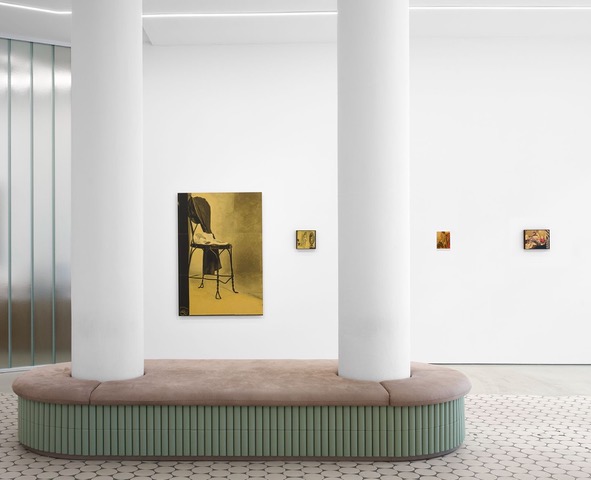
Installation view:
Blind Spot
With works by Billie Clarken, Aura Rosenberg, Anastasia Samoylova, Britta Thie
Photo: Matthias Kolb.
In one set of images, entire cities collapse into surfaces of glass, branding, and repetition. Location survives solely as a caption. In Anastasia Samoylova’s Image Cities, the frame is a form of exclusion, and its casualty the context. Dehumanized by the very images designed to guide its citizens, the anonymous tread lightly into unknown locations.
Elsewhere, fragments of celebrity images circulate with a different kind of insistence. They are familiar without being close. Billie Clarken delivers them to us, as aware as ever that, although already overproduced, they are never quite resolved. To put it in the words of a celebrity culture connoisseur, Courtney Love: “Celebrity is concept art. What is real art is music and film.”
As pop culture permeates our intimate spaces, even bathtubs, it becomes increasingly difficult to switch off. We are constantly being observed by an unseen audience, all the while we are blurring the line between consumption and observation itself. Further along, objects that were never meant to be central begin to look self-sufficient. Meaning tends to accumulate here. Objects, leftovers, stuff positioned just outside the action.
Aura Rosenberg’s series Scene/Obscene plays with this contradiction. The word obscene carries its origin within it. Or so the story goes. Coming from ancient Greek theatre ob skene: what was kept off-stage in the theatre, excluded from the frame of representation. Whether etymology or myth, the image holds. In her paintings of props and objects from pornographic films, Rosenberg drops the pornographic for the obscene.
These very mechanisms are subject matter in the work of Britta Thie. In her paintings, behind-the-scenes machinery of watching, recording, staging become front and center. The invisible is rendered visible, affirming the image as a site of power. They personify the object, the machine; we live with it, and now we’ve lived to see it.