

Albert Oehlen
12 JUN until 8 AUG 2026
At Bleibtreustraße 45
Galerie Max Hetzler, Berlin, is pleased to announce a solo exhibition of works on paper and paintings on acrylic glass by Albert Oehlen.
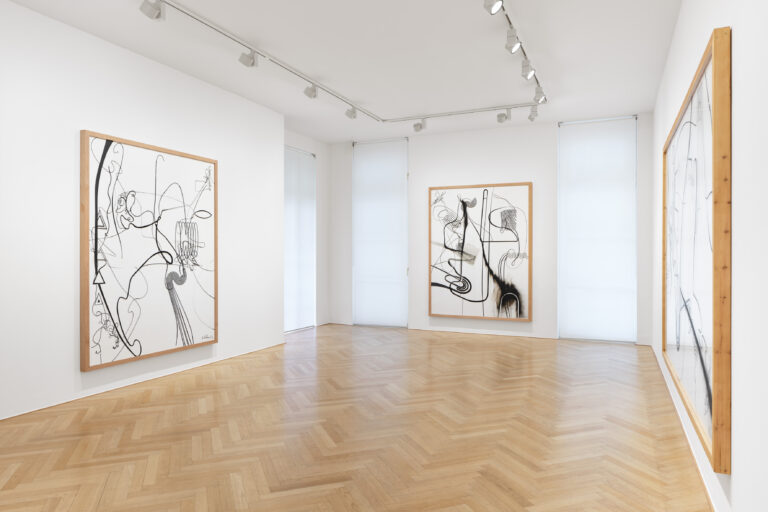
Exhibition view:
Albert Oehlen,
12 June – 8 August 2026, Galerie Max Hetzler, Berlin.
© Albert Oehlen,
courtesy the artist and Galerie Max Hetzler Berlin | Paris | London | Marfa
Photo: def image
Spanning more than a decade, the exhibition presents works from Oehlen’s ‘Computerbilder’ (Computer Paintings) and ‘Conduction’ series. Combining rhythmic lines with varied motifs, the exhibited works convey an intricate network of black contours against crisp white grounds. Oehlen’s fluid, looping forms trace pathways which lead the viewer’s eye across the compositions in a lyrical dance. In the ‘Computerbilder’, first created between 1991–2008 and revisited by the artist from 2024 onwards, Oehlen foregrounds computer-generated imagery, merging printing, painting and collage in a symbiosis of digital and analogue, human and machine. By contrast the ‘Conduction’ works, initiated in 2009, are executed entirely by hand. Rendered with pencil, ink and collage on paper, the present works are distinguished for their conflation of geometric patterns, meandering lines and organic forms. The series is further extended with a new body of work from 2025, composed in oil and lacquer on acrylic glass.
Echoing the pixelated patterns found in digital imagery, the curving black lines in Oehlen’s works simultaneously recall Surrealist automatism, as well as the emotive energy of Abstract Expressionist painters, from Jackson Pollock to Franz Kline. In several of the works on paper, certain passages are covered with collaged paper or smears of white paint, creating a pentimento effect. Brimming with free-flowing forms, letters and movement, the works read like cyphers, graphs or musical scores. Enacting a push-and-pull, these systems seem to indicate paths to reading the works, no sooner followed than they are interrupted. Layering and unfurling over one another, the lines convey a sporadic musicality akin to the syncopated rhythms of jazz – a longstanding influence on Oehlen’s practice. On this, the late art critic Pierre Sterckx noted: ‘Oehlen tries to do with painting what others (Coltrane, Zappa) have attempted in jazz or rock: to immerse the listener in a burst of overlapping, saturated and expansive strata, getting rid of any story-line since there is no beginning nor end.’1
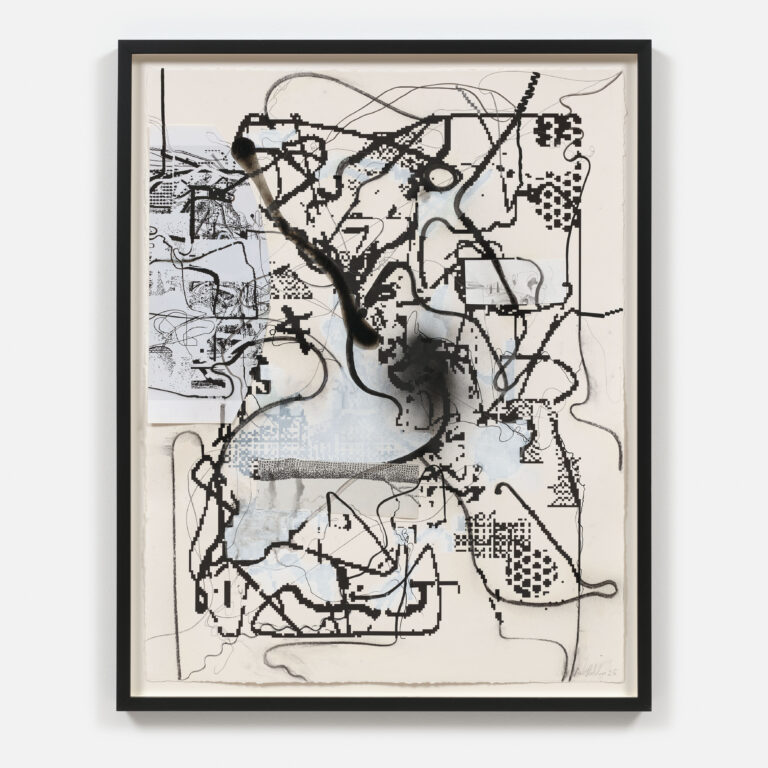
Untitled
2025
silkscreen, lacquer, pencil and collage on handmade paper
90 x 70 cm.; 35 3/8 x 27 1/2 in.
98 x 78 x 4 cm.; 38 5/8 x 30 3/4 x 1 5/8 in. (framed)
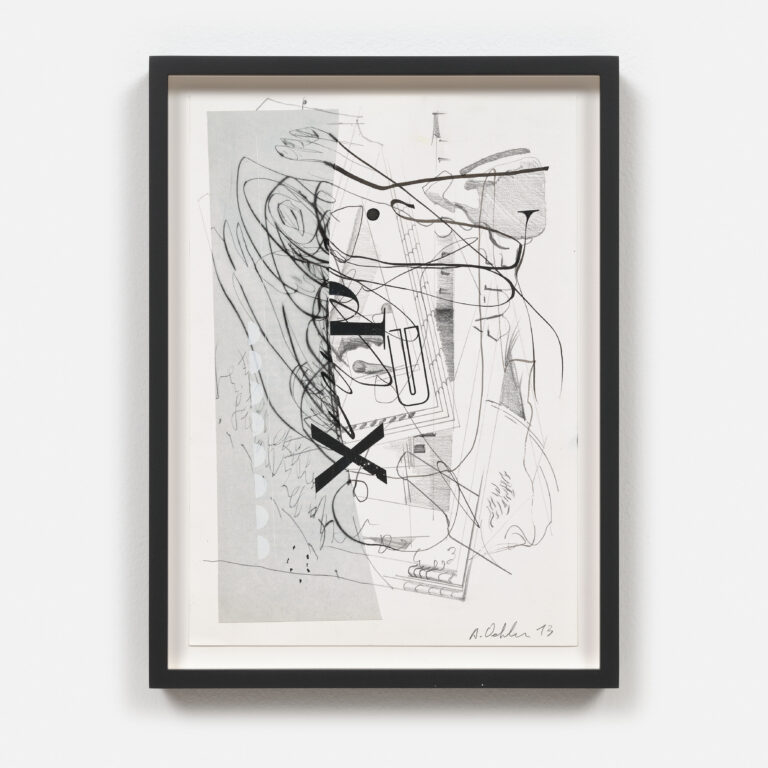
Untitled
2013
pencil, ink and collage on paper
29.7 x 21 cm.; 11 3/4 x 8 1/4 in.
33.7 x 25 x 3.5 cm.; 13 1/4 x 9 7/8 x 1 3/8 in. (framed)
Underscoring the parallels between musical composition and artistic composition in Oehlen’s work, the ‘Conduction’ series was named after a pioneering type of structured improvisation developed by American musician and composer, Lawrence ‘Butch’ Morris (1947–2013). This method involves a mix of systems and structures, intuition and improvisation, whereby the composer and the instrumentalist initiate a real-time alteration of harmonies and melodies, referred to as ‘controlled freedom’. Across his own practice, Oehlen similarly adheres to a set of self-imposed conceptual or formal parameters, whilst simultaneously embracing elements of indeterminacy and chance as key components of his creative process. As writer and curator John Corbett has stated: ‘It’s not chaos. It’s order without dominion’.2 In the exhibited works, sprawling forms snake across the surfaces of the compositions. Like a visual stream of consciousness, they bloom at times into hazy anamorphic shapes or recede into thin lines and pointillist dots. Some end abruptly; others extend to the very edges of their parameters. Whereas the works on paper seem to absorb the light around them, the glass surfaces of the large-scale paintings warp and reflect the surrounding environment, imbuing them with an additional layer of dynamic movement.
In the exhibited works, Oehlen offers a striking representation of the contradictions at the heart of his practice, combining constraint and intuition, order and improvisation, structure and formlessness. The artist’s approach to image-making is at once pragmatic and questioning, finding original expression and endless possibility in the tension and release which extends across his freely structured improvisations.
1 P. Sterckx, ‘Albert Oehlen: Junk Screens’, in Albert Oehlen, exh. cat., Clermond-Ferrand: Frac Auvergne, 2005.
2 J. Corbett, Painthing On The Möve, exh. cat., London and Chicago: Thomas Dane Gallery and Corbett vs. Dempsey, 2011.
Konrad Klapheck
12 JUN until 8 AUG 2026
At Potsdamer Straße 77-78
Galerie Max Hetzler, Berlin, is pleased to announce a solo exhibition of paintings by Konrad Klapheck. This is our first presentation of the artist’s work.
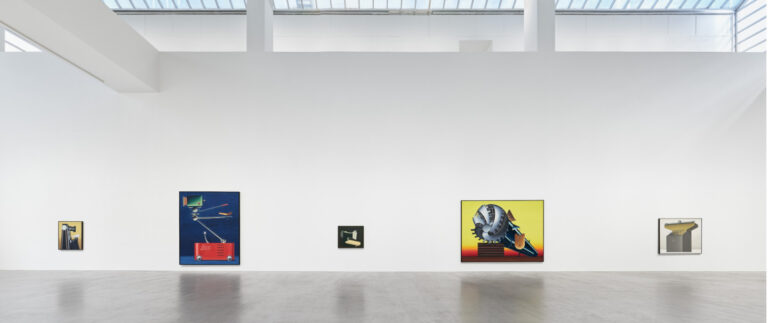
Across his oeuvre, Klapheck created an exceptional body of paintings, whose significance extends well beyond the context of German post-war art. At a time when many international artists were painting abstractly in the 1950s, Klapheck turned against the trend and towards figuration. Between 1954 and 1958, he studied painting at the Düsseldorf Art Academy under Bruno Goller, an influential figure in the German postwar art scene whose enigmatic, figurative painting offered an alternative to the dominant Informel. It was perhaps through the encouragement of his teacher and mentor that Klapheck painted his first typewriter in 1955, inaugurating the ‘Machine Paintings’ which would shape his artistic practice for the next four decades. The seemingly banal everyday objects that Klapheck rendered in a precise, realist style comprise an entire genealogy of domestic appliances and ordinary things: motorcycles, radios, hairdryers, chairs, and other familiar devices. Works from this series dating 1963–1993 are on view in the exhibition.
Stylistically poised between Surrealism, New Objectivity and Pop art, Klapheck developed a visual language entirely his own. Through isolation, simplification, and the exaggerated use of perspective, he transformed his objects into imposing, uncanny presences. An object painted by Klapheck is instantly recognisable for its monumental appearance and cold metallic sheen. An otherwise realistically rendered bicycle or motorcycle is almost always missing a crucial functional component, whilst ordinary utilitarian objects are detached from their original context. Transformed into surreal and symbolic images, his works become metaphors for human relationships, power, sexuality and alienation. Abstracted, defamiliarised, aestheticised and personified, they withdraw from the logic of the consumer world. For each painting, Klapheck meticulously developed a preparatory drawing in charcoal or pencil, through which he established the proportions, precision and psychological charge of his images. Two such preliminary drawings on canvas are on view in the exhibition.
Through his decades-long engagement with machines, Klapheck aligned himself with the Surrealists, whose circle and intellectual atmosphere he closely inhabited. One might think of Francis Picabia’s subversive paintings of mechanisms with no practical use; or Marcel Duchamp, who challenged traditional notions of artistic authorship, function and value with his readymades. Indeed, the upside-down bicycle in Klapheck’s Die Fragwürdigkeit des Ruhmes (The Questionable Nature of Fame), 1978, seems reminiscent of Duchamp’s readymade Bicycle Wheel from 1913. Running beyond this shared motif, echoes of Duchamp’s work can be traced throughout Klapheck’s oeuvre. André Breton, whom Klapheck first met during a stay in Paris in 1961 and subsequently befriended, likewise drew a connection to Duchamp in a text written for Klapheck’s 1965 solo exhibition at Galerie Ileana Sonnabend. Yet, Breton emphasised that Klapheck’s work was not merely a continuation of Surrealism, but an independent position situated between precision, irony, and unease1.
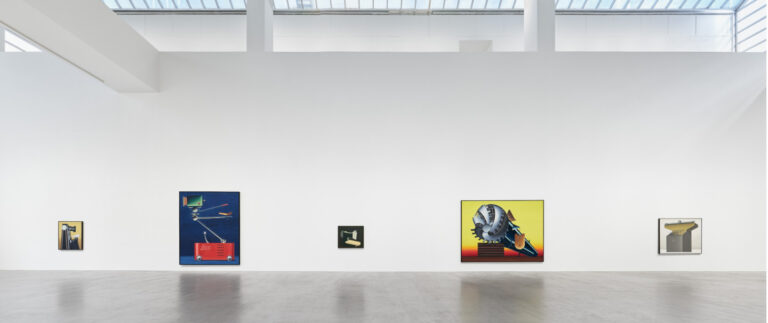
A disjunction emerges between Klapheck’s depicted objects and their titles, opening up an additional layer of interpretation for the viewer. Using names such as Die Gastgeberin (The Hostess), Die Verführerin (The Seductress) or Der mütterliche Vater (The Motherly Father), the artist assigns gendered identities to his objects: sewing machines are cast as female, typewriters as male. Other titles, including Die Jagd nach dem Glück (The Pursuit of Happiness), Die Fragwürdigkeit des Ruhmes (The Questionable Nature of Fame), and Der Erfolg und sein Preis (Success and its Price), reference Klapheck’s personal memories, encounters with his peers, and situations that resonate with broader human experience. Leaving them intentionally open-ended, the artist believed that explaining a title was akin to explaining the punchline of a joke.
Through the charged interplay of form, title and association, his machines become psychologically and socially resonant presences: transcending mere depiction, they embody lived experience, fear and desire. As familiarity and strangeness merge, Klapheck’s unique objects resonate with universality, drawing on the viewer’s own memories and emotional responses.
Galerie Max Hetzler would like to thank all lenders for their generous support of the exhibition.
1 A. Breton, Konrad Klapheck, exh. cat., Paris: Galerie Ileana Sonnabend, 1965.