

Brett Charles Seiler
occasional lovers
1 MAY until 20 JUN 2026
Opening – 1 MAY 2026, 6-9 pm
At Galerie EIGEN + ART Berlin
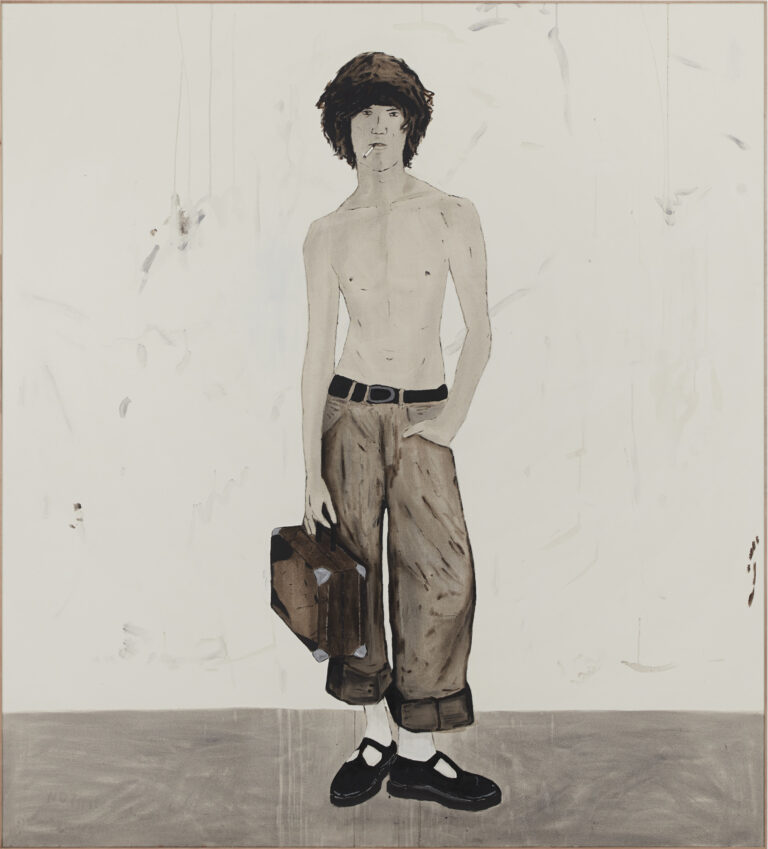
Brett Charles Seiler
Bradley Smoking A Cigarette, 2026
Bitumen, Dichtungsfarbe und Wandfarbe auf Leinwand / Bitumen and wall paint on canvas
200,5 × 180,5 cm
Courtesy Galerie EIGEN + ART Leipzig/Berlin
Foto: Nina Lieska
In occasional lovers, Brett Charles Seiler transcribes the tensions of noncommittal encounters. Figuring a succession of visitors to his studio in large-scale compositions and smaller studies, his ‘midday, midnight, and morning-after’ paintings have about them a sense of disquiet. Where his early works showed moments of shared intimacy and lust, the characters now appear distracted and dejected, their expressions deadpan. There is something unsettling about the word ‘occasional’, the artist suggests. ‘There are secrets and shadows, there is shame.’
Made with the reduced palette of bitumen black, roof-paint and chalk white, and raw canvas that has become Seiler’s signature style, the works are coloured with a muted nostalgia. Of his subjects, the artist speaks with tenderness of ‘my people’, listing a cast of friends and muses – Clemence, Felix, Prince, Bradley, Lukas, Adam, and Terence, among others – a bouquet of boys, as one work is titled. There are two women, too, who bend the rule. The portraits seldom share a close resemblance to their sitters: they are not descriptions of individuals, Seiler says, but rather recollections of time spent together in the studio, embellished by memory and self-referential asides. His practice, he suggests, is predicated on a certain urgency: to forget no one, exclude nothing, to remember this place, these people, the feeling of it all.
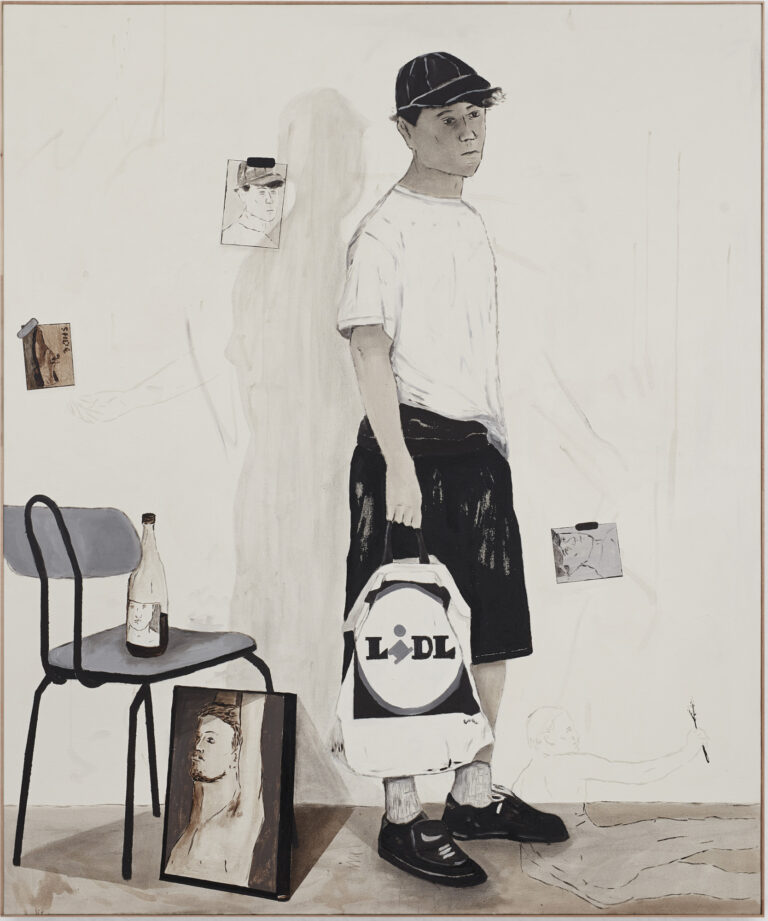
Brett Charles Seiler
Adam As An Existential Shopper (Holding Weight Of Consumerism), 2026
Bitumen und Wandfarbe auf Leinwand / Bitumen and wall paint on canvas
182 × 152 cm
Courtesy Galerie EIGEN + ART Leipzig/Berlin
Foto: Nina Lieska
In Seiler’s studio tableaux, the likenesses of his figures are rehearsed in sketches tacked to the wall or inscribed on incidental props, alongside allusions to previous works and freefloating images borrowed from different settings. Like that of the artist’s real studio, the floors he describes in paint reveal a state of mind, tracing the subconscious and the surreal between the bottles of turpentine, paint pots, buckets, and brushes that punctuate his scenes. ‘The studio is a force, a place where things are lost only later to be found,’ Seiler says. It is also a lover of a kind, he suggests, constant rather than casual, a character all its own.
Distinct from his larger portraits, Seiler’s pared-back studies – liminal and only vaguely libidinal – offer fleeting impressions of the same sitters seen in isolation. Most are given as busts, few as framed fragments (a crotch, a torso, a backside). Pictured against the unarticulated ground that is as much a feature of these works as their figuration, the individuals appear all the more uncertain and exposed. The surrounding emptiness is not so much an absence of context, Seiler suggests, as ‘a space to negotiate the independent self’. With nowhere to hide, the figures are left wanting and waiting.
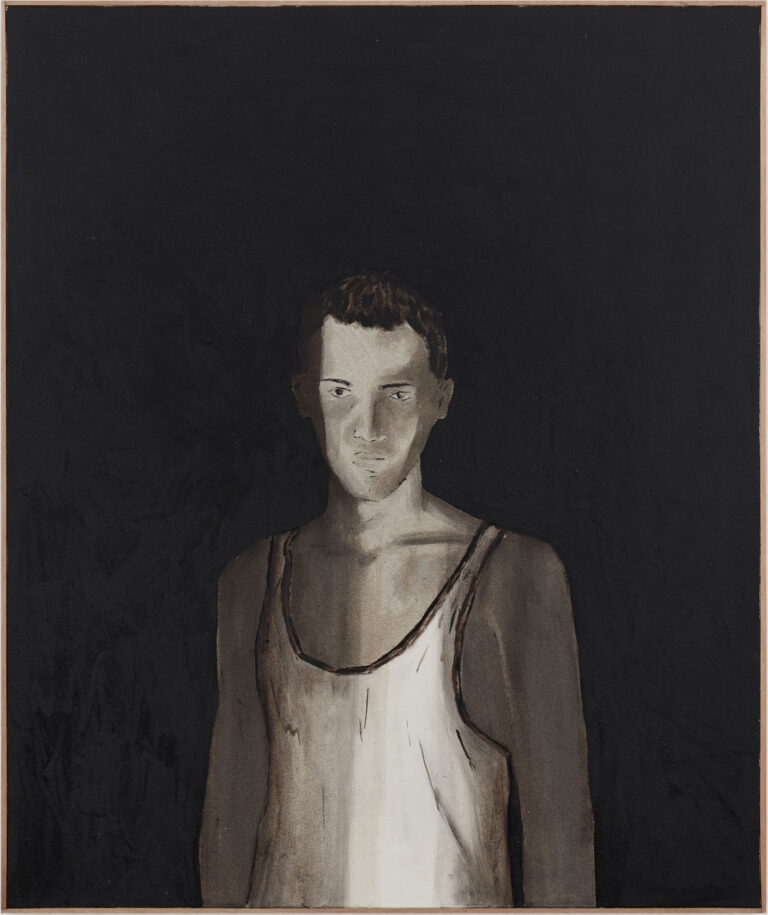
Brett Charles Seiler
Klemenc Caught In The Light, 2026
Bitumen, Dichtungsfarbe und Wandfarbe auf Leinwand
121,5 × 102 cm
Courtesy Galerie EIGEN + ART Leipzig/Berlin
Foto: Nina Lieska
In addition to his paintings, a series of motifs quoted in the artist’s studio compositions are reprised as wood-carved objects in the gallery: Cock soda bottles, cans of Spite, half-smoked cigarettes, and apples – all suggestive of oral fixations, but also consumerism’s manufactured desires, forbidden pleasures, and romantic betrayals. These are accompanied by found suitcase assemblages, recalling both the essential restlessness that has defined much of Seiler’s peripatetic life and the anticipation of visiting – or leaving – a love interest. The artist’s aphorisms, transcribed in his portraits or given as standalone pieces, lend inflexions of brevity to the otherwise subdued register of his paintings. Pairing irony and pathos, these one-liners ask after queer masculinity and the promises and perils of promiscuity, with wry after-the-after-party clarity. Unfaithful me making out with unfaithful you, one reads; Wank and cry, reads another.
Entering the exhibition, the viewer steps into a restaging of Seiler’s studio, becoming just another figure in the crowd, an occasional lover among countless others. Slip off your shirt, pick up a cigarette, try not to choke on an apple. Come and go, touch and gone.
– Lucienne Bestall
Nils Ben Brahim
Die Lücke, die der Teufel lässt
1 MAY until 30 MAY 2026
Opening – 1 MAY 2026, 6-9 pm
At EIGEN + ART Lab
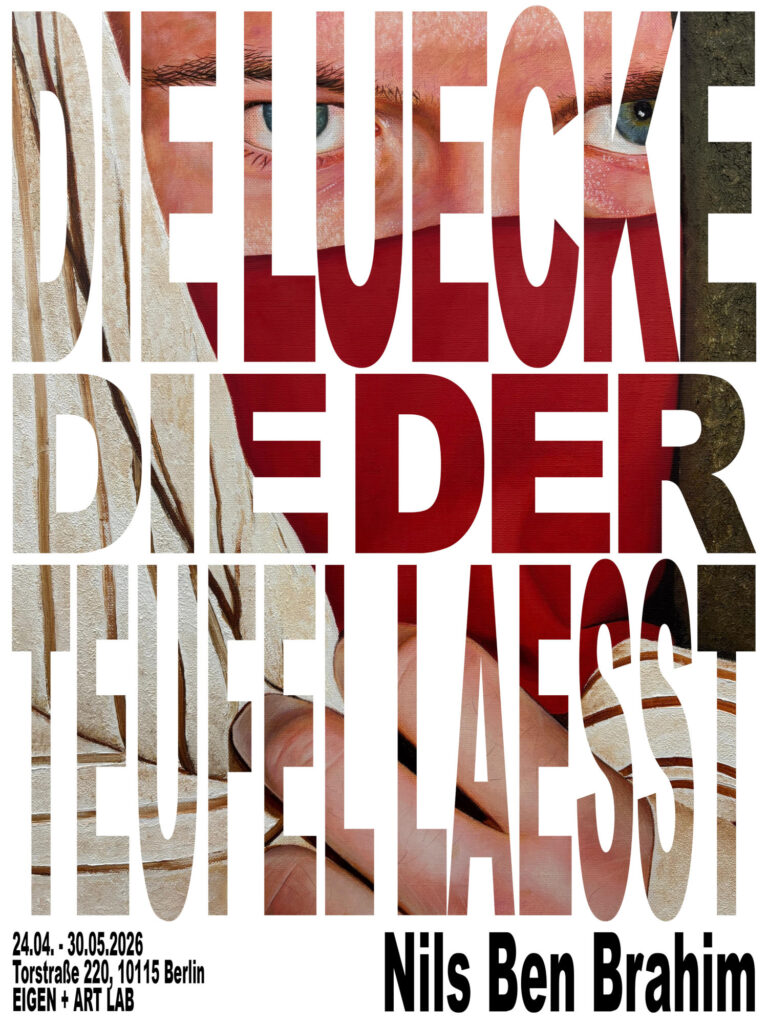
The exhibition Die Lücke, die der Teufel lässt presents recent works by Berlin-based artist Nils Ben Brahim. The point of departure is Alexander Kluge’s book of the same title (2003), in which Kluge describes those gaps in which subjective experience, historical ruptures, and social contradictions overlap. For Kluge, despite the fall of the Berlin Wall and prevailing narratives of progress, the twentieth century remains an era in which evil persists as a systematic gap—as an interstice that cannot be closed.
Ben Brahim’s painting takes up this conceptual figure and translates it into images of a searching present. His works portray visibility, belonging, and class relations by reflecting the gaining and losing of perspectives in the early twenty-first century. The depicted figures often appear isolated, positioned between withdrawal and confrontation, placed within the gaps of an overpowering system.
Nils Ben Brahim
EIGEN + ART Lab
Die Lücke, die der Teufel lässt
Einzelausstellung
April – 30. Mai 2026
What becomes particularly visible are polarities unfolding across an open spectrum between the individual and the collective, death and vitality, as well as the intimate and the public. These dichotomies are experienced primarily through differentiated regimes of looking that frame visibility as a question of power: Who is seen? Who is allowed to withdraw? And what does it mean to refuse the gaze or to return it deliberately?
In some works, figures turn away; in others, they look back frontally, ambivalent between protection and resistance. Anonymity does not appear here as dehumanization, but as a strategic subjective position: a withdrawal from public exposure and, at the same time, a precondition for collective agency.
By linking historically charged painting techniques with contemporary image politics of masking, protest, and observation, Ben Brahim repositions his work within the field of portrait painting—as images of a present in which the gaps remain open.
Text by Marla Heid