

Nida Sinnokrot
Above Ground Below
1 MAY until 29 AUG 2026
Opening – 1 MAY 2026, 6-9 pm
carlier | gebauer, Berlin, is pleased to announce Above Ground Below, a solo exhibition by conceptual Palestinian artist Nida Sinnokrot.
Nida Sinnokrot
Installation view
Courtesy of the artist and carlier | gebauer, Berlin/Madrid
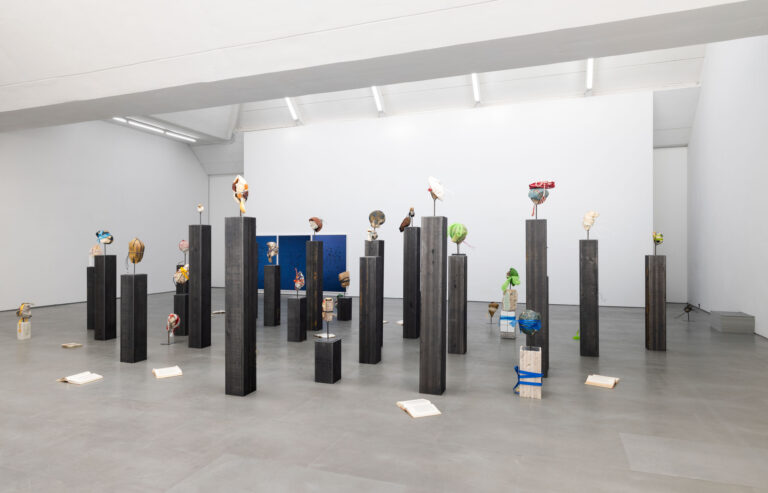
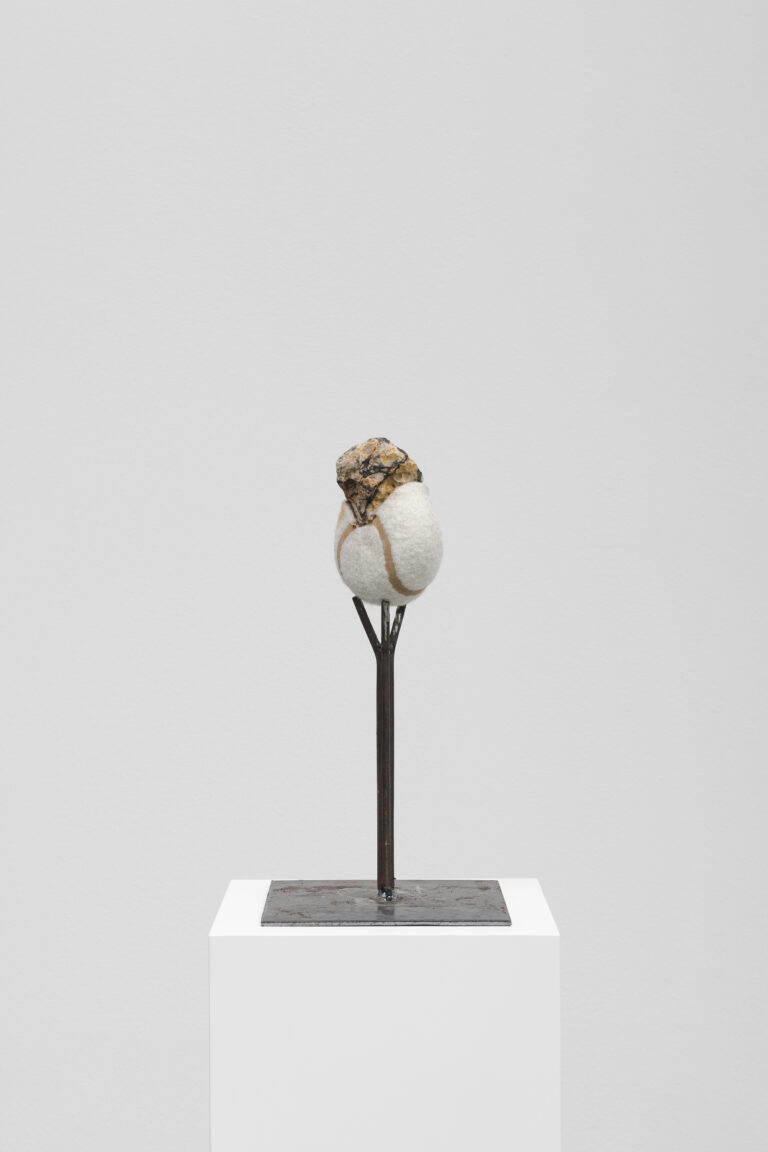
Rubber-Coated Rocks, initiated in 2001, is presented here in a 2024–26 iteration. Composed of stones, discarded footballs, and other found materials gathered near checkpoints in Palestine, each sculpture binds together elements marked by circulation, impact, and abandonment. The forms recall heads or assemblies of bodies—worn, weathered, and held in tension and suspension — suggesting both vulnerability and persistence. Bound and stabilized, they stand as accumulations of contact: between surface and force, object and memory, play and violence. In this 2024–26 presentation, the works are elevated on industrial steel pipes and limestone blocks, extending their material language into a vertical register, linking ground, infrastructure, and display, forming constellatory groupings that oscillate between the bodily and the architectural.
Nida Sinnokrot
Untitled #28, 2026
from the series Rubber-coated Rocks
stone, football, tie-down strap, steel
stand, Plinth, Metal: 100cm
38 x 18 x 15 cm
Courtesy of the artist and carlier | gebauer, Berlin/Madrid
Photo © Andrea Rossetti
Nida Sinnokrot
Rubber-coated Rocks, All-Stars (6), 2015
from the series Rubber-coated Rocks
Stone, rubble, football, brick, string
28 x 15 x 15 cm
Courtesy of the artist and carlier | gebauer, Berlin/Madrid
Photo © Trevor Good
Water Witness extends this inquiry into infrastructure, shifting from the projectile to the conduit. These sculptures assemble ceramic vessels, steel pipes, irrigation valves, and custom-cast fittings into upright configurations that evoke systems of flow, storage, and control. Drawing on vernacular water practices and the sacred Palestinian geographies documented by Dr. Tawfiq Canaan, particularly his accounts of springs, wells, and cisterns as sites of belief, ritual, and guardianship, the works situate infrastructure within a broader cosmological framework. Canaan’s writings on amulets and protective devices inform the logic of assembly: materials are combined, bound, and suspended for their capacity to mediate vulnerability and care, producing forms that are at once infrastructural and symbolic.
Presented together, these bodies of work trace a shift from impact to flow, from the immediacy of collision to the extended temporalities of infrastructure. Both operate through assemblage, binding disparate materials into upright figures that hold and release tension. Each sculpture functions as a structuring presence that makes visible the systems—material, ecological, and political—in which it is embedded, and the aesthetic forms through which protection is imagined and enacted. Taken as a whole, the installation operates as a field of constellations, objects held in relation, forming a cosmology grounded in material practice and resistance.
Nida Sinnokrot
Shepherd, 2020 / ongoing
from the series Water Witness
Metal pipes and fittings, clay vessels, found objects
130 x 50 x 50 cm
Courtesy of the artist and carlier | gebauer, Berlin/Madrid
Photo © Andrea Rossetti
Nida Sinnokrot
Untitled (Constellations), 2016 / 2026
Archival Pigment Print on Hahnemühle Photo Rag
triptych, each work (framed): 155,5 cm x 105,5 cm
Courtesy of the artist and carlier | gebauer, Berlin/Madrid
Photo © Andrea Rossetti
Nida Sinnokrot
Installation view
Courtesy of the artist and carlier | gebauer, Berlin/Madrid
Nida Sinnokrot (b. 1971) lives and works in Boston and Ramallah. Sinnokrots’ works have featured in exhibitions including the Sharjah Biennial 16 (2025); Untranquil Now: a Constellation of Narratives and Resonances, Kunsthalle Hamburg (2024); History Is Not Here: Art and the Arab Imaginary, Minnesota Museum of American Art (2019); Sharjah Biennial 13 (2017); Taipei Biennial, Taiwan (2016); Art in the Age of Asymmetrical Warfare, Witte de With Center for Contemporary Art, Rotterdam, Netherlands (2015); Tea with Nefertiti, Mathaf; Arab Museum of Modern Art, Doha; Institut du Monde Arabe, Paris; Institut Valencià d’Art Modern, Spain; Staatliches Museum Ägyptischer Kunst, Munich (2012-2014); Biennale Cuvée, World Selection of Contemporary Art, Linz, Austria (2010); Sharjah Biennial 9 (2009); Never- Part: Histories of Palestine, Palais des Beaux-Arts, Brussels (2008-2009); The Jerusalem Show, Al Ma’mal Foundation, Jerusalem (2008); and the first museum exhibition in the United States devoted to the contemporary art of Palestine, Made in. Palestine, Station Museum, Houston; SomArts Cultural Center, San Francisco; T.W. Wood Gallery and Arts Center, Montpellier, US and The Bridge, New York (2003-2006). Nida’s first feature film, Palestine Blues (2006) screened in over thirty festivals worldwide and won seven awards for Best Documentary. Nida Sinnokrot’s work is in various public collections including the Sharjah Art Foundation, Sharjah, United Arab Emirates; the Khalid Shoman Foundation, Amman, Jordan; the Palestinian Museum, Birzeit, Palestine; and the Adrastus Collection, Arévalo, Spain.
Luis in friendly company
With works by Luis Gordillo, Philip Guston, Uwe Lausen, Julie Mehretu, Néstor Sanmiguel Diest, Thomas Scheibitz, Amy Sillman
1 MAY until 11 JUL 2026
Opening – 1 MAY 2026, 6-9 pm
carlier | gebauer, Berlin, is pleased to present the group exhibition, Luis in friendly company, with works by Luis Gordillo, Philip Guston, Uwe Lausen, Julie Mehretu, Néstor Sanmiguel Diest, Thomas Scheibitz, and Amy Sillman.
Luis in friendly company,
Installation view
Courtesy of the artist and carlier | gebauer, Berlin/Madrid
Photo © Andrea Rossetti
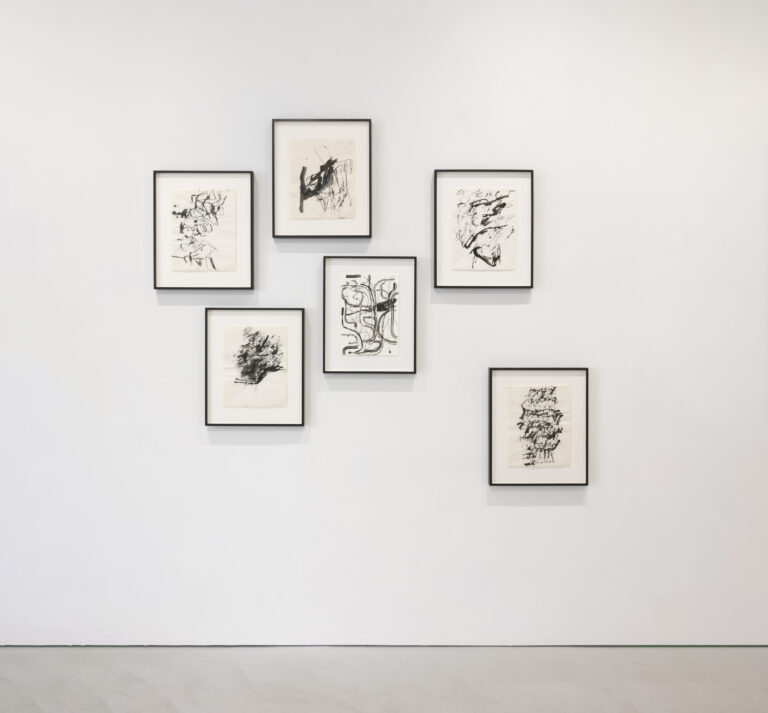
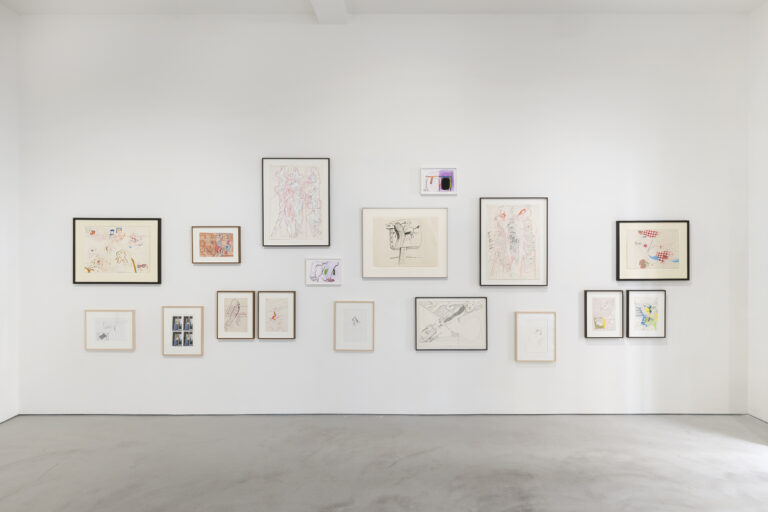
Original exhibited at carlier | gebauer, Madrid on the occasion of Apertura 2025, the exhibition is a joyful journey through the distinct stages of life and forms of expression, filled with entertaining encounters with fictional travel companions and creative accomplices, the group exhibition is devoted entirely to drawing: its rhythms, resistances, and radical possibilities.
Gordillo’s automatic drawings, humorous calligraphic diagrams, produced between the 1960s and 1990s, are displayed in playful dialogues alongside carefully selected works by each invited artist. Rather than illustrating influence in a linear way, these pairings reveal reciprocal affinities, echoing formal choices, and conceptual friction. The result is a constellation of conversations: a polyphonic arrangement that allows viewers to experience drawing as a musical structure — where repetition, variation, interruption, and syncopation shape the visual field.
Luis in friendly company,
exhibition view at carlier | gebauer, Madrid, 2025
Courtesy of the artists and carlier | gebauer, Berlin/Madrid
Photo © Roberto Ruiz
Luis in friendly company,
exhibition view at carlier | gebauer, Madrid, 2025
Courtesy of the artists and carlier | gebauer, Berlin/Madrid
Photo © Roberto Ruiz
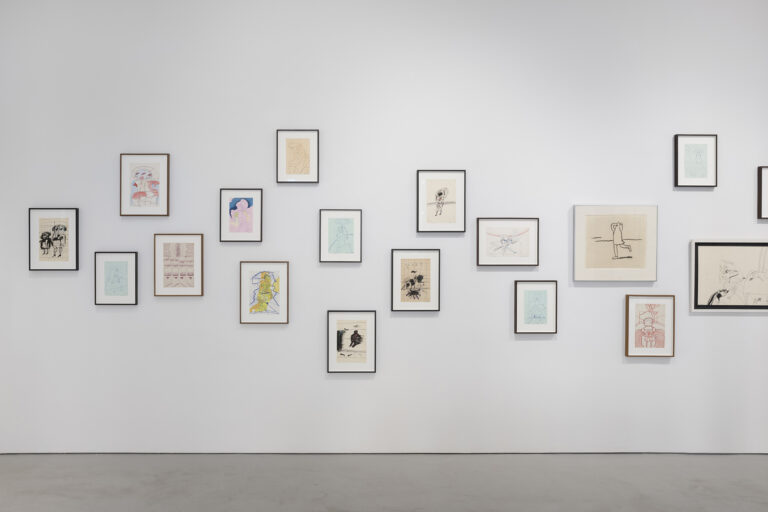
Luis in friendly company,
exhibition view at carlier | gebauer, Madrid, 2025
Courtesy of the artists and carlier | gebauer, Berlin/Madrid
Photo © Roberto Ruiz
Gordillo emerges here not only as a precursor to many contemporary approaches to drawing, but as an artist deeply embedded in a dense network of aesthetic exchange. Luis in friendly company is an invitation to look closely at how drawing functions not just as a preparatory act or a automatic, private gesture, but as a fully realized, autonomous language — one that connects generations, geographies, and sensibilities in a shared visual rhythm.
Luis Gordillo (1934, Spain) established himself as a pioneer of artistic experimentation with his unique use of figuration and color. He has a deep interest in psychoanalysis and is constantly looking for new ways of expression, utilizing photography and other image reproduction methods alongside traditional painterly techniques. Over his sixty-year career Luis Gordillo has risen to become one of Spain’s most prolific painters and one of the leading figures of abstract art in the country.
For over 50 years, artist Philip Guston (1913, Canada – 1980, USA) restlessly made paintings and drawings that captured the anxious and turbulent world he was witnessing. Born in Canada to a Jewish immigrant family, he grew up in the US and eventually became one of the most celebrated abstract painters of the 1950s and 1960s, alongside Mark Rothko and his childhood friend Jackson Pollock. His early work included murals and paintings addressing racism in America and wars abroad. During the social and political upheavals of the late 1960s, Guston grew critical of abstraction, and began producing large-scale paintings that feature comiclike figures, some in white hoods representing evil and the everyday perpetrators of racism. These paintings and those that followed established Guston as one of the most influential painters of the late 20th century. Guston was a complex artist who took inspiration from the nightmarish world around him to create new and surprising imagery.
In only nine years of art production, autodidact Uwe Lausen (1941 – 1970, Germany) created a provocative and stylistically hybrid body of paintings that translate the tensions and contradictions inherent in postwar Germany. From 1960, in reaction to the middle-class milieu where he grew up and the socio-political context of West Germany, Lausen developed a personal vocabulary. His exploration of the human figure is haunted by the cohabitation of younger and older generations, the latter held responsible for Third Reich politics. His paintings conflate many influences, from Francis Bacon to British pop artists Peter Blake and Allen Jones. Close to the SPUR group of artists based in Munich, Lausen lived in Hans-Peter Zimmer’s studio and met the revolutionary Situationist International group in Paris in 1961, taking part in their activities until his eviction in 1965. In an effort to reflect on and extract from the socio-cultural and political establishment of his time, Lausen created a singular pictorial language marked by his resolutely rebellious character and experimentation with drugs.
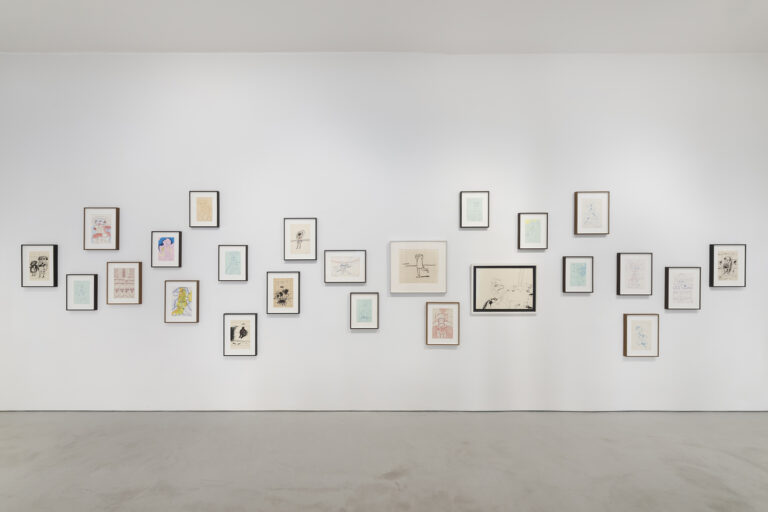
Luis in friendly company,
exhibition view at carlier | gebauer, Madrid, 2025
Courtesy of the artists and carlier | gebauer, Berlin/Madrid
Photo © Roberto Ruiz
Julie Mehretu (1970, Ethiopia) makes large-scale, gestural paintings. Her work conveys a compression of time, space, and place and a collapse of art historical references. Known for a deep political and social engagement, Mehretu’s dynamic compositions have been lauded for their capacity to convey the energy, chaos and urgency of our globalized world. Over the years her works have made reference to architecture, traffic patterns, wind and water currents, migrations, military plans, border crossings, and travel. Her signature sharp lines and geometries have softened as she probes deeper into the visual language of abstraction.
Spanish artist Néstor Sanmiguel Diest (1949, Spain)’s art practice has developed a nuanced, diosyncratic visual language shaped by a voracious interest in literature and philosophy. Sanmiguel Diest constructs his paintings and works on paper as palimpsests, alternately layering strata of found materials like magazine clippings, newspapers, industrial reports, mail, formulas, and texts atop one another in interplay with layers of ink, paint, graphite, solvents, and ballpoint pen. He wields superimposed layers of information as screens, simultaneously revealing and hiding a succession of pictorial stories or texts. Sanmiguel Diest‘s at times hermetic and highly personal conception of art has resulted in a nuanced vocabulary of methodologies and symbols. Like German artist Hanne Darboven, who employed personally derived numerical systems in the creation of her artworks, Sanmiguel Diest‘s paintings and drawings have an algorithmic quality. However, if we consider an algorithm to be a finite process with a fixed symbolic vocabulary governed by precise instructions, then Sanmiguel Diest‘s algorithms are unstable, constantly stuttering and re-aligning themselves as the repetition of one process unlocks new, unpredictable effects.
Thomas Scheibitz (1968, Germany) is among the most important German painters and sculptors of his generation. Since the early 1990s, he has developed a kind of conceptual painting and sculpture that draws upon art-historical references, and at the heart of the Berlin-based artist’s work is a search for a new relationship between figuration and abstraction. The search leads him to not only pushing the limits of his media, expanding its potential, but also to question the contemporary relevance of this traditional antagonism between the two poles
Born in Detroit, Amy Sillman (1955, USA) worked at cannery in Alaska and a feminist silkscreen factory in Chicago, and trained at NYU to be a Japanese interpreter for the United Nations, before landing at Manhattan’s School of Visual Arts, from which she graduated in 1979. She found herself deeply enmeshed in the feminist and countercultural movements of downtown New York, becoming a member of the lesbian feminist journal Heresies, while also engaging with the area’s burgeoning community of artists. She cites Abstract Expressionists such as Willem de Kooning and Philip Guston as influences, but also foils: “I wanted to learn about both Abstract Expressionism and the critique of easel painting—not because I wanted to emulate them, but because I didn’t like them.”
Jessica Rankin
The Weight of Light
14 MAR until 20 JUN 2026
carlier | gebauer, Berlin, is pleased to announce the solo exhibition The Weight of Light by New York–based painter Jessica Rankin, presenting seven new works.
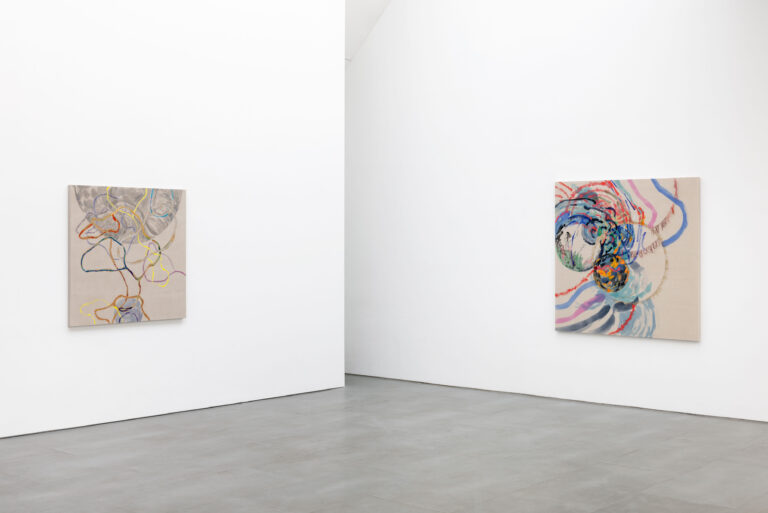
Jessica Rankin,
The Weight of Light,
exhibition view at carlier | gebauer, Berlin, 2026
Courtesy of the artist and carlier | gebauer, Berlin/Madrid
Photo © Andrea Rossetti
Known for her distinctive application of yarn and paint on canvas, Rankin renounces in her work notions of mastery over a medium in favour of an intuitive, playful approach, where paint behaves like thread and thread like paint. Veering between the disciplines, Rankin creates a visual back and forth between paint and thread, between painting and writing. Neither having trained as a painter nor embroider, and thus relinquishing mastery as a form of command over the medium, Rankin gains a freedom in her process. Reflection upon the work is part of its creation or follows afterwards, Rankin herself refers to her process “as making in a state of trepidation”.
Jessica Rankin
“Her Gathered Beams” (M) Milton, 2026
Acrylic and embroidery on linen
152,4 x 213,3 x 3,8 cm
Courtesy of the artist and carlier | gebauer, Berlin/Madrid
Photos © Andrea Rossetti
Jessica Rankin
“Her Gathered Beams” (M) Milton, 2026
Acrylic and embroidery on linen
152,4 x 213,3 x 3,8 cm
Courtesy of the artist and carlier | gebauer, Berlin/Madrid
Photos © Andrea Rossetti
The compositions spill over the edge of the canvas, onto which Rankin stitches text fragments.
These references are folded away, inviting the viewer to step closer and around the canvas, positioning them in relation to the work. These text fragments, as well as the titles of her large-scale paintings often quote poems from Rankin’s personal canon, thus unravelling a net of deeply intimate and personal references. These references in turn pose questions about art making and art history, lineage and visibility rendered through the lens of poetry, unfolded across a canvas. Rankin considers herself as an “earnest artist”, who does not approach her work with an ironic distance, but rather a certain scepticism.
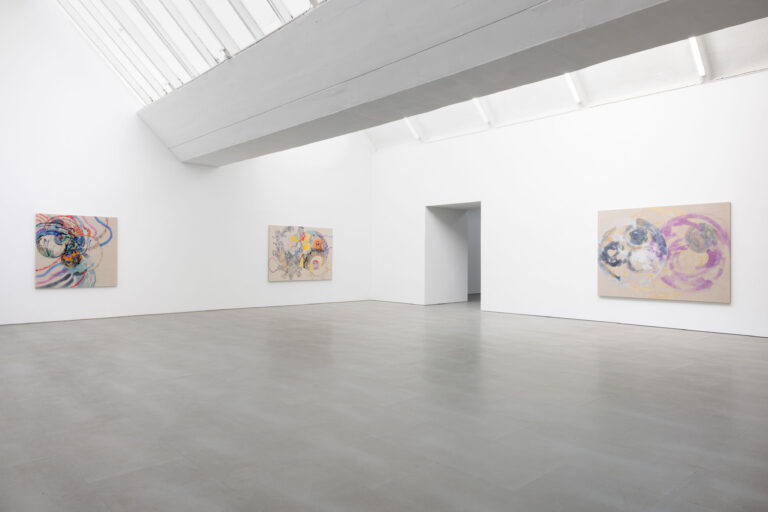
Jessica Rankin,
The Weight of Light,
exhibition view at carlier | gebauer, Berlin, 2026
Courtesy of the artist and carlier | gebauer, Berlin/Madrid
Photo © Andrea Rossetti
With the poet Ada Limón, whose poem Fifteen Ball of Feathers Rankin quotes in the paintings Watery Extension of Time (AL) and Small Susurrations (AL) the artist shares her exploration of the excitement and passion of being human, living life day by day. Like ripples of water, like powerful rays of sun, like it’s reverberations in the retina, these concentring compositions convey the wonder before the multitude of human experiences, as well as before nature and the natural environment. In her work, Limòn, touches upon topics of her heritage, which Rankin continues throughout the exhibition in a twofold way. Loop up the Sky Swooping (JR) quotes Mainland Eyes, a poem by the artists mother Jennifer Rankin, an acknowledged poet herself. About this poem, Martin Duwell writes in 2026: “The impression given is that a scene is being painted and some humans are located within it, doing the usual uninteresting things that humans do. The poet’s real interest is in the sky and its inhabitants, the birds, and in this sense Mainland Eyes is an introduction to one of Rankin’s continuing interests. There are birds in an extraordinary number of her poems, birds which, unlike bees and other insects, show no great interest in the earth”. In Her Gathered Beams (M) Rankin extracted this fragment from John Milton’s Paradise Lost, with which Milton aimed to achieve writing the first biblical epic in English, focusing on the so-called elevated subjects of love and heroism. Instead of telling a tale of a heroic subject, Rankin introduces a radiant heroine to this story, who instead of conquering gathers. One can think here along the lines of Ursula K. Le Guin’s Carrier Bag Theory of Fiction. Finally, with Whistle Anciently (AN), taken from the poem For the Ride Rankin reflects alongside Alice Notley on the solitary conditions of art making, filling the linen canvas with ribbon likes shapes, flowing alongside each other, while rarely intertwining or overlapping.
Anna Bella Geiger
Typus Terra Incognita
14 MAR until 20 JUN 2026
carlier | gebauer, Berlin, is pleased to announce Typus Terra Incognita, Anna Bella Geiger’s first solo exhibition in Germany. This show spans more than 50 years of Geiger’s artistic production, bringing together seminal historical works as well as recent ones.
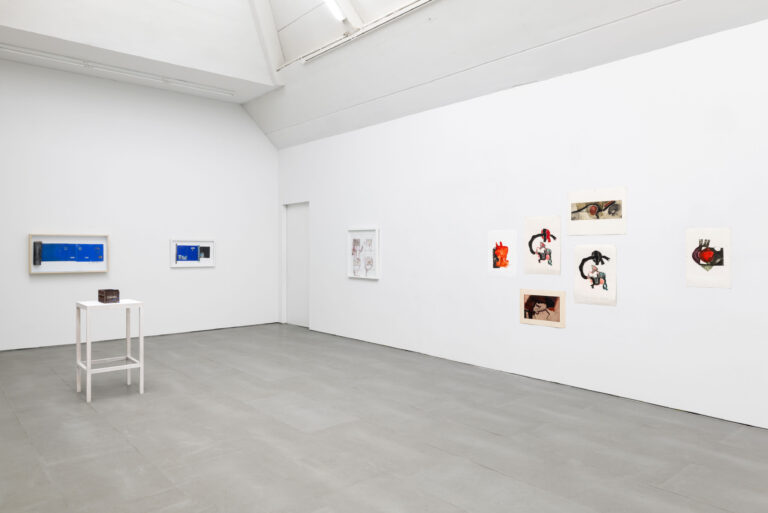
Anna Bella Geiger,
Typus Terra Incognita,
exhibition view at carlier | gebauer, Berlin, 2026
Courtesy of the artist and carlier | gebauer, Berlin/Madrid
Photo © Andrea Rossetti
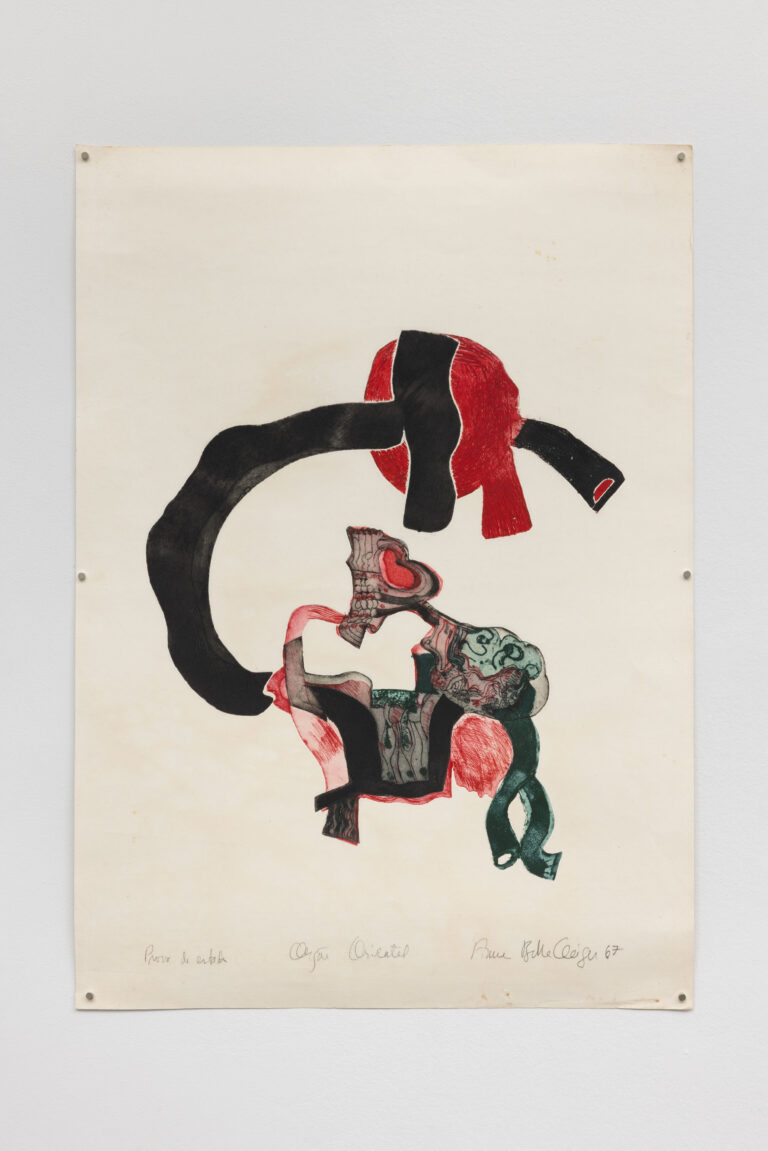
Born in 1933 in Rio de Janeiro, Geiger remains since the beginning of her career and until the present day as one of Brazil’s pioneering artists. She studied drawing and painting with Fayga Ostrower, whose teachings and works—expressions of her “respect for art as the eternal language of humanity”— were influential for a generation of Brazilian artists. Turning early on to abstraction in her work, in 1954 Geiger was already invited to participate in the First National Exhibition of Abstract Art. Geiger does not confine herself to the medium of painting, she continues to push her practice to draw from technical innovations as well as systems alien to art. Her oeuvre spans video, painting, drawing, engraving, textile, embroidery, collage, photography and installation. However, as Estrella de Diego, the Spanish art critics and curator, notes, Geiger does not abandon any of her media, she rather alternates from one to another. Even to the first drawing and etching, Geiger returns during what she calls her visceral phase. The medium she employs is merely a tool to explore the political dimensions of the world, as well as her interest in anthropology and geography. The map emerges as a sort of leitmotif in the practice, sometimes making appearances as neat miniatures, sometimes as deconstructed and distorted fragments. With this alteration Geiger’s precisely opens up the space, by transforming representations of space, to question cartography as a transparent, verified knowledge. To map is to name, thus expressing a mode of knowledge production full of hegemonic implications. Historically the domain of the man, the explorer cum colonizer, map making and the map itself seek to inscribe themselves upon a heterogenous reality, establishing one perspective dominant over others. Mapping implies also omission and erasure. Geiger counters these with her intuitive, poetic approach, a form of “geopoetics”. Her maps become expressive containers, relinquishing the quest for objectivity and omnipotence, in favor of a subversive, situated and even personal knowledge. Rather than representations these maps can be described as translations, which challenge the notions of control and command representation carries with it.
Anna Bella Geiger
Untitled, 1998 / 1999
from the series Rolinhos
Lead, drawing, and engraving on parchment paper
3 x 32,2 x 6 cm
Photo © Roberto Ruiz
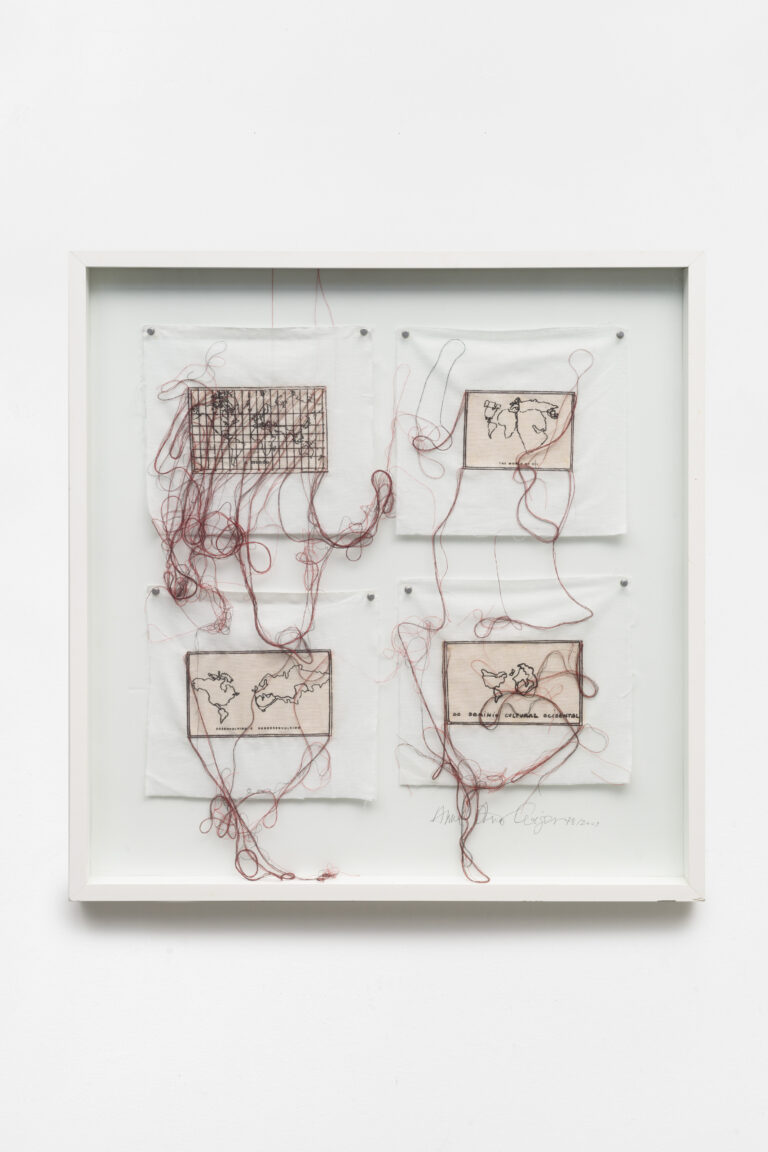
Anna Bella Geiger
Variáveis, 1978-2009
Serigraphy and machine embroidery on linen
83,5 x 81 x 5 cm
Photo © Roman März
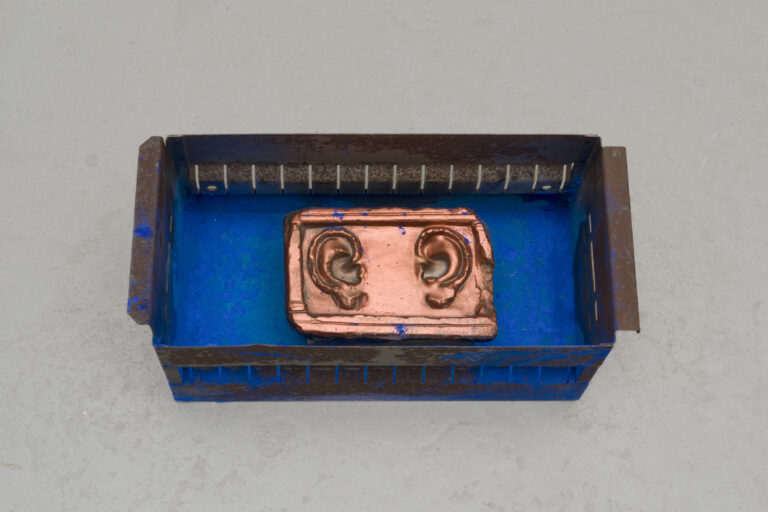
Anna Bella Geiger
OHREN ATHENA NºII, 1997
from the series Borderline
Iron file drawer, mold taken from the original at the Temple of Athena on the Acropolis in copper pigment and cobalt blue pigment provided by Yves Klein
13,5 x 32,5 x 15 cm
Photo © Roman März
In the series Scrolls (Rollos), and Little Scrolls (Rollinhos), created in the 1990s, Geiger continues what can be essentially described as an epistemological approach and analysis. These sculptures, which simultaneously function as graphic objects, resemble the oldest forms of knowledge preservation and transfer, the scroll. In The Book of Ester we encounter another form of knowledge organization, indexation and classification, as the scroll is made up by pages from an antique encyclopedia. Ambitiously aimed at a total reconstruction of knowledge on particular subjects as sciences, arts, and occasionally all human knowledge, encyclopedias can be viewed as maps of knowledge. Geiger deconstructs these by making the pages unreadable, only leaving visible certain elements, such as the syllables “ester”. The knowledge contained in the encyclopedia becomes therefore fractured, and almost as with automatic writing, another meaning emerges as from the subconscious of the text. Further, these scrolls are not presented fully unrolled, rather they show that they also hide. The transparency of knowledge is once more revealed as ephemeral in itself. Instead of rejecting this, Geiger fully embraces these uncertainties as a method in her ever changing, innovative life’s work. The exhibition is supported by The Brazilian Embassy and the Guimarães Rosa Institute in Berlin.
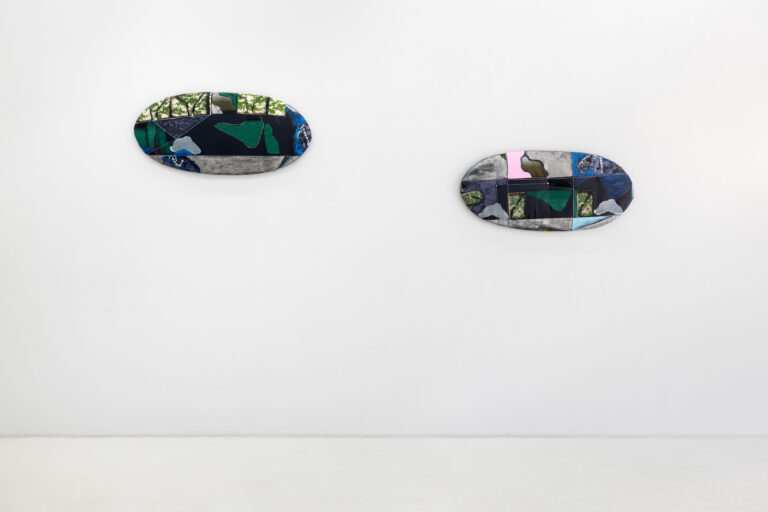
Anna Bella Geiger,
Typus Terra Incognita,
exhibition view at carlier | gebauer, Berlin, 2026
Courtesy of the artist and carlier | gebauer, Berlin/Madrid
Photo © Andrea Rossetti