

Gallery Portrait
Galerie Max Hetzler
Beate Scheder, 2021
Remember Everything. This was the title given by Max Hetzler to the group exhibition celebrating his gallery’s 40th anniversary in late 2013. It was a retrospective of museum proportions, bearing witness to four decades of intensive collaboration with artists and featuring contributions by all those currently represented by the gallery. While it has made a lasting impression, the appeal to remember everything should definitely be further pursued. The Galerie Max Hetzler has made history and continues to do so.
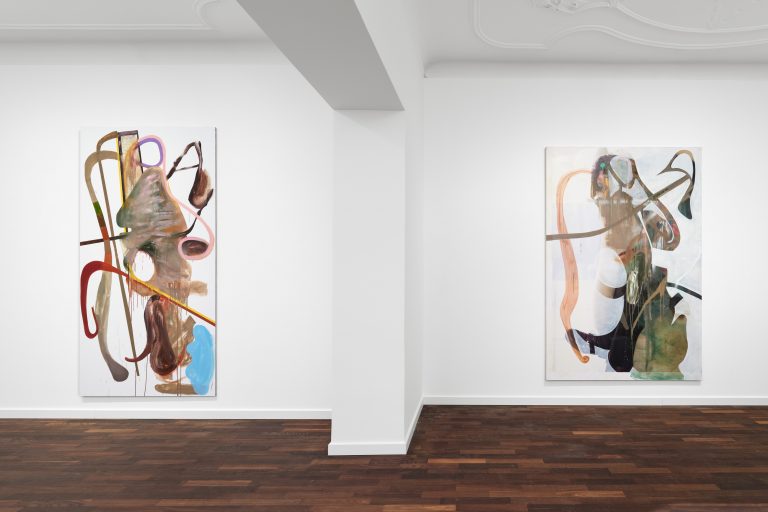
Albert Oehlen, unverständliche braune Bilder, Galerie Max Hetzler, Berlin, April – August 2021. Courtesy of the artist and Galerie Max Hetzler, Berlin | Paris | London © Albert Oehlen. Photo: def image
Only recently, the gallery has opened its new premises on Potsdamer Straße. They are spectacular in terms of their dimensions alone. Originally built as a printing facility for the Tagesspiegel, this location later housed Blain|Southern’s Berlin branch for ten years. The hall is 17 meters high, with gates at the front and back, through which even large sculptures can be easily transported. Up until now, there was no space at Max Hetzler in Berlin for the kind of bronze sculptures that Christopher Wool has been creating for some time. Hetzler is currently present in three locations across the city, including two galleries in Charlottenburg, on Bleibtreustraße—one in an elegant apartment in a historic building, the other in a retail space with large windows in the former home of art dealer Alfred Flechtheim—and one on Goethestraße, in a converted post office branch.
Hetzler opened his first gallery in Stuttgart in 1974. He was 25 at the time. He had just finished an apprenticeship at Kunsthaus Schaller and an internship with Hans Mayer in Düsseldorf, as well as worked briefly at Galerie Rothe in Heidelberg. You could only do something like that if you were very naïve—as the gallery owner puts it today. “You need naivety, enthusiasm, and impudence to open a gallery. And, of course, respect for artists and love for art.”
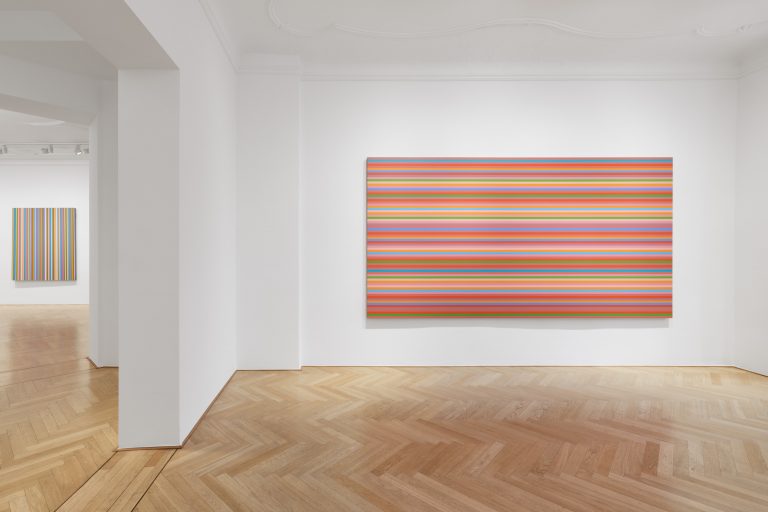
Installation view: Bridget Riley, Galerie Max Hetzler, Berlin, September – October 2020. Courtesy the artist and Galerie Max Hetzler, Berlin | Paris | London © Bridget Riley 2021. All rights reserved. Photo: def image
In 1982, the gallery relocated to Cologne. “Because that’s where you had to be, because that’s where the artists had to be”—artists with whom he had already started working in Stuttgart in the late 1970s. Albert and Markus Oehlen, Werner Büttner, Martin Kippenberger, Reinhard Mucha, and Günther Förg, for example. Extremely successful years for the Rhineland gallery followed. Then, in the late 1980s, the art market collapsed. “Things were at a dead end. It was terrible.” Hetzler wanted a fresh start in a different place. Berlin seemed like an obvious choice. “We hoped that Berlin would become the center for a lot of things—but then it still took 20 years.” As far as art is concerned, Hetzler certainly played his part, not least as the co-founder and driving force behind Berlin’s Gallery Weekend.
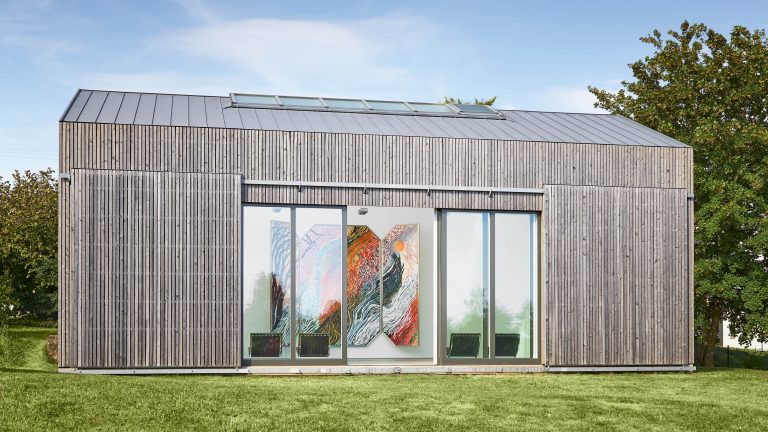
Installation view: Jeremy Demester, Stiftung zur Förderung zeitgenössischer Kunst in Weidingen, Weidingen, 2018. Courtesy the artist and Stiftung zur Förderung zeitgenössischer Kunst in Weidingen, Weidingen © Jeremy Demester. Photo: def image
But before anything else, he had to find gallery spaces again. He recalls that there were plenty of spaces in the east at the time, but the infrastructure was deplorable. Instead, he found what he was looking for in an industrial loft in Charlottenburg. From there, he moved around the city over the next few years: first to Zimmerstraße, and later, after a stopover on Holzmarktstraße, to the imposing former Osram-Höfe in Wedding. It was actually too big for some of his artists—Glenn Brown really didn’t want to exhibit there, so the gallery owner freed up his apartment on Bleibtreustraße for the artist. Furthermore, the rooms posed a number of technical challenges, as Hetzler recalls. There was a freight elevator that kept getting stuck, difficult lighting conditions, water dripping from the ceiling. Artists were happy to work with these obstacles—Albert Oehlen, for example, or Bridget Riley. Mona Hatoum filled the Osram-Höfe with sinisterly enlarged household appliances, Rineke Dijkstra with photographic and video portraits of adolescents, André Butzer with black-and-white N-paintings. Despite such outstanding exhibitions, moving back to Charlottenburg came to the owner as a great relief.
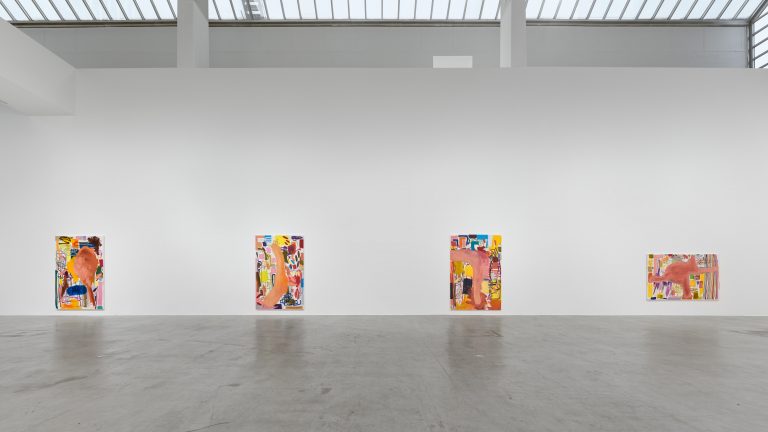
Installation view, André Butzer, Rohe Milch, Galerie Max Hetzler, Berlin, November 2021 – January 2022. Courtesy of the artist and Galerie Max Hetzler, Berlin | Paris | London © André Butzer. Photo: def image
The gallery currently has branches in Paris (since 2014) and London (since 2018). The Paris gallery is run by Hetzler’s wife Samia Saouma, the London one by his son Max Edouard Hetzler. But Berlin is and will remain central, in part because it continues to give Hetzler a space to try things out—unlike London and Paris, where a lot has already been occupied and historically defined, he says. “Berlin remains full of surprises when it comes to exhibitions.”
Since 2012, there is also the Foundation for the Promotion of Contemporary Art in Weidingen, in the Eifel region. It holds an exhibition once a year, offering a residency opportunity. It has also been home to the Günter Förg Library since 2013. Starting in 2022, another gallery location with a similar concept will open in Marfa, Texas.
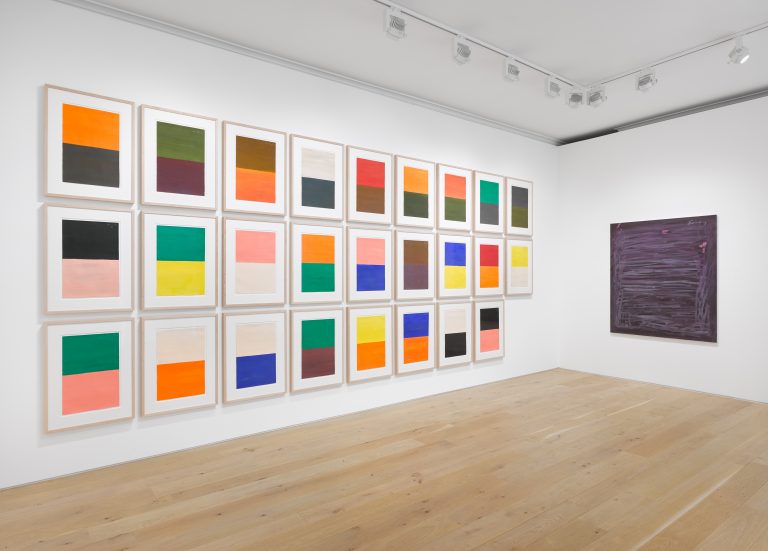
Installation view: Günther Förg, Constellation of Colour, Galerie Max Hetzler, London, November 2020 – Januar 2021. Courtesy the estate and Galerie Max Hetzler, Berlin | Paris | London © Estate Günther Förg, Suisse / VG Bild-Kunst, Bonn 2021. Photo: Jack Hems
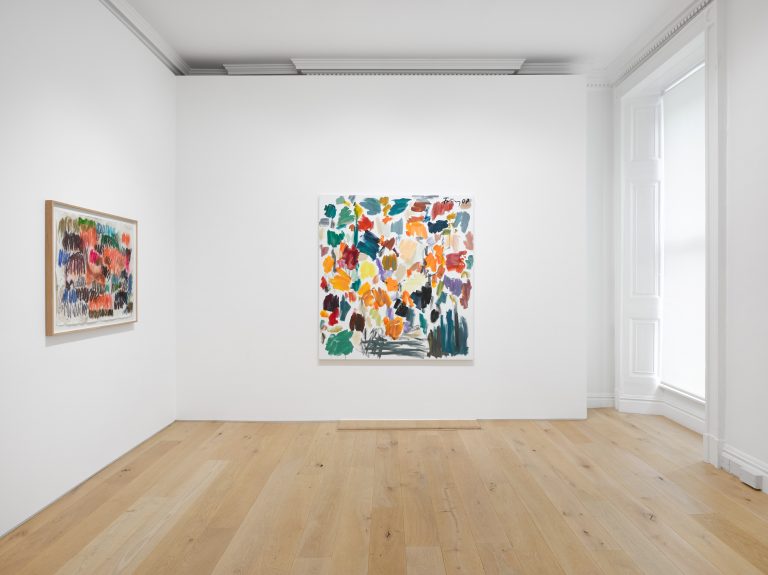
Installation view: Günther Förg, Constellation of Colour, Galerie Max Hetzler, London, November 2020 – Januar 2021. Courtesy the estate and Galerie Max Hetzler, Berlin | Paris | London © Estate Günther Förg, Suisse / VG Bild-Kunst, Bonn 2021. Photo: Jack Hems
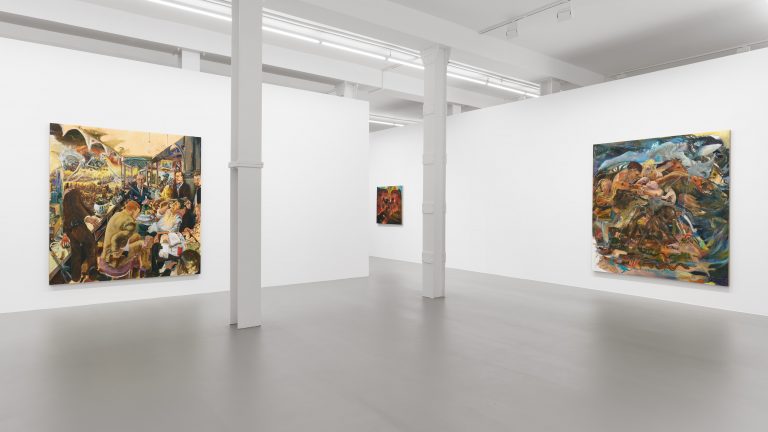
Installation view: Celeste Dupuy-Spencer, But the Clouds Never Hang So Low Before, Galerie Max Hetzler, Berlin, November 2020 – Januar 2021. Courtesy the artist and Galerie Max Hetzler, Berlin | Paris | London © Celeste Dupuy-Spencer. Photo: def image
Max Hetzler is sitting at his desk on the upper floor of the Bleibtreustraße gallery when he tells us about it. It is almost rare to get the chance to meet him there. The conversation takes place at the end of October. He has just returned from the fairs in Basel, London, and Paris, and there will be two openings in Berlin in the following week, including the new Potsdamer Straße space. To kick things off, André Butzer will be showing large-format paintings. A solo exhibition by Ida Ekblad, featuring painting and sculpture, is planned to follow next. The choice of both artists can also be seen as a commitment to the location, “a tribute to Berlin,” as he puts it; both Butzer and Ekblad started their careers in Berlin.
Indeed, artists have always been Hetzler’s top priority. “We try to give everything within our means so that we can make good exhibitions.” And it shows—then as now, here as there.
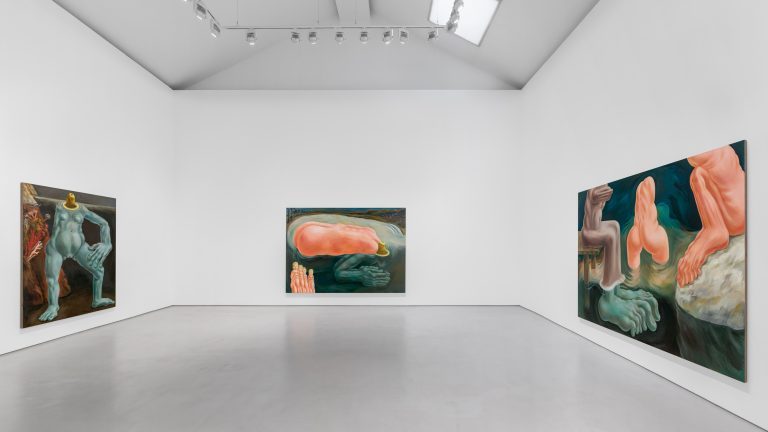
Installation view: Louise Bonnet, Bathers, Galerie Max Hetzler, Paris, September – October 2021. Courtesy the artist and Galerie Max Hetzler, Berlin | Paris | London © Louise Bonnet. Photo: Nicolas Brasseur