

Bunny Rogers
My Original Friend
13 MAR until 18 APR 2026
Bunny Rogers’ conceptual practice draws upon deeply personal references to reflect on experiences of alienation and intimacy. Her intricate narrative worlds often center on “overlooked objects,” endowing modest everyday items with the presence of people and moments that have shaped her life. For Rogers, imagination is not secondary to “reality”, but a parallel structure through which experience is processed and reconfigured. Drawing on the pop-cultural landscape of the late 1990s and early 2000s, her multifaceted practice considers how notions of identity and belonging were reshaped at the moment when the virtual and the real began to overlap and intermingle in unprecedented ways.
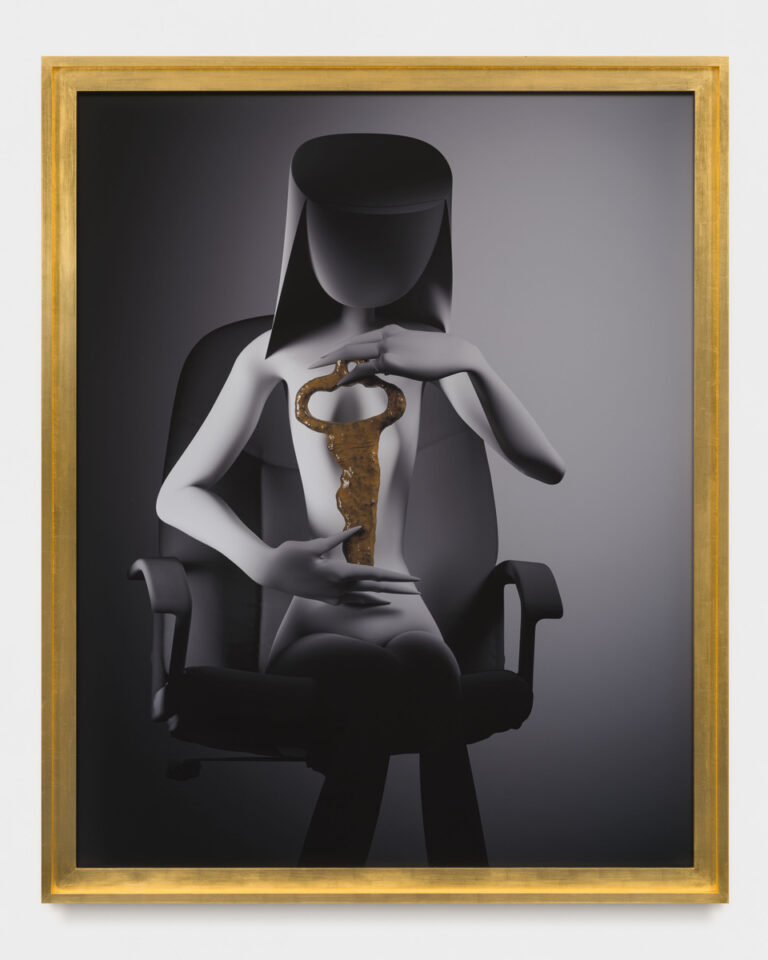
Bunny Rogers,
Joan P Key, 2025
Fine Art Print on Hahnemühle PhotoRag Ultrasmooth 305g, gold-leafed artist frame
200.5 × 163 × 7.5 cm // 79 × 64 × 3 in
Courtesy of the artist and Société, Berlin
Ph: Trevor Good
In her fourth solo exhibition with Société, entitled My Original Friend, Rogers transforms the gallery into an immersive installation that spatializes the familiar iconography of video game quests. In this dark, strangely flattened environment of grey brick, pseudo-classical columns, and torch lighting, we encounter a series of self-portraits in the guise of Joan of Arc, an animated character from the short-lived MTV series Clone High. Joan functions as a mask or placeholder for the artist, allowing Rogers to remove herself from the image and displace autobiography into a mediated form. In each image, she holds a different key derived from drawings of actual keys belonging to people close to the artist.
Rendered as quest objects, these keys become charged relics. They carry the intimacy of their owners while operating within the symbolic logic of the game world. Rather than serving as simple emblems, they suggest access, withholding, and the fragile architectures of trust that structure attachment. Suspended between personal artifact and digital artefact, the keys bridge Rogers’ inner life and the visual language of virtual space. Through subtle shifts in gesture, the figures stage the relationship between key and lock as a psychological threshold—charged with violence and tenderness, reverence and protection.
Bunny Rogers (b. 1990, USA) is a visual artist, poet, and performer based in New York. Rogers has been exhibited internationally in solo exhibitions at venues including Hamburger Bahnhof, Berlin; Kunsthaus Bregenz, Bregenz; MMK Museum für Moderne Kunst, Frankfurt; Marciano Art Foundation, Los Angeles; Whitney Museum of Art, New York; De 11 Lijnen, Oudenburg; and Musée d’Art Moderne, Paris. She has participated in group exhibitions at Pinakothek der Moderne, Munich; Hangar Y, Paris; Den Frie Centre of Contemporary Art, Copenhagen; Palais de Tokyo, Paris; Julia Stoschek Foundation, Berlin; Hamburger Bahnhof, Berlin; New Museum, New York; Fondation Louis Vuitton, Paris; OCAT Shanghai, Shanghai; Louisiana Museum of Modern Art, Humlebaek; LUMA Westbau, Zurich; The Rubell Family Collection, Miami; Marian Goodman Gallery, Paris; Hessel Museum of Art, Annandale-on-Hudson, New York; and Sandretto Re Rebaudengo Foundation, Turin; The Jewish Museum, New York; Queens Museum, New York. She is the author of My Apologies Accepted and Cunny Poem Vol. 1 & 2. Bunny Rogers is part of a number of public collections including Boros Collection, Berlin; Fondation Louis Vuitton, Paris; Hamburger Bahnhof, Berlin; Julia Stoscheck Foundation, Düsseldorf; Louisiana Museum, Humlebæk; MMK Frankfurt; Whitney Museum, New York; among others.
Antonio Calderara
13 MAR until 18 APR 2026
SOCIÉTÉ and Larkin Erdman are pleased to announce a joint exhibition dedicated to the work of Antonio Calderara.
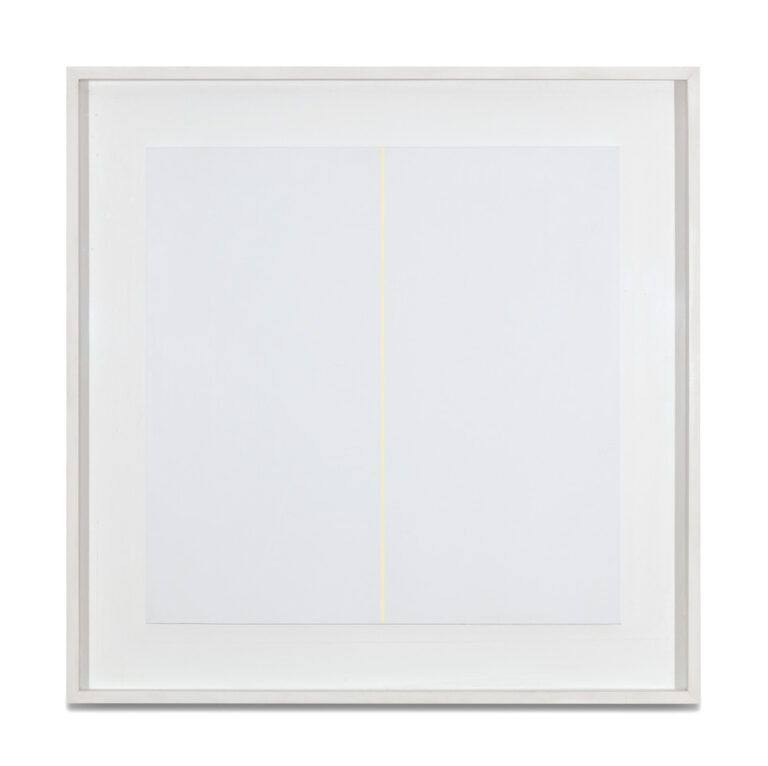
Antonio Calderara,
Tensione Verticale Gialla, 1973
Oil on panel
54 × 54 cm // 21 1/2 × 21 1/2 in
Courtesy of Larkin Erdman, Zurich
Ph: Flavio Karrer
Antonio Calderara is regarded as one of the quiet yet significant figures of European postwar abstraction. He was born in 1903 in Abbiategrasso near Milan and spent most of his life in Vacciago on Lake Orta. The landscape of this place, with its calm waters, shifting light, and the clear horizon line of the lake, profoundly shaped his artistic perception and remained a central point of reference throughout his work for decades.
Calderara was largely self-taught. His early works from the 1930s and 1940s still relate to the visible world and depict motifs from his immediate surroundings, including houses, churches, and quiet village scenes. Even in these paintings, a clear and reduced pictorial conception becomes evident, in which composition, proportion, and the relationship between light and space play a central role. The serene atmosphere of these early works already hints at the sensitivity for balance and harmony that would later become a defining characteristic of his abstract painting.
In the 1950s Calderara underwent a decisive artistic development. The forms in his paintings became increasingly simplified, while the color palette grew more subtle and restrained. Figurative motifs gradually dissolved, giving way to a more abstract pictorial order. This transformation did not occur abruptly but evolved gradually through his intensive engagement with space, light, and proportion. By the early 1960s Calderara arrived at the distinctive visual language for which he is best known today. Delicate color fields, fine lines, and precise geometric structures define his rigorously composed yet poetic works. Color appears not as an expressive gesture but as a finely calibrated nuance that lends the pictorial space a quiet, almost immaterial presence. The compositions are reduced yet imbued with great sensitivity.
Horizontal and vertical lines structure many of his works and subtly recall the landscape of Lake Orta, whose tranquil expanses and atmospheric light continue to resonate in abstracted form. Calderara’s painting unfolds its effect not through drama, but through balance, precision, and concentration. Within this reduced visual vocabulary, he developed a pictorial world of remarkable calm and clarity.
Until his death in 1978, Calderara continued to work in his studio in Vacciago, pursuing this concentrated form of painting. His work engages in dialogue with international developments in concrete and constructive art while maintaining a deeply personal dimension that reflects his experience of light, space, and silence.