

Winter 2026
With works by Saâdane Afif, Rosa Barba, Angela Bulloch, Julius von Bismarck, Martin Boyce, Etienne Chambaud, Thomas Demand, Ryan Gander, Dominique Gonzalez-Foerster, Pierre Huyghe, Ann Veronica Janssens, Lee Bae, Sojourner Truth Parsons, Philippe Parreno, Anri Sala and Anicka Yi
20 JAN until 21 FEB 2026
Esther Schipper Berlin is pleased to present Winter 2026, bringing together works by Saâdane Afif, Rosa Barba, Angela Bulloch, Julius von Bismarck, Martin Boyce, Etienne Chambaud, Thomas Demand, Ryan Gander, Dominique Gonzalez-Foerster, Pierre Huyghe, Ann Veronica Janssens, Lee Bae, Sojourner Truth Parsons, Philippe Parreno, Anri Sala and Anicka Yi.
WINTER 2026,
WITH WORKS BY SAÂDANE AFIF, ROSA BARBA, JULIUS VON BISMARCK, MARTIN BOYCE, ANGELA BULLOCH, ETIENNE CHAMBAUD, THOMAS DEMAND, RYAN GANDER, DOMINIQUE GONZALEZ-FOERSTER, PIERRE HUYGHE, ANN VERONICA JANSSENS, LEE BAE, PHILIPPE PARRENO, SOJOURNER TRUTH PARSONS, ANRI SALA AND ANICKA YI, ESTHER SCHIPPER, BERLIN, 2025
Over four decades ago, Gil Scott-Heron observed that – “politically, and philosophically, and psychologically” – there was only one prevailing season, “the season of ice”; words that, without doubt, mirror the current atmosphere. While the winter solstice promises the gradual return of light, days remain swayed in darkness for weeks on end. Though tiresome, this long night opens a space for introspection, even spurs the fire in one’s belly. Winter, for Scott-Heron, signified a state of frozen aspiration and inspiration. Yet this bitter condition provoked a moody, by now iconic, song that he liked to perform seasoned with a grain of salt. In this vein, and uncovering the creative underbelly of such chilled times, the works on view navigate the uncanny and the cosmic across decades, centuries, even millennials. They draw on a fossilized, charred, or blurred past and envision smart, weird, or weirdly rosy nurseries of the future; their aesthetics converge at a dense point of thick materiality and precise formal execution. Light fractures the exhibition space, transforming it into a chiaroscuro landscape suffused by shadow and spotlight.
WINTER 2026,
WITH WORKS BY SAÂDANE AFIF, ROSA BARBA, JULIUS VON BISMARCK, MARTIN BOYCE, ANGELA BULLOCH, ETIENNE CHAMBAUD, THOMAS DEMAND, RYAN GANDER, DOMINIQUE GONZALEZ-FOERSTER, PIERRE HUYGHE, ANN VERONICA JANSSENS, LEE BAE, PHILIPPE PARRENO, SOJOURNER TRUTH PARSONS, ANRI SALA AND ANICKA YI, ESTHER SCHIPPER, BERLIN, 2025
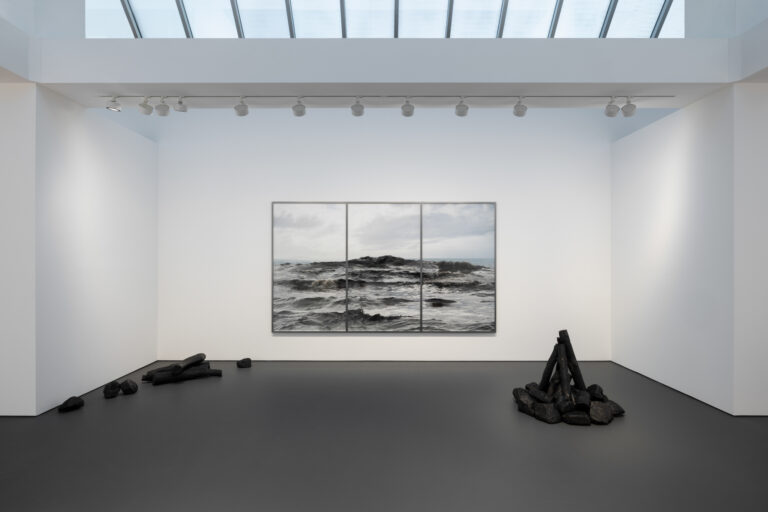
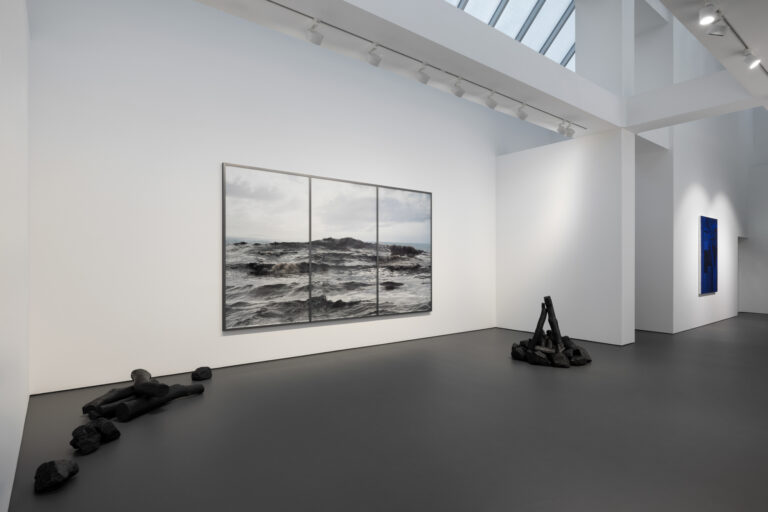
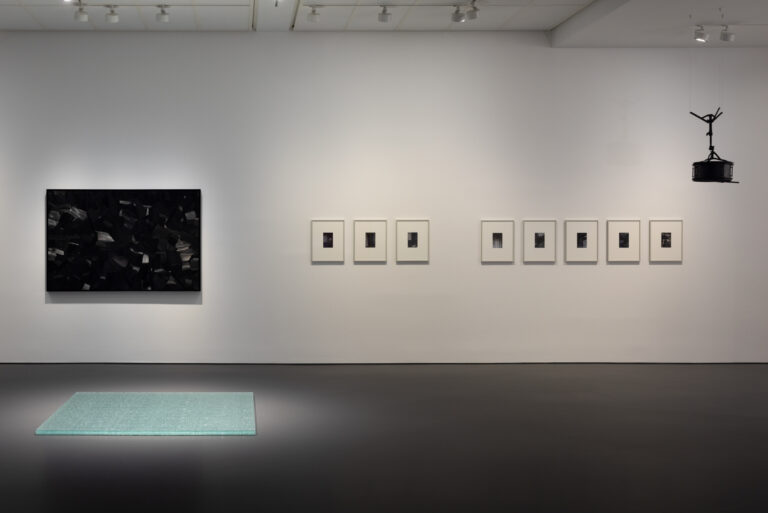
The exhibition opens on a vexed double-entendre signaled by the figure of a pyre, at once a relic of wreckage and a promise of renewal. Ryan Gander’s In the very beginning, before words, there were… (2021) consists of black cold-cast bronze forms reminiscent of rocks and logs; these scorched elements conjure both ruination and the birthplace of a phoenix. The sculpture is backed by Julius von Bismarck’s The Day the Ocean Turned Black (2025) that captures the Pacific Ocean darkened to near black after airborne ash settled into and stained the water in the wake of the January 2025 Southern Californian wildfires. Taking the second eruption of Mount Vesuvius 79 AD as a sonic point of departure, Anri Sala’s Body Double in the Doldrums (2025) reaches further into the past, dusting off the ashes of ancient times. Suspended from the ceiling in the main exhibition hall, the work consists of a snare drum with built-in speakers that fill the gallery with eerie rumbles. Hovering between lament and warning, the soundscape is unsettling, consoling, and timelessly melancholic. Extending across an entire wall of the gallery, Spook School (2016) by Martin Boyce documents the interior of the Glasgow School of Art (one of Charles Rennie Mackintosh’s most celebrated architectural landmarks) after a fire and before a second blaze would devastate the restored building. In retrospect, the work reads as quietly haunted, anticipating the scale of the subsequent destruction.
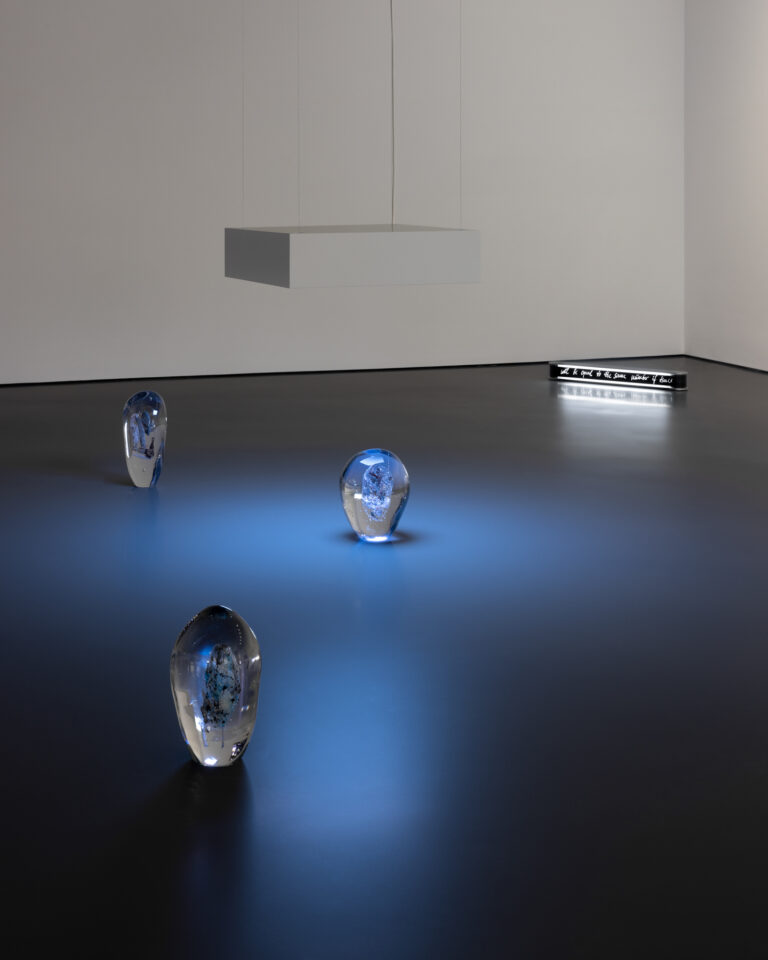
Sidestepping any narrative arc, Lee Bae’s Issu Du Feu 1g (2000-2025) stylizes raw materiality: hundreds of small, grafted and polished chards of charcoal are aligned across the panel. The surface shows wood grain and growth rings made by nature and time, refracting light in various directions and in multiple angles. The hypnotizing shimmer of light, collected and cut, too, is crux of the matter in Ann Veronica Janssens’ Atlantic (2020-23). The sculpture consists of nine hammered glass panels reflecting light at different angles and thus creating an effect akin to the effect of daylight on a large body of water. Étienne Chambaud’s Globe (2021) series encases everyday objects in molten glass, at once preserving and destroying them. His sculpture Model for Afar (Regensburg, 5 November 333 BCE) (2021) responds to historical meteorological data through shifting illumination – and circles back into the ancient timeline sounded by Sala’s sculpture.
WINTER 2026,
WITH WORKS BY SAÂDANE AFIF, ROSA BARBA, JULIUS VON BISMARCK, MARTIN BOYCE, ANGELA BULLOCH, ETIENNE CHAMBAUD, THOMAS DEMAND, RYAN GANDER, DOMINIQUE GONZALEZ-FOERSTER, PIERRE HUYGHE, ANN VERONICA JANSSENS, LEE BAE, PHILIPPE PARRENO, SOJOURNER TRUTH PARSONS, ANRI SALA AND ANICKA YI, ESTHER SCHIPPER, BERLIN, 2025
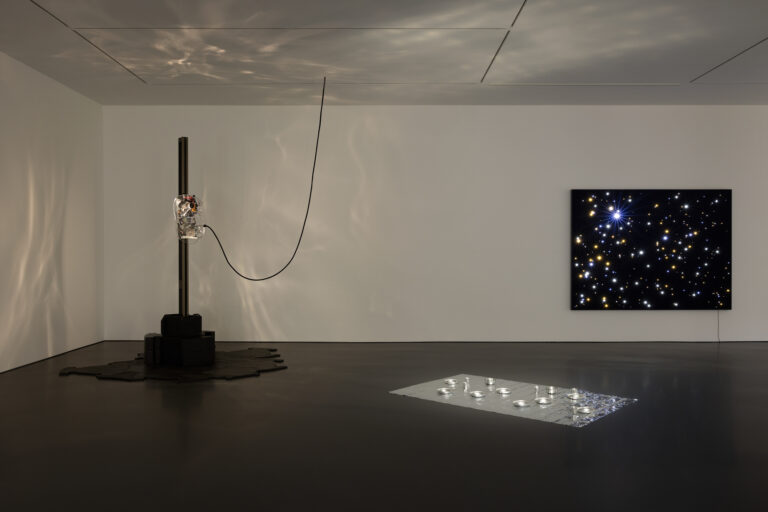
Like a recurring thought or ill omen jettisoned by the ceaseless stream of consciousness, Rosa Barba’s Footnote (…my distance from the object…) (2021) remains trapped in mimetic repetition: a backlit handwritten text fragment exposed on 70mm film is ensnared into an endless loop. Angela Bulloch’s Night Sky: Capricorn Into Aquarius (2025), contrastingly, bespeaks the tranquil anticipation of an epochal shift. Using a program that maps the positions of the stars in a 3D virtual model of the universe, Bulloch pictured an existing area of the sky in a displaced perspective, rendering the resulting image a representation foreclosed from Earth. Dominique GonzalezFoerster’s Untitled (1987/2015) remains tethered to the gravitational pull below stellar constellations. Characteristic of her continuous play with temporal displacements, the work figures the survival-turned-picnic-blanket as a space for leisure, appealing to the urgent need for recreation.
Gonzalez-Foerster’s work is animated by the kaleidoscopic reflections of Philippe Parreno’s The Crawler (2024). Parreno’s work takes inspiration from one of the first robots designed to study the brain’s electrical activity. Moving up and down its track at varying speed, its bulbs flash randomly; Parreno’s luminous crawler generates endless new configurations. Placed in proximity, Pierre Huyghe’s Mind’s Eye (F) (2021) is a sculptural work composed of an aggregate of synthetic and biological material, including microorganisms. In its sheer materiality, the sculpture – suggestive of living organisms of symbolic familiarity (animal, oyster, organ, alien) – is alive; Huyghe defamiliarizes the familiar. The work originates in Huyghe’s UUmwelt project, borne by a braincomputer interface that filtered “mental images” from a sequence of morphing images in real time. Anicka Yi’s LKñL§RHR†ßñ§ (2023) is a painting produced in collaboration with an algorithm fashioned and fed by the artist. Yi lured this algorithm into an exploration of the visual study of the aquatic, fungal, and microbial forms idiosyncratic to her oeuvre.
WINTER 2026,
WITH WORKS BY SAÂDANE AFIF, ROSA BARBA, JULIUS VON BISMARCK, MARTIN BOYCE, ANGELA BULLOCH, ETIENNE CHAMBAUD, THOMAS DEMAND, RYAN GANDER, DOMINIQUE GONZALEZ-FOERSTER, PIERRE HUYGHE, ANN VERONICA JANSSENS, LEE BAE, PHILIPPE PARRENO, SOJOURNER TRUTH PARSONS, ANRI SALA AND ANICKA YI, ESTHER SCHIPPER, BERLIN, 2025
Such untamable variety is juxtaposed by Thomas Demand’s Nursery (2020), depicting small plants neatly arranged on long tables; overhanging lights die the scene in a somewhat theatrical pink. The photograph stages the hydroponic laboratory at Niagara College in Ontario, at the time leading the commercial cannabis production worldwide. While the controlled cultivation of cannabis speaks of an economy in which time equals money, consuming such crops escapes any temporal order: now, time is warped, lost, wasted. Portraying the timeliness of fashion in the face of unceasing consumption, Saâdane Afif’s Old Shop-Vac Wet / Dry (2025) is a tongue-in-cheek homage to Jeff Koons. As Afif painstakingly skimmed American suburbs for outdated hoovers, he displaced the readymade performance of conceptual art’s selfreferential (vacuum-sealed yet dusty) orbit, piercing the carousel harnessed to the arts of mechanical reproduction. Sojourner Truth Parson’s Alone with tree II (2025), on the other hand, appears to suspend time altogether. Interspersed by a virtually Kleinian blue, the painting depicts a tree stretching its leafless branches towards a starless sky. The scene’s initial tristesse gives way to moving stillness, a transportive force hovering inbetween introspection, desire, fantasy, or, straightforwardly speaking, the untimely longing for change.
WINTER 2026,
WITH WORKS BY SAÂDANE AFIF, ROSA BARBA, JULIUS VON BISMARCK, MARTIN BOYCE, ANGELA BULLOCH, ETIENNE CHAMBAUD, THOMAS DEMAND, RYAN GANDER, DOMINIQUE GONZALEZ-FOERSTER, PIERRE HUYGHE, ANN VERONICA JANSSENS, LEE BAE, PHILIPPE PARRENO, SOJOURNER TRUTH PARSONS, ANRI SALA AND ANICKA YI, ESTHER SCHIPPER, BERLIN, 2025
Saâdane Afif was born in 1970 in Vendôme, France. Afif received a Master of Fine Arts at the École des BeauxArts in Bourges in 1995. The artist lives and works in Berlin.
Rosa Barba was born in Agrigento, Italy. She studied at the Academy of Media Arts Cologne and has completed her PhD at the Malmö Faculty of Fine and Performing Arts, Lund University in 2018. She currently lives and works in Berlin.
Angela Bulloch was born 1966 in Rainy River, Ontario, in Canada. She studied at Goldsmiths, University of London. The artist lives and works in Berlin.
Julius von Bismarck was born 1983 in Breisach am Rhein, Germany, and grew up in Riyadh, Saudi Arabia. The artist studied at the Berlin University of the Arts (2005-2013) and Hunter College, New York (2007). He currently lives and works in Berlin and in Switzerland.
Martin Boyce was born 1967 in Hamilton, Scotland. He studied at Glasgow School of Art and at California Institute for the Arts. He lives and works in Glasgow.
Etienne Chambaud was born 1980 in Mulhouse, France. He studied at Ecole cantonale d’art de Lausanne (ECAL), Villa Arson, Nice, and Ecole nationale des Beaux-Arts (ENBA), Lyon. The artist lives and works in Paris.
Thomas Demand was born in 1964 in Munich, Germany. He studied at the art academies in Munich and Düsseldorf. He received an MFA from Goldsmiths, University of London. The artist lives and works in Berlin and Los Angeles.
Ryan Gander was born in 1976 in Chester, England. He received his First Class Degree, BA (Hons) in Interactive Art at Manchester Metropolitan University and was a Post-Graduate Fine Art Participant at Jan van Eyck Academie Maastricht and Rijksakademie van Beeldende Kunsten in Amsterdam. The artist lives and works between Suffolk and London.
Dominique Gonzalez-Foerster was born in 1965 in Strasbourg, France. She studied at École des Beaux-Arts, Grenoble, L’École du Magasin, Centre National d’Art Contemporain de Grenoble and Institut des Hautes Études en Arts Plastiques, Paris. The artist lives and works in Paris and Rio de Janeiro.
Pierre Huyghe was born in 1962 in Paris, France. He studied at the École nationale supérieure des arts décoratifs, Paris. The artist lives and works in Santiago de Chile.
Ann Veronica Janssens was born in 1956 in Folkestone, England. She studied at L’École de la Cambre in Brussels. The artist lives and works in Brussels.
Lee Bae was born in 1956 in Cheongdo, Korea. He received his BFA and MFA in Fine Arts at Hongik University in 1981 and 1986. The artist lives and works between Paris and Seoul.
Sojourner Truth Parsons was born in 1984 in Vancouver, Canada. She is an artist of Afro-Indigenous and settler heritage. She holds a Bachelor of Fine Arts from Nova Scotia College of Art and Design, Halifax, Nova Scotia. The artist l lives and works between the southern Catskill mountains and Brooklyn, NY.
Philippe Parreno was born 1964 in Grenoble, France. He studied at École des Beaux-Arts in Grenoble, and Institut des hautes études en arts plastiques at Palais de Tokyo, Paris. He lives and works in Paris, France.
Anri Sala was born in 1974 in Tirana, Albania. He received his BA in Painting and Sculpture from the National Academy of Arts Tirana, studied Video at the École Nationale des Arts Décoratifs in Paris and completed post-graduate studies in Film Directing at Le Fresnoy–Studio National des Arts Contemporains in Tourcoing. The artist lives and works in Naples and in Berlin.
Anicka Yi was born in 1971 in Seoul, South Korea. She studied at the University of California, Los Angeles, and Hunter College, New York. She lives and works in New York City