

Grant Falardeau
Ma
14 MAR – 18 APR 2026
Opening – 13 MAR 2026, 6 – 8 pm
Grant Falardeau
Ma
14.03.2026 – 18.04.2026
Courtesy of the Artist and Galerie Neu, Berlin
Photog: Stefan Korte
“I’m certain that there’s probably all sorts of stuff pushing me in all kinds of directions subconsciously. That is part of the fun. I feel like my process is just to let everything completely go and let the characters start from scratch every time. Because also I feel like that’s like life. You’ve got to become. Every day is a new beginning and you can become any character you want to.”*
The one-word title of Grant Falardeau’s debut solo exhibition in Germany – Ma – is at once potent and nonprescriptive. The Japanese concept of ‘Ma’ (間) refers to meaningful pauses, gaps, or in-between spaces, whilst in the Hindu tradition, the word is a reverential title for Kali – a goddess who can bring fertility but also wreak havoc. As Falardeau lives and works in Los Angeles, the title may equally function as an acknowledgment of his own mother, or of mothers more generally. Certainly, some kind of direct encounter with creation is evoked.
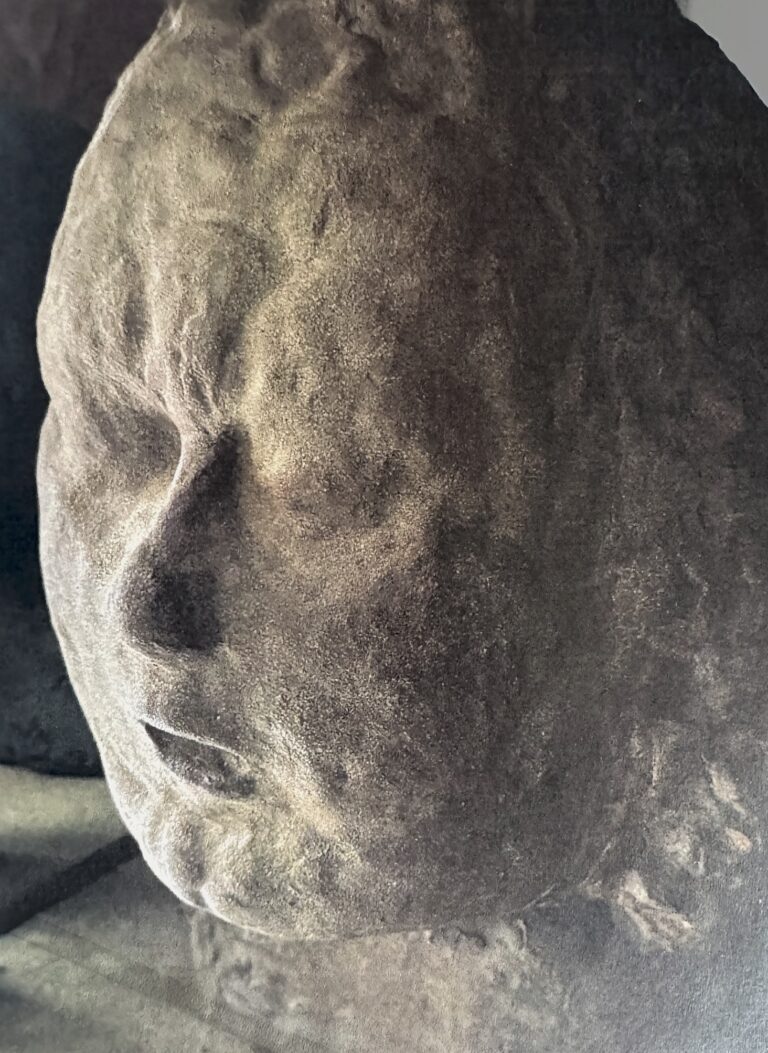
Distributed throughout the gallery, a suite of fired clay busts displayed on metal stands and wooden plinths seek company, inviting us to mingle among them – become one of the bunch. In this communion of earthy-toned oddfellows, each work has its own eye-catching bent and eccentric surface. The figures appear as if in a liminal state. Characters and emotions, imagined conversations and phantom memories fill the room – all of them invented.
We are left to make of this work what we will. And if biographical traces are involved, they are wholly subsumed in material and gesture.
The works’ absent bodies are ones viewers bring along. Or perhaps they combine as the notional ‘body social’ that an art gallery represents. But there is another implied missing body as well: the artist’s own, working away in a potter’s shed.
These personalised effigies, wandering totems, have in common marks left by the artist’s hands, in particular on the back of their heads and necks. Here Falardeau typically deploys some expressive roughness, for example, where the jowls and hair are abstractly indicated. On some works, amongst these gestural passages, tiny emergent figures and other mysteriously meaningful marks are rendered, then baked in.
“One would need many minds to portray all these different moods and soul characters, but here they combine in one. Depending on the incidence of light, they merge into one another from every side, constantly changing, deep, mild, sometimes alienating, disturbing; they oscillate back and forth, but always remain calm and self-contained. Almost commanding respect.”*
The other quality of the works is their diversity – an engrossing material celebration of subjective nuances. The history of sculpture is intuitively at play. Meanwhile, the artist engages our curiosity with an origin mystery. Who are these figures? Where do they come from? Falardeau’s work invites productive layers of ambiguity, and given his embrace of old-school craft and slippery stylistic anachronisms, manages to appear at once both pre- and postmodern. At this moment in time, valuing the handmade, the personal address, embodied human experience, seems urgent. This work speaks to the tantalising quality of being.
The accessibility of figurative art, however, is at once a boon and a bane. Art history is full of a struggle with the ‘human figure’ utilised across the politcal spectrum as an ideological ‘beast of burden’. It seems pertinent, then, to note that Falardeau’s ‘heads’ have not been guillotined or toppled from monuments, nor do they represent questionable ideals; instead, they have been nurtured out of the ground with his bare hands – formed without foreknowledge of what they would become or where they might ultimately end up.
Dominic Eichler
*The quotes are taken from a recent conversation with the artist, and the gallery’s studio visit notes.