

Paul Seidler
Nightmarket
21 FEB until 18 APR 2026
At Nagel Draxler Kabinett
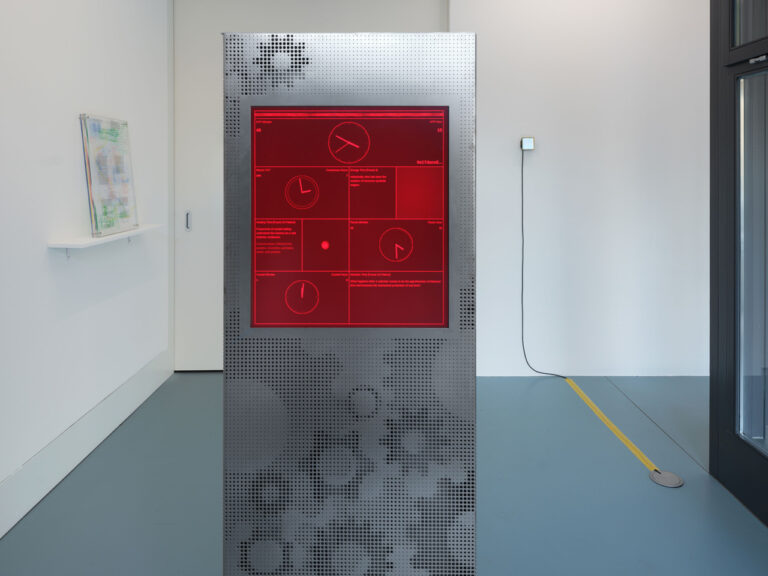
“Nightmarket”, Paul Seidler.
Exhibition view,
Nagel Draxler Kabinett, 2026.
Photo by Simon Vogel.
Courtesy the artist and Galerie Nagel Draxler.
Historically Nightmarkets can be traced to the medieval Tang Dynasty China (618–907 AD), first appearing as an alternative to the older market system called the fāngshì zhì (坊市制), or ward-and-market system. State-sanctioned markets and commerce was only permitted by day, while at night access to the streets was heavily regulated, with guards stationed at junctions enforcing compliance. Nightmarkets were, in a sense, one of the first cracks in that system, emerging as forms of trade and commerce that escaped the formal, state-designated market. The earliest Nightmarkets were primarily informal venues for nighttime grain trading to accommodate farmers and laborers after daytime agricultural work. While daytime imperial markets were reserved for official transactions, Nightmarkets catered to commoners seeking readily available affordable goods – a parallel economy for people the formal system didn’t serve.
The art market, and more specifically the digital art market – as the various places where artists, gallery owners, and buyers come together – can be described as an “informal market” (Isabelle Graw, 2008). Informal markets often exhibit characteristics that correspond to the precarious economic conditions of art production. However, with the emergence of non-fungible tokens (NFTs), it became apparent that the overriding logic of traditional art markets was not wholly compatible with digital works. As a result, the primary and secondary markets for contemporary digital art differ fundamentally in structure from established art markets. In its infancy, the price and volume of primary sales of NFTs were too low to be of interest to commercial enterprises. During this period, artists typically created their own bespoke interfaces, tooling and websites where buyers could purchase and mint their NFTs. These early forms established a small but significant alternative to the gallery system for digital works, forging parallel distribution mechanisms and channels while enabling new spaces for critical discourse.
While primary sales of digital artworks integrating with NFTs remained economically marginal, especially in the formative stages, the majority of profits accumulated through resale on secondary markets. This ‘primitive accumulation’ culminated in what was essentially a market monopoly by OpenSea (the largest NFT marketplace), which persisted for several years. OpenSea placed considerable stress on artists, as their work was subjected to a 24-hour buy-and-sell logic – every piece accompanied by a real-time price feed and publicly visible analytics. Unlike traditional art markets, where prices remain opaque, negotiated privately, or revealed only at auction, OpenSea’s interface transformed every artwork into a constantly fluctuating financial ticker – a permanent stock exchange where aesthetic value became indistinguishable from speculative volatility.
Nightmarkets appear wherever the internal contradictions of valorization lead to a divergence between the form of value and the substance of value. It is not itself a revolutionary social form, any more than the market is, but rather manifests itself as a temporary transitional phenomenon toward another mode of production. It arises as a consequence of a crisis logic in which commodities and exchange value are decomposed by the productive forces inscribed in them.
— Paul Seidler & Christopher Dake-Outhet
Paul Seidler is an artist, researcher and programmer based in Berlin, whose work traverses networks — from creating decentralized protocols to deploying legal interventions. Since 2015, he has been working with blockchain-based technologies to investigate questions of value, ownership and encryption, thereby creating a body of onchain work using self-written smart contracts, zero-knowledge circuits and token-based protocols. Seidler is recognized as one of the founding members of terra0, a collective comprising developers, theorists, and artists committed to developing hybrid ecosystems within the technosphere. His work has been featured in prominent exhibitions and discussions, including the 7th Athens Biennale, Schinkel Pavilion, Transmediale, the 58th Carnegie International, and KW Institute for Contemporary Art.