

Peter Dreher
31 952
14 MAR until 18 APR 2026
I accepted the invitation to write a short text for Meyer Riegger’s show of works by Peter Dreher without thinking and now it appears I have to think.
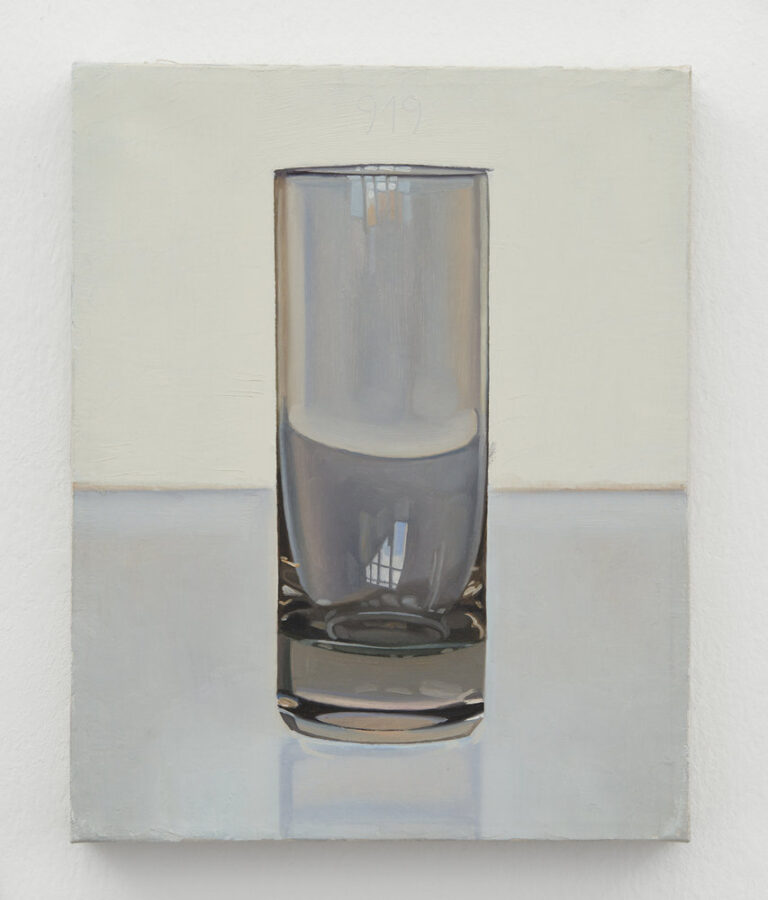
I am a fan of Dreher’s empty glass paintings that appear to follow similar a system created by On Kawara within his series of ‘Date Paintings’ (1966–2013). The paintings simply depict the date in which they were painted and must be completed within the day specified.
Kawara’s paintings are conceptually beautiful… as the world moved the work pretty much stayed the same. I think Dreher’s glasses do a similar thing but they are all very different. The empty glass reflects the situation or context in which it was painted (inside, outside, daylight, artificial light, etc). It holds nothing but possibilities. As Dreher has painted so many empty glasses, I can only assume they got better as he went along. Practice makes perfect. I wonder if there is a preference for early or late paintings. I think they must be painted from photographs or at least that’s the only way I could attempt them. Apparently they are all painted from life…
He also painted other objects… door keys seem to have been an ongoing project too. I’m not sure if these followed a similar conceptual logic. But carrying one’s subject around must be handy.
I like the idea of a constant. Knowing what you are going to paint… the rules have been set, so the work appears to make itself.
It brings to mind a quote from Andy Warhol:
‘I like boring things. I like things to be the same over and over again.’
I wanted to also the mention Michael Craig Martin’s An Oak Tree (1973) and Ceal Floyer’s Half Full and Half Empty (1999) works… but what sets them aside is water.
Louis Lawler’s No Drones (2013) are also empty…
The empty glass somehow symbolises the beginning of something and the end of something. Peter Dreher’s ‘Tag um Tag guter Tag’ series is not an actual glass (see Magritte) but a pretty good, almost photorealist, representation of a glass. Outside forces push themselves into the picture and are reflected back to the viewer. The curvature of the glass doesn’t offer the opportunity to see the artist in the process of painting. He’s there but not there.
The gallery wanted me to mention other works within this exhibition.
As the name suggests, I think I’ve walked in a circle.
Jonathan Monk
Friday, 13 February 2026