

Heimo Zobernig
new works (Hamlet total abstract)
1 MAY until 27 JUN 2026
Opening – 1 MAY 2026, 6-10 pm
At Galerie Nagel Draxler
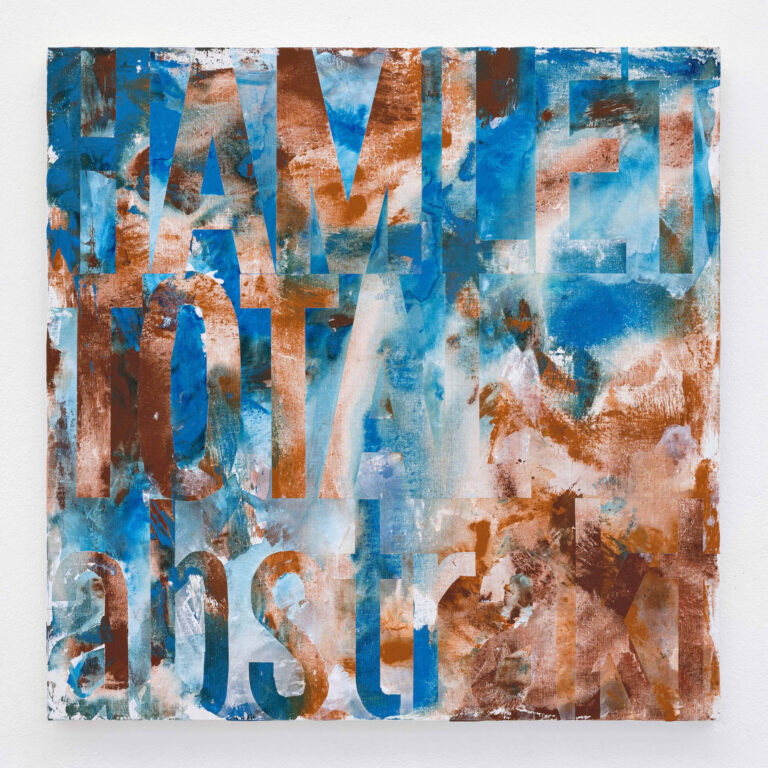
Heimo Zobernig,
untitled (2025)
Acrylic, canvas
100 x 100 cm
Image courtesy the artist and Galerie Nagel Draxler Berlin/Cologne/Meseberg
One has to flee modernity for fear that it won’t save itself.
Frank Perrin, Symposium Villa Arson, Nice, 1991
When New York curator Matthew Higgs asked Heimo Zobernig to name the book that was most important to him, he chose the Reclam edition of Shakespeare’s Hamlet. The fratricide in this tragedy is enacted as a “play within the play.” We learn from Hamlet that the dead are not dead. They return as specters. Zobernig started his artistic practice at the end of the 1970s, at a time when skepticism about what art can do (or be) was already rather old. Since Hegel it has been clear that art is made, but no longer true; since Adorno that nothing else about it can be taken for granted. At no time since modernity has art been apace with its own theory.
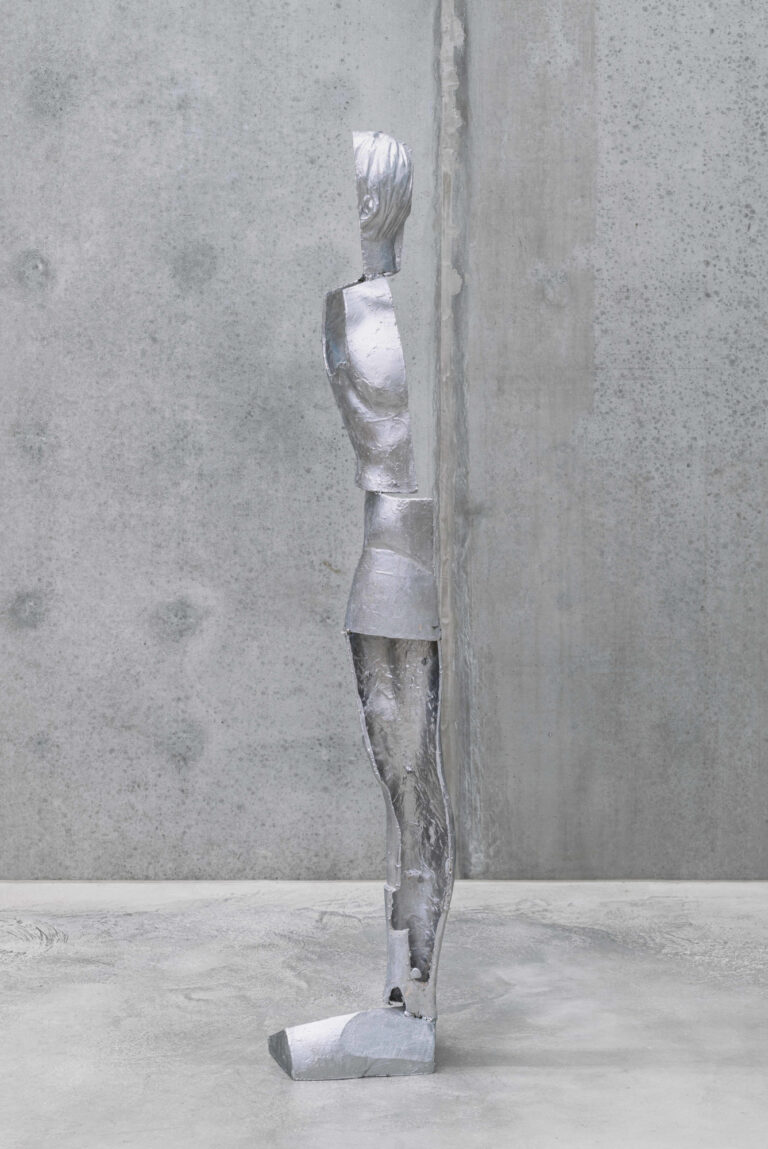
Heimo Zobernig,
untitled (2025)
Aluminum
190 x 32 x 37 cm
Image courtesy the artist and Galerie Nagel Draxler Berlin/Cologne/Meseberg
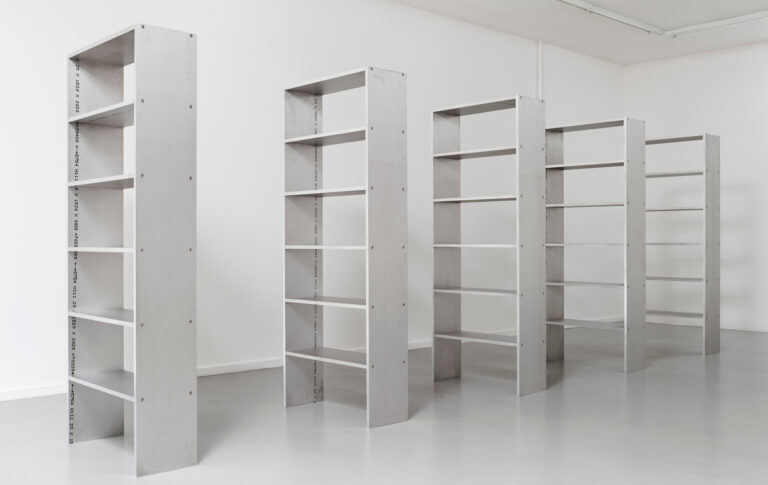
Heimo Zobernig,
untitled (2024)
5 shelves, aluminum
each 80 x 200 x 30 cm
Image courtesy the artist, Galerie Nagel Draxler and Centre d’édition contemporaine, Geneva.
Photo by Sandra Pointet.
The new Hamlet paintings, which Zobernig displays here together with IKEA Billy bookcase sculptures made of solid cast aluminum, contain the words ‘Hamlet total abstrakt’ or ‘Hamlet totally abstract’. Added to this is a fragmented human figure, also made of cast aluminum. The canvases fall into the category of Zobernig’s letter paintings, which generally do not refer to specific content: they rather carry tautologies or single terms such as ‘painting’, ‘video’, ‘REAL EGAL’, or ‘LOVE’, whereas “Hamlet totally abstract,” seems to be charged with meaning.
Zobernig, who studied stage design and designed a set for Heiner Müller’s play Quartett in 1982 before working exclusively as an artist, brings Hamlet’s ghost onto the stage of his art and, at this time and in this place, also the ghost of Heiner Müller.
Huang Rui
《89》 Ink-stained books
1 MAY until 27 JUN 2026
Opening – 1 MAY 2026, 6-10 pm
At Nagel Draxler Kabinett
In his exhibition《89》Ink-stained books, Chinese artist Huang Rui reflects on historical memories of the year 1989 in Beijing and Berlin.
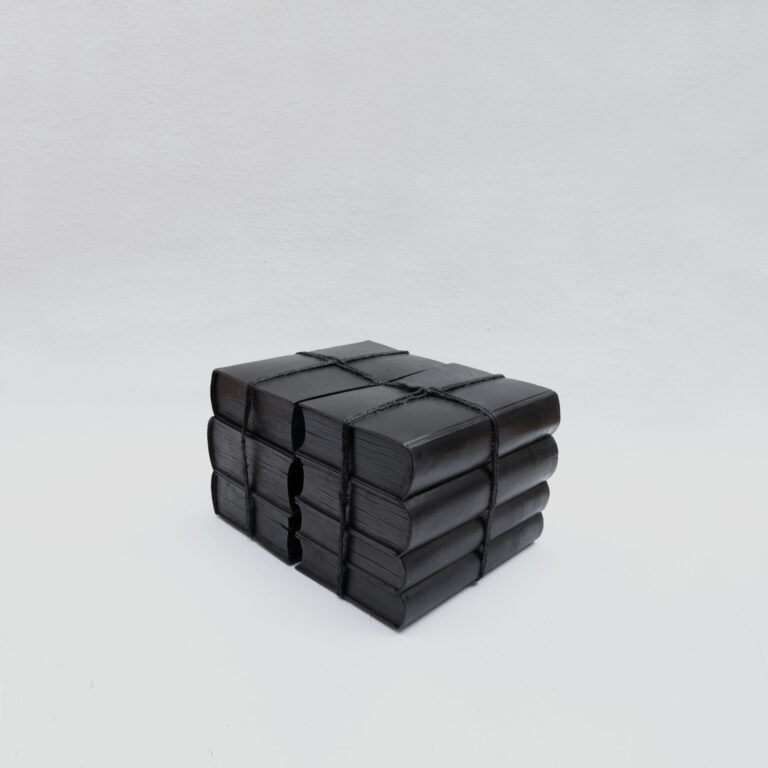
Huang Rui,
Works of Karl Marx, 6 volumes (2025)
Books and ink, stone and rope
42 x 30 x 38.5 cm
Image courtesy the artist and Galerie Nagel Draxler Berlin/Cologne/Meseberg
“Ink-stained books bestow forbidden value upon what was once forbidden. In 1992, I first saw the crumbling Berlin Wall. I knew its story—before 1989 and in 1989. Now it is nearly invisible. The “1989 Wall” in Beijing, China, is tall, heavy, and long.
Not only is it invisible, but almost no one is aware of its existence. Any written text, printed material, or online/offline content
about that history remains taboo in China. Seeing yet not seeing, knowing yet not knowing – concepts rooted in Daoist philosophy, symbols and their connotations—directly guide me in this work. Encasing ordinary books and printed material in ink is an act of violence, far from normal. Yet my practice remains intensely personal and introspective. I use the number 8 to allude to China, and 9 to allude to Germany. The problem is there is no fair or reasonable way to view 1989—the confrontation and dialogue between Eastern and Western histories. Thus, I chose the distinction between two modes of viewing: on the street, people see numbers; within the space, they see everything—an artwork that refuses further communication. An alien text encased in solidified black blood.“
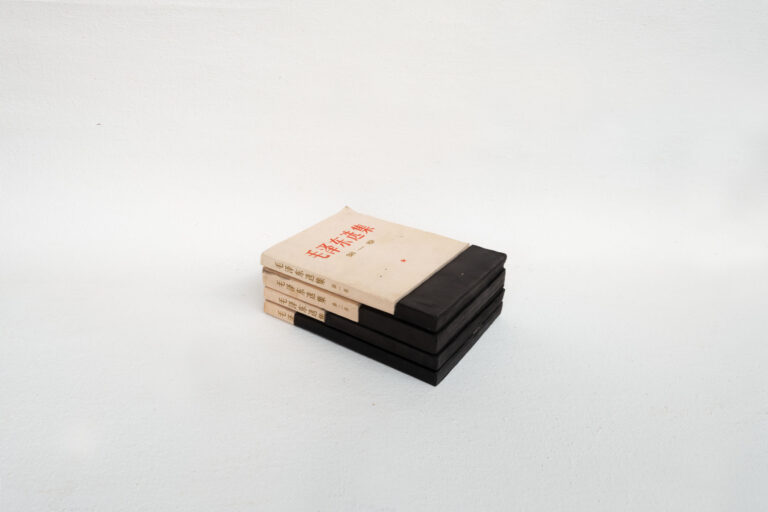
Huang Rui,
Yin & Yang – Selected Works of Mao Zedong, 4 volumes (1990)
Books and ink
6 x 13.7 x 20.2 cm
Image courtesy the artist and Galerie Nagel Draxler Berlin/Cologne/Meseberg
Huang Rui was born in 1952 in Beijing. He lives and works between Paris (France) and Beijing
(China). Founder of the Stars Group (Xing Xing 星星), he played a pivotal role in what was the first public art exhibition of the post-Mao era in China in 1979, considered the pioneering movement of contemporary art. It gave rise to some of the first expressions of artistic freedom and brought together like-minded artists. Since more than 40 years, Huang Rui has strived to express that the function of art is a reflection of society, and one of its missions is to respond to contemporary concerns. It was with this conviction that he initiated the creation of the 798 Art District in Beijing in 2002, which has since become the hub of contemporary art in China. His work – whether painting, sculpture, installation and performance – is deeply rooted in a living, contemporary approach to the principle of Tao (Book of Changes), through an often minimalist aesthetic search, renowned for challenging the political and aesthetic conventions of his era.
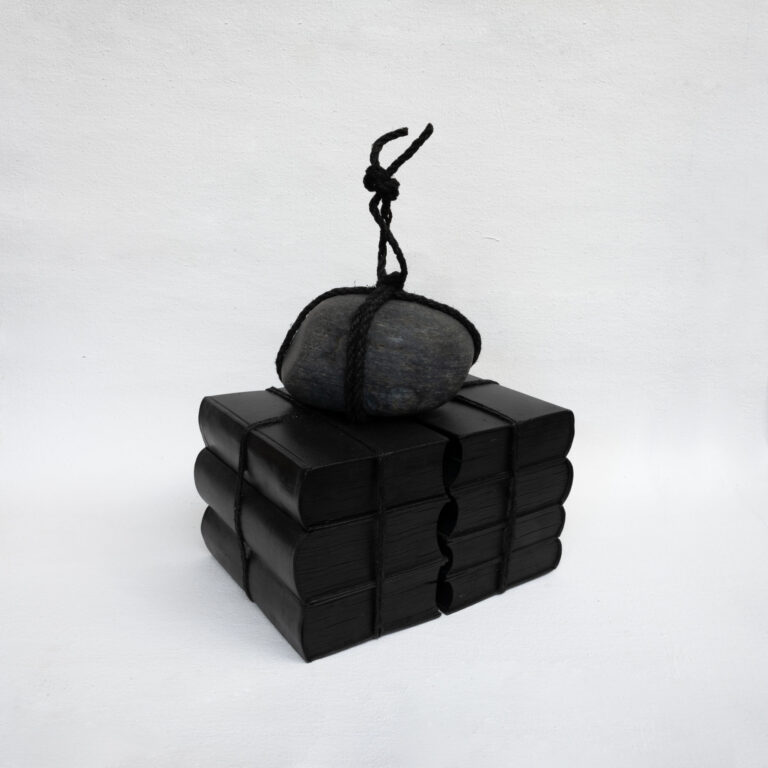
Huang Rui,
Works of Karl Marx, 6 volumes (2025)
Books and ink, stone and rope
42 x 30 x 38.5 cm
Image courtesy the artist and Galerie Nagel Draxler Berlin/Cologne/Meseberg