

Petrit Halilaj
Who does the earth belong to while painting the wind?!
1 MAY until 25 JUL 2026
Opening – 1 MAY 2026, 6-9 pm
ChertLüdde is pleased to present Who does the earth belong to while painting the wind?!, an exhibition by Petrit Halilaj, resulting from decades of collaboration between the artist and the gallery and unfolding in parallel with Halilaj’s largest institutional presentation in Germany, An Opera out of Time, at Hamburger Bahnhof.
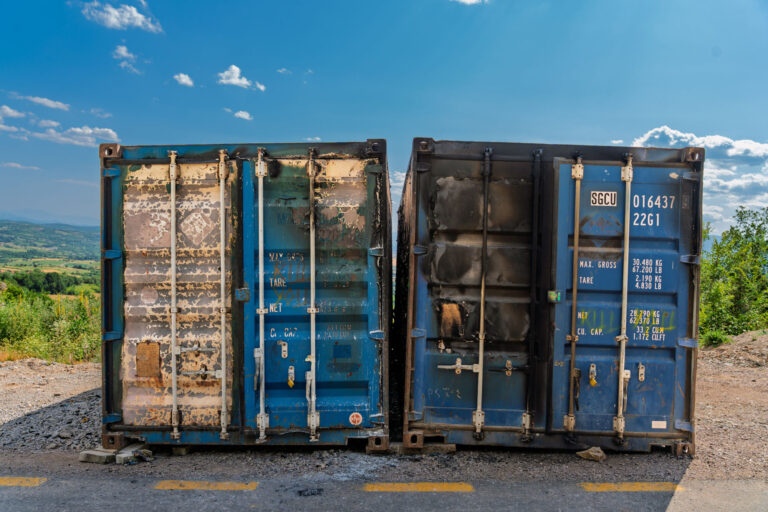
Petrit Halilaj,
Charred and Graffitied steel shipping containers housing ‘Syrigana’ props, Syrigana, 2025
Photo by Esad Duraki
Courtesy of ChertLüdde, Berlin and Petrit Halilaj
The exhibition at the museum centers on Halilaj’s open-air opera, staged in June 2025 with the Kosovo Philharmonic Orchestra on the hill of Syrigana in Kosovo.
Shortly before the opera’s premiere, two of the artist’s storage containers were broken into, defaced with hate speech and Serbian nationalist symbols, and set ablaze. While in the Hamburger Bahnhof’s presentation this story is only present in the accompanying catalogue, at ChertLüdde the focus shifts precisely on the vandalized containers, presented publicly for the first time.
Now transported to the gallery after being cut apart, the containers’ charred surfaces continue to bear the visible traces of that attack.
The flames consumed much of the opera’s scenography, from the sculptural flowers and pear trees to the ocarinas and other props like helicopters and Kosovar qilim carpets. With only days remaining before the premiere, the artist and his team painstakingly rebuilt what had been lost, producing the opera as it was originally conceived. Their determination to stage the opera unchanged became a deliberate affirmation of its central message of unity, refusing to let the hatred behind the attack overshadow its spirit.
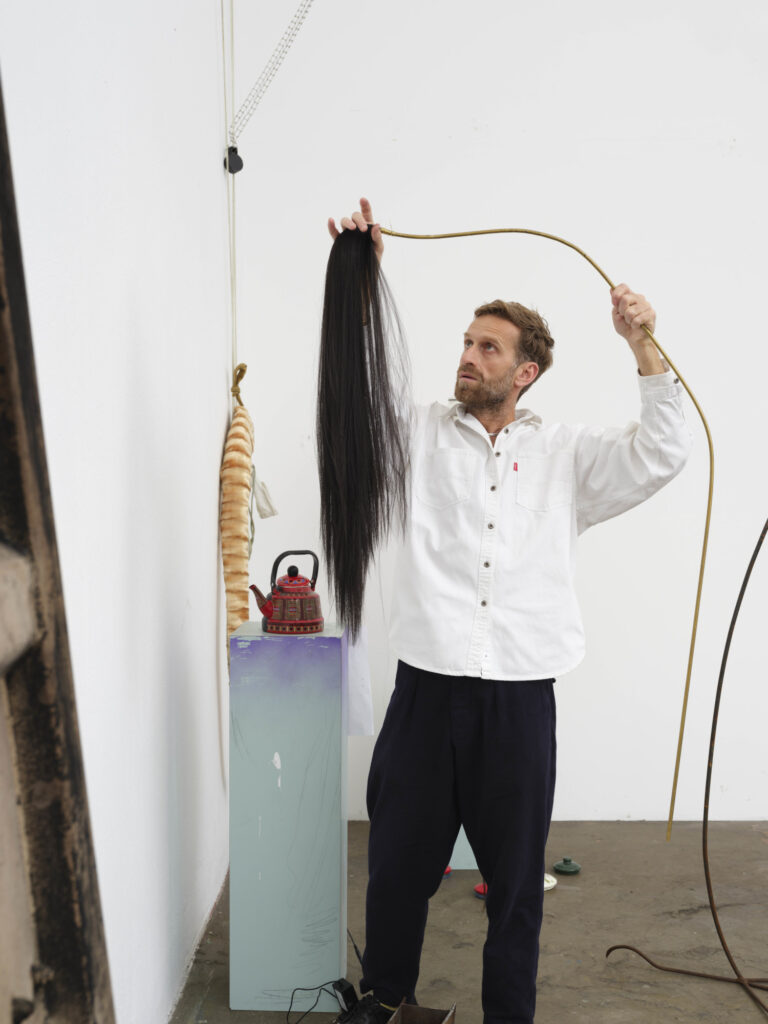
Petrit Halilaj in his Berlin studio preparing for his ChertLüdde Gallery show, 2026
Photo by Marjorie Brunet Plaza
Courtesy of ChertLüdde, Berlin and Petrit Halilaj
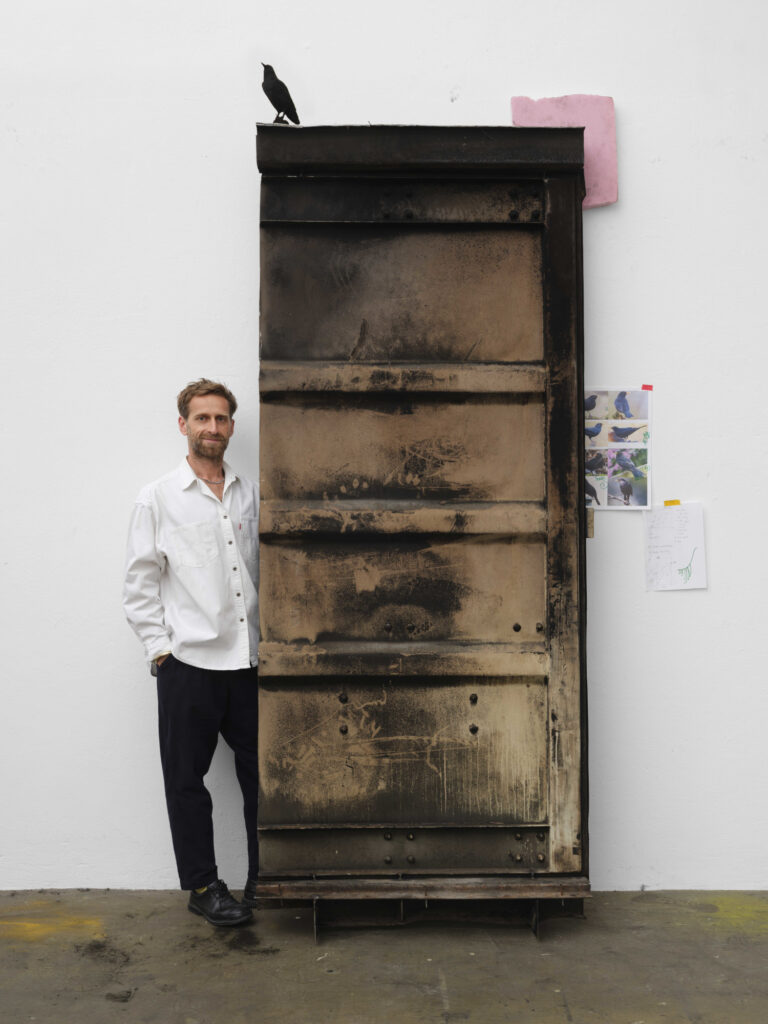
Petrit Halilaj in his Berlin studio preparing for his ChertLüdde Gallery show, 2026
Photo by Marjorie Brunet Plaza
Courtesy of ChertLüdde, Berlin and Petrit Halilaj
Still, the emotional and symbolic weight of the attack remains. The exhibition thus reflects not only the vivid memories of Petrit Halilaj’s childhood shaped by armed conflict, but also the unresolved tensions that continue to reverberate across the Balkan region today. In Who does the earth belong to while painting the wind?!, Halilaj reflects on this, using the exhibition as a platform to confront violence and imagine how its destructive force might be transformed or overcome.
The exhibition brings together artworks spanning more than a decade of the artist’s practice, from pieces originally shown in the 2012 exhibition of the same title at Kunsthalle St. Gallen to newly created works.
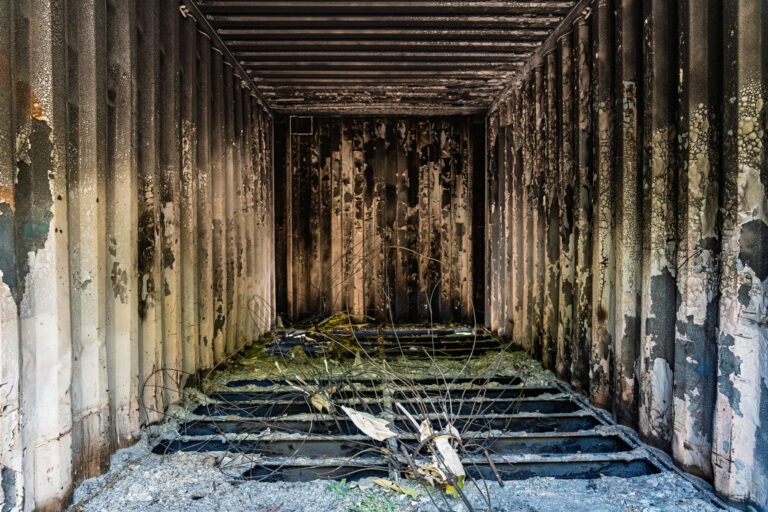
Petrit Halilaj,
View inside one of the charred and graffitied steel shipping containers housing ‘Syrigana’ props, Syrigana, 2025
Photo by Esad Duraki
Courtesy of ChertLüdde, Berlin and Petrit Halilaj
“Who does the earth belong to while painting the wind?!” is a question originally posed by the artist in his poetry collection of course blue affects my way of shitting (Chert and Motto Books, 2014). Written shortly after his arrival in Italy in 2003 to study at the Brera Academy, the text reflects on land and belonging at a moment when he had become an immigrant, navigating an unfamiliar language and culture. At the same time, it carries a more profound and enduring meditation—one that underlies and continues to shape the core of Halilaj’s artistic research.
Halilaj was just thirteen when, in 1999, he and his family were caught in the violent conflict between Serbian nationalism and Kosovo’s struggle for independence. Rooted in a centuries-long dispute over land and sovereignty, this war left a lasting imprint—one that resurfaces in his practice through color, materials and symbols.
BIOGRAPHY
Petrit Halilaj (1986, Kostërrc, Kosovo) lives in Berlin.
Petrit Halilaj understands exhibitions as a way to alter the course of personal and collective histories, creating complex worlds that claim space for freedom, desire, intimacy, and identity. His work is deeply connected to the recent history of his native country Kosovo and the consequences of cultural and political tensions in the region, which he often takes as a starting point for igniting countercurrent poetics for the future. Rooted in his biography, the projects encompass a variety of media, including sculpture, drawing, painting, text, and performance. Often incorporating materials from Kosovo and manifesting as ambitious spatial installations, his work transposes personal relationships, places, and people into sculptural forms. Halilaj’s practice can be seen as a playful and, at times, irreverent attempt to resist oppressive politics and social norms towards an untamed celebration of all forms of connectedness and freedom.
Currently, his work is on display at Petrit Halilaj: An Opera out of Time, Hamburger Bahnhof, Berlin (11 September – 31 May 2026) and In Interludes and Transitions, Diriyah Contemporary Art Biennale, JAX District (30 January – 2 May 2026).
Robert Rehfeldt
Mail Message from my Studio
1 MAY until 25 JUL 2026
Opening – 1 MAY 2026, 6-9 pm
ChertLüdde is pleased to present Mail Message from my Studio, an exhibition by Robert Rehfeldt.
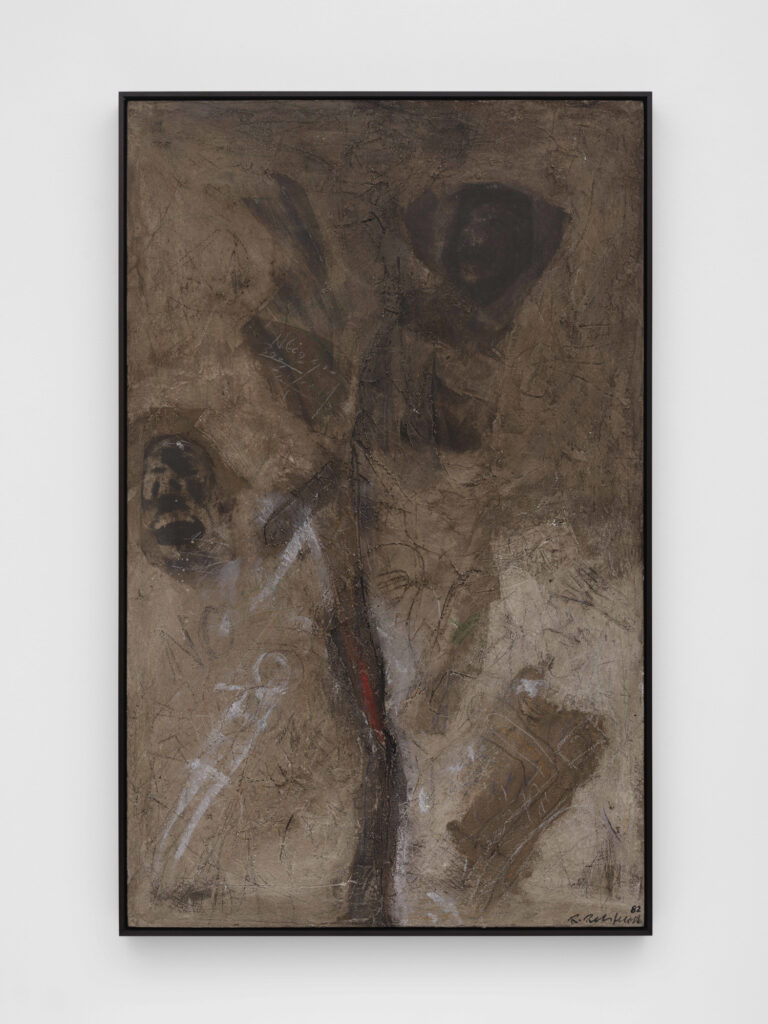
Robert Rehfeldt,
Zeichenbild (Scripural), 1982,
Mixed media on board, 160.2 × 100.1 × 3 cm
Photo by Marjorie Brunet Plaza
Courtesy of The Artist and ChertLüdde, Berlin
More than twenty years after his death, ChertLüdde dedicates a comprehensive survey to Robert Rehfeldt, focusing on two fundamental dimensions of his artistic research: his deep-rooted connection to the city of East Berlin and his expansive international network forged through the Mail Art circuit. Bringing together works across painting and diverse graphic techniques, the exhibition highlights Rehfeldt’s pivotal role within his own generation and underscores his lasting influence on those that followed.
The exhibition is accompanied by newly commissioned academic paper by art historian Christopher Williams-Wynn and brings together paintings from the Estate of Robert Rehfeldt, Mail Art correspondence form the Mail Art Archive of Ruth Wolf-Rehfeldt and works by Robert Rehhfeldt from the collection of Zentrum für Kunstausstellungen der DDR.
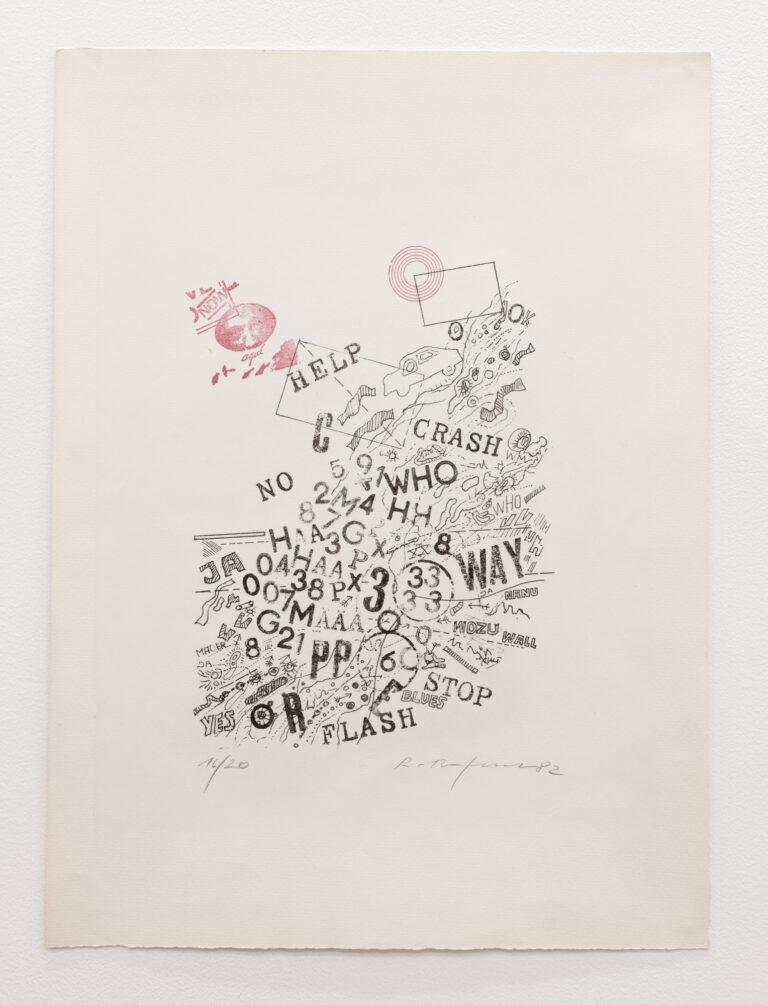
Robert Rehfeldt,
Blatt aus Mappe (KUNSTPOSTBRIEFE), 1982,
Lithografien auf Papier, 54 × 42 cm
Courtesy of The Artist and ChertLüdde, Berlin
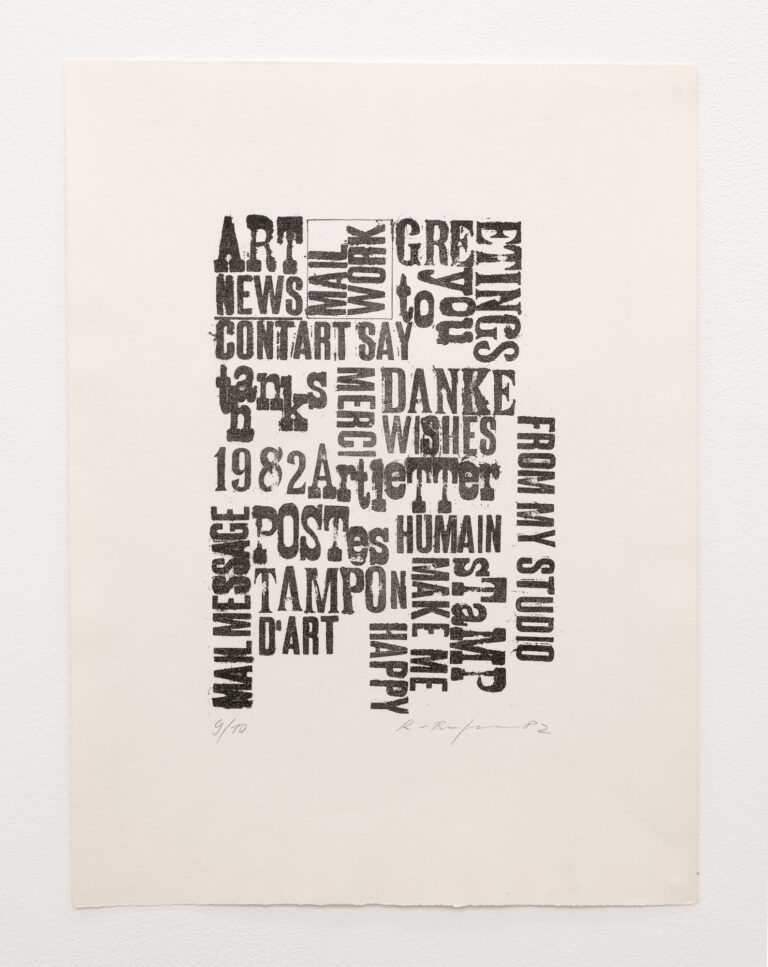
Robert Rehfeldt,
Blatt aus Mappe (KUNSTPOSTBRIEFE), 1982,
Original lithograph printed from stone on paper, 54 × 42 cm
Courtesy of The Artist and ChertLüdde, Berlin
Born in 1931 in what is today Stargard Szczeciński, Robert Rehfeldt (1931, Stargard – 1993, Berlin, Germany) spent most of World War Two with foster carers in Austria. He moved to the Soviet Occupation Zone in Berlin with his mother in 1946, before studying at the Hochschule für Bildende Künste in West Berlin between 1948 and 1953. After living in Berlin-Mitte, he moved to Pankow in the northeast of the divided city, a location that became his base of operations for 40 years. While maintaining his studio practice, he became one of the most internationally-connected artists in the German Democratic Republic (GDR), corresponding with hundreds of artists from the early 1970s until he passed away in 1993.
Rehfeldt entered the mail art network in the early 1970s. This community of artists exchanged works—often postcards, photocopies, rubber-stamp impressions, and small objects—through the postal system. By the middle of the decade, he collaborated at a distance with Horacio Zabala, whose exchanges with Robert Rehfeldt provide further insight into the development and context of his practice within the exhibition. Born in 1943 in Argentina, Zabala initially trained as an architect. While still living in Buenos Aires, he developed a conceptualist practice that grappled with the possible role of art amidst extreme political repression. After a military coup in 1976, he left the country and remained in Europe for over 20 years. His mail art will also be on view.
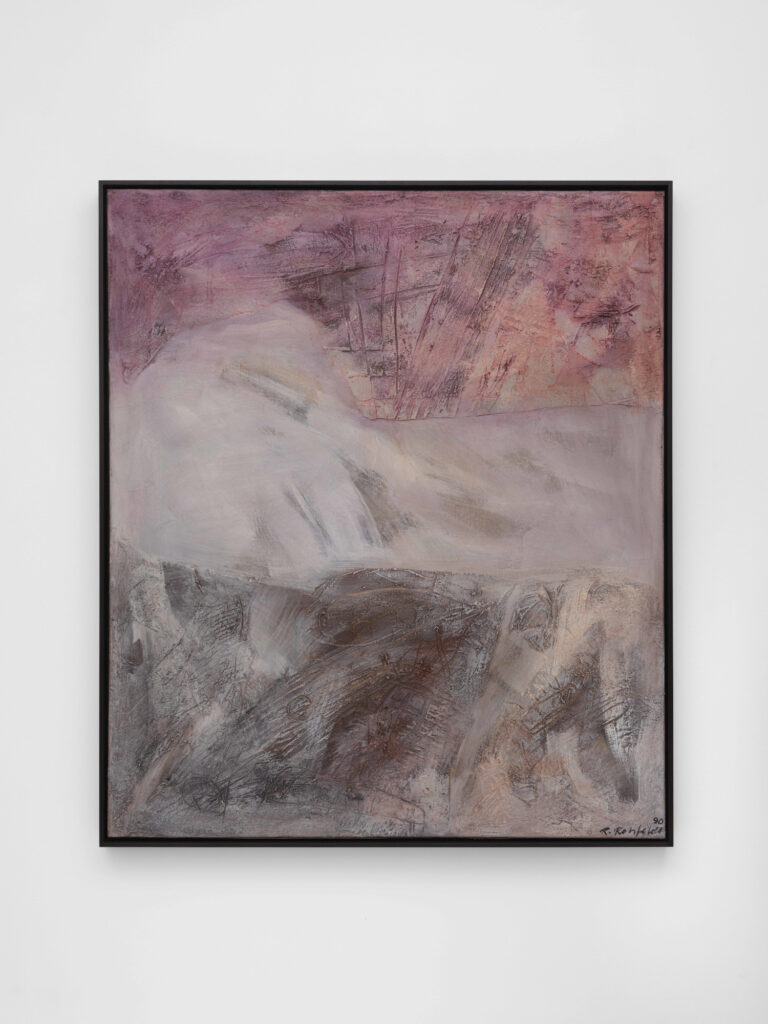
Robert Rehfeldt,
“Untitled”, 1980s, finished 1990;
Paint, mixed-media on canvas; 140.5 × 120.5 × 2.7 cm
Photo by Marjorie Brunet Plaza
Courtesy of The Artist and ChertLüdde, Berlin
Maintaining open channels of communication was vital for Rehfeldt, as was his studio practice. Over the course of the 1980s, he produced a number of paintings that show how he worked within and between painterly idioms. Through complex layers of mediation, he found ways to address aspects of wider social conditions in the GDR.
BIOGRAPHY
Robert Rehfeldt (1931, Stargard – 1993, Berlin) was a central figure of experimental art in East Germany and a pioneer of the international Mail Art movement behind the Iron Curtain.
He graduated in 1953 from the Hochschule für Bildende Künste Berlin in West Berlin. While working as a freelance graphic artist and press illustrator, he continued to develop his own artistic practice. Encounters with artists such as Karl Schmidt-Rottluff and Alexander Camaro shaped his understanding of art as an open, experimental act rather than an ideological tool. This foundation proved crucial after the political climate in East Germany grew increasingly restrictive. From 1963 onward, Rehfeldt was active in East Berlin’s experimental art circles and became a member of the Association of Fine Artists of the GDR. As cultural exchange with the West tightened after the closure of the borders, artistic production became more constrained. In response, Rehfeldt developed what he called “Kontakt-Kunst” (contact art), producing works in his basement studio in Berlin-Pankow and sending them abroad via post. He famously coined the phrase: “Dada is dead, contact art is living in your mailbox.”
In the early 1970s, through contact with Klaus Groh, Rehfeldt became deeply involved in the international Mail Art network. His studio evolved into an informal information hub for Western art developments, providing rare insight for East German artists. He corresponded with major international figures including Nam June Paik, Wolf Vostell, Robert Filliou, Horst Tress, and Dick Higgins.
Rehfeldt also built strong connections with artists in socialist countries, especially Poland and Hungary, and collected key postwar publications that influenced his collages. After an early realist phase marked by metaphysical elements under the influence of his friend Ernst Schröder, he began experimenting across styles—working abstractly and figuratively, as a pop artist, assembler, installer, activist, and filmmaker. Using a Super 8 camera, he secretly documented performances, exhibitions, travels, and daily life, often pairing the footage with sound collages made from radio recordings, which he described as “vocal/melodic audio-tape letters from East to West.”
In 1975, on the occasion of his exhibition at Galeria Teatru Studio in Warsaw, he invited artists worldwide to design postcards, creating what became the first Mail Art exhibition initiated from the GDR. This project inspired subsequent landmark exhibitions at the Arkade Gallery (1978) and Jürgen Schweinebraden’s EP Gallery (1979) in East Berlin. In 1986, he organized the first meeting of the “Discrete International Mail-Art Congress.”
After German reunification, Rehfeldt presented his work and a retrospective of his 1975 Mail Art project at Berlin’s Ephraim Palace in 1991. He died on 28 September 1993 following a medical operation in Berlin. His work has since appeared in numerous posthumous exhibitions, including a 2008 retrospective at the Parterre Gallery in Berlin.
Christopher Williams-Wynn is a historian and theorist of modern and contemporary art. Currently an Alexander von Humboldt Foundation Research Fellow at Freie Universität Berlin, he examines how media have been used to explore the epistemological claims, political consequences, and aesthetic implications of disciplinary knowledge and practice. He received his PhD in art history from Harvard University, and his writing has appeared in Art Journal, Grey Room, and The Art Bulletin, among other venues.
Horacio Zabala (1943, Buenos Aires) is an Argentinian conceptual artist and architect known for his politically charged and intellectually rigorous work. Emerging in the late 1960s, he became associated with avant-garde movements that challenged authoritarianism and traditional art institutions in Argentina and across Latin America. His practice spanned drawing, cartography, mail art, and installation, often using maps and architectural plans to question borders, power structures, and systems of control. Zabala’s work has been exhibited internationally, including at the Museum of Modern Art and the Venice Biennale, cementing his influence within global conceptual art.