

Mihai Olos
The Knot
27 FEB until 18 APR 2026
Galeria Plan B is pleased to present Mihai Olos’ second solo exhibition at the gallery, offering an overview of his complex oeuvre through a selection of drawings, paintings, sculptures, and photographs.
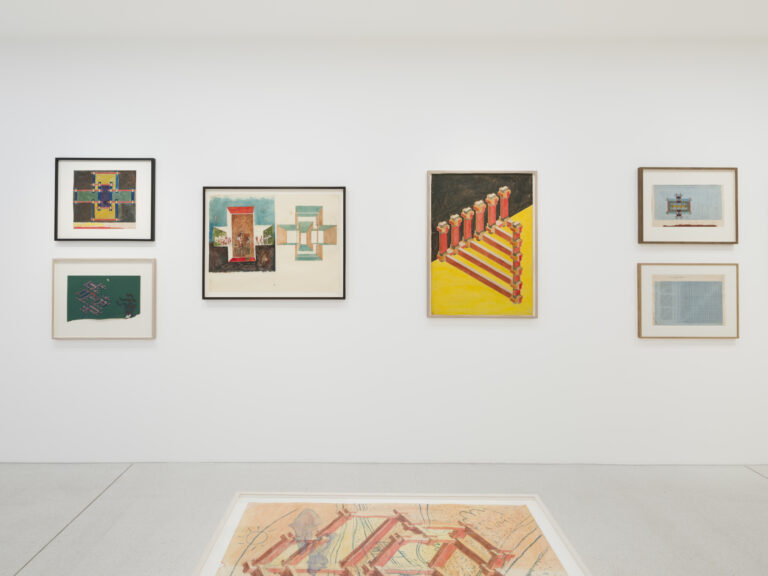
Mihai Olos
The Knot
Galeria Plan B, Berlin 2026
Photo: Trevor Good
For some of his exhibition openings, Mihai Olos invited guests to connect their fingers in a structure suggesting a knot and to create a human chain through the gallery space. It is a gesture he also performed spontaneously with friends in their studios, and which he exemplified with Joseph Beuys at documenta 6 in 1977, when Olos explained his vision of the knot and drew this symbolic element on a blackboard that Beuys later integrated into his installation Das Kapital Raum.
The knot appears in various colours, shapes, and textures, from the geometrical precision of the 1970s paintings to the looser modules in the large-scale canvases of the late 1980s and early 1990s. It also emerges in sketches exploring its potential in a methodical, almost technological way; in watercolours merging dreamlike figurative elements; in small erotic paintings of intertwined bodies; and in wood sculptures, ceramics, and small objects. The motif is present as well in land art, digital sketches, and performative projects.
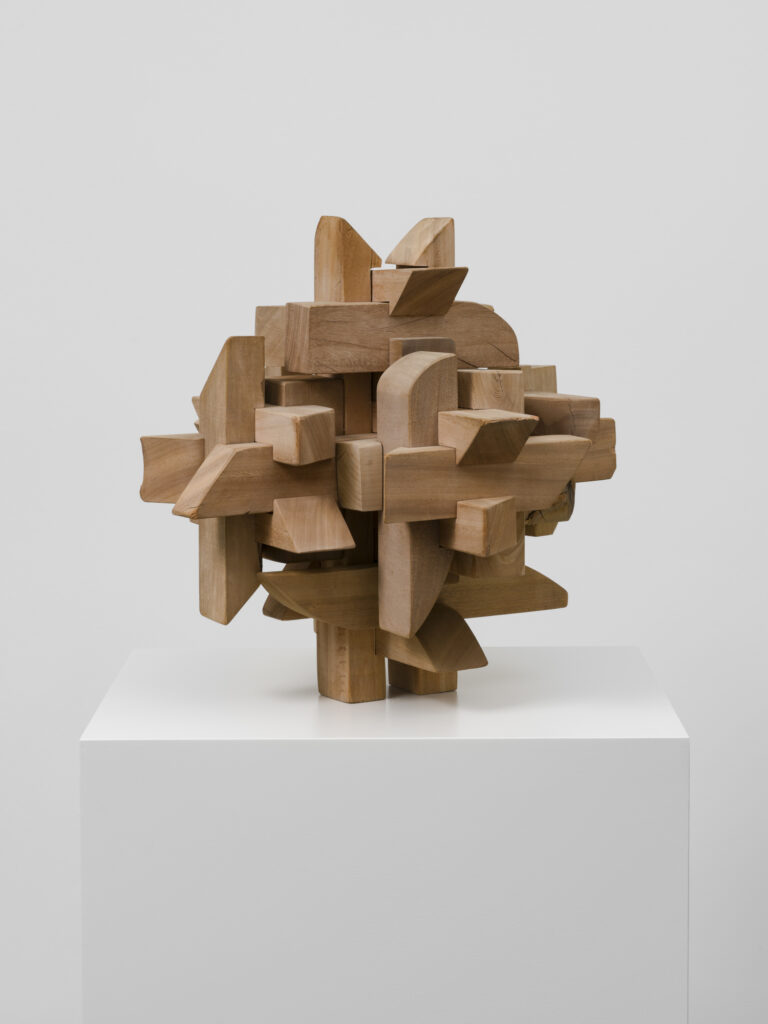
Mihai Olos
Untitled
1977-1978
teak wood
61 x 61 x 61 cm
Photo: Trevor Good
Courtesy of the Estate of Mihai Olos and Plan B Cluj, Berlin
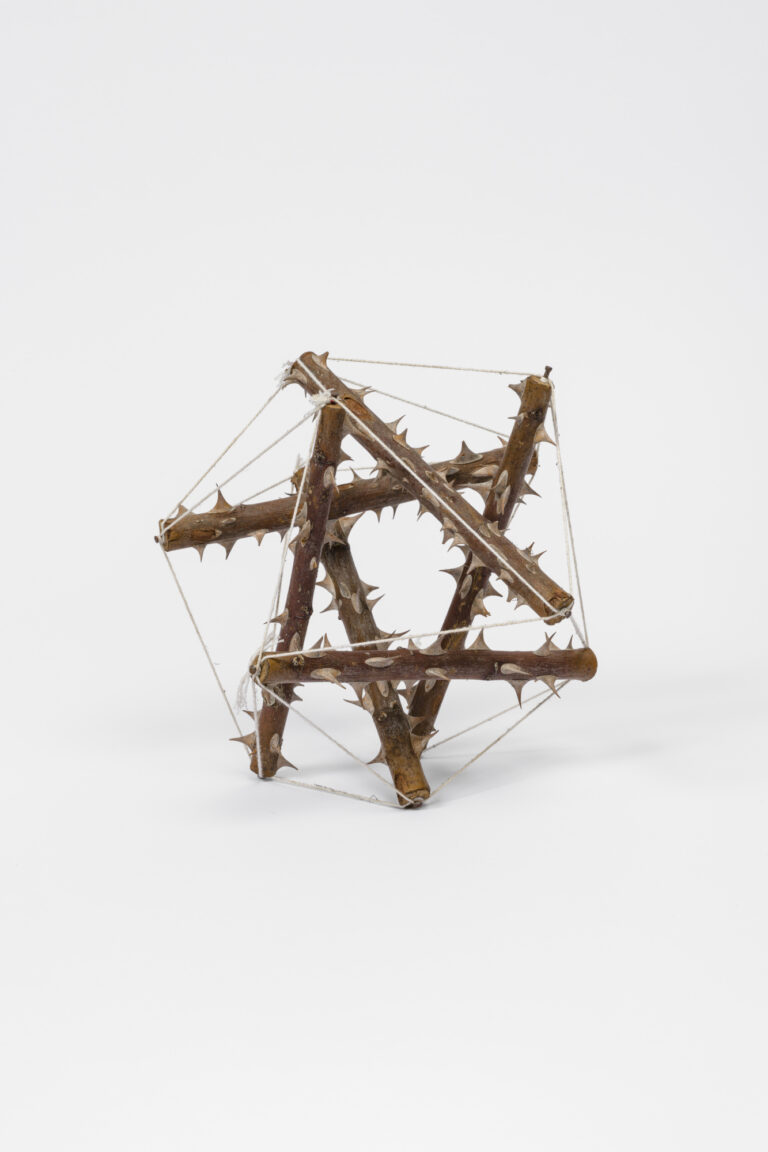
Mihai Olos
Untitled
n.d. (2004-2006)
rose branches, threads, nails
14 x 18 x 18 cm
Photo: Trevor Good
Courtesy of the Estate of Mihai Olos and Plan B Cluj, Berlin
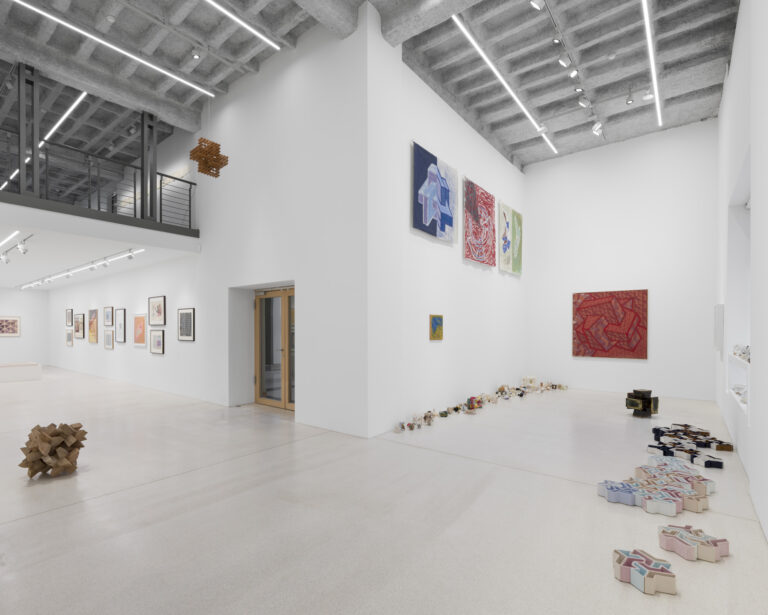
Mihai Olos
The Knot
Galeria Plan B, Berlin 2026
Photo: Trevor Good
With roots in the archaic structures of the spindles used to twist fibres, and in the glue- or nail-free joints of wooden buildings from his native region of Maramureș, the knot bridges art and science in a personal way. It resonates with ideas of knowledge modularity proposed by the quantum physicist Philip Morrison, while also referencing modern architecture in Japan and the geodesic domes of Buckminster Fuller. For Olos, the social potential of the module was at the core of his vision, best expressed in the concept of Olospolis or The Universal City — a utopian project of modular communities in which members are knotted together, supporting one another in a harmonious way of living.
His idea of the knot transcends the visual realm into that of language. In Romanian, a word for knot is rost, which refers both to the physical intersection of elements, as in a joint, and to the abstract sense of meaning, while the extended word rostire means utterance. In fact, Olos was a gifted speaker and writer, and his texts reveal a sophisticated approach to the Romanian language as well as a poetic quality. This linguistic layer emphasizes his unique vision, in which the knot or module represents the core of a diverse body of work marked by lifelong experimentation.
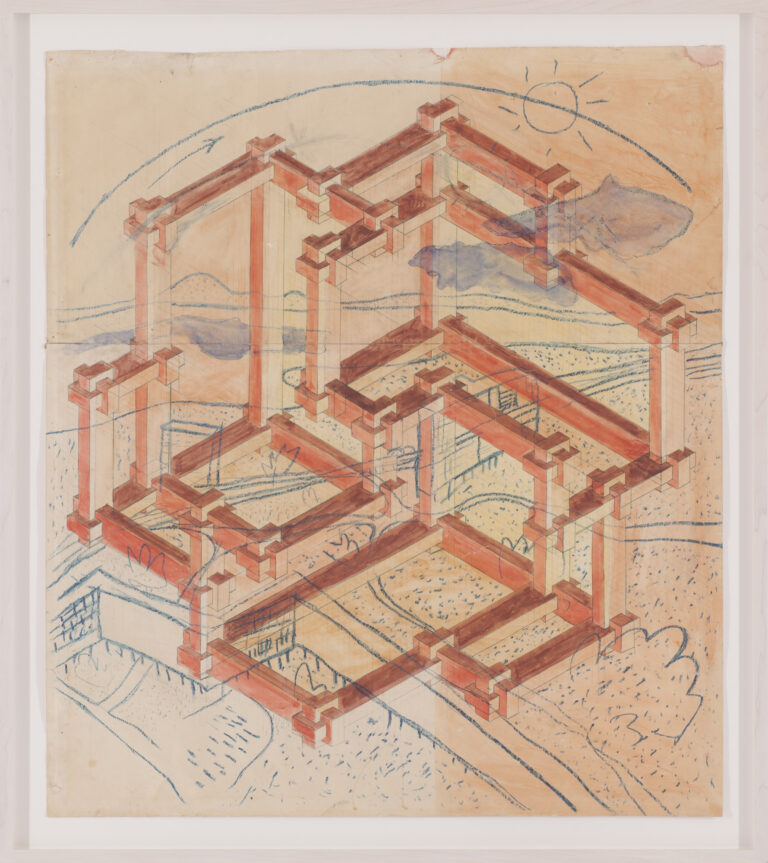
Mihai Olos
Universal City / Urban structure project (overlapped on a
drawing of Le Corbusier)
n.d. (1970s)
pencil, gouache and wax crayon on paper
116 x 115.6 cm
Courtesy of the Estate of Mihai Olos and Plan B Cluj, Berlin
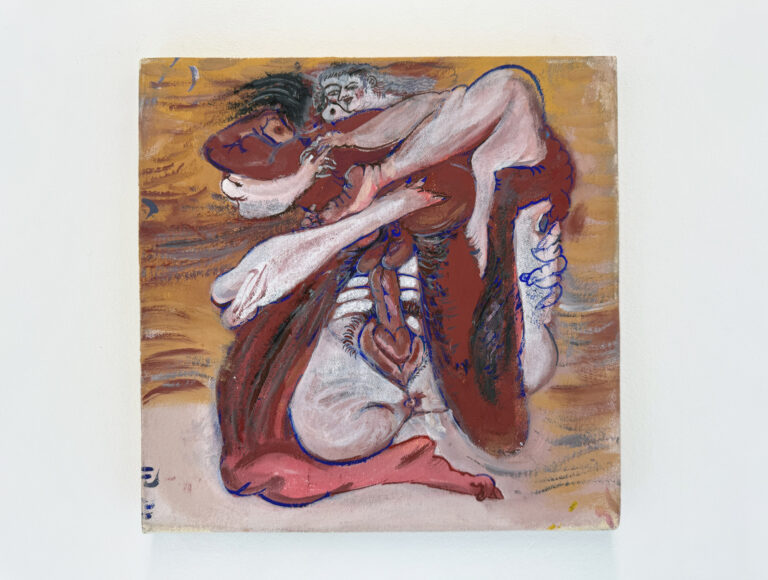
Mihai Olos
Untitled
n.d. (1985)
mixed media on canvas
30 x 30.5 cm
Courtesy of the Estate of Mihai Olos and Plan B Cluj, Berlin
In his exuberance, Olos managed to avoid the strictness of form dictated by such a clear shape, engaging with it instead in a playful manner, best exemplified by his experiments in drawing, small objects, and his spontaneous invitations to join hands.
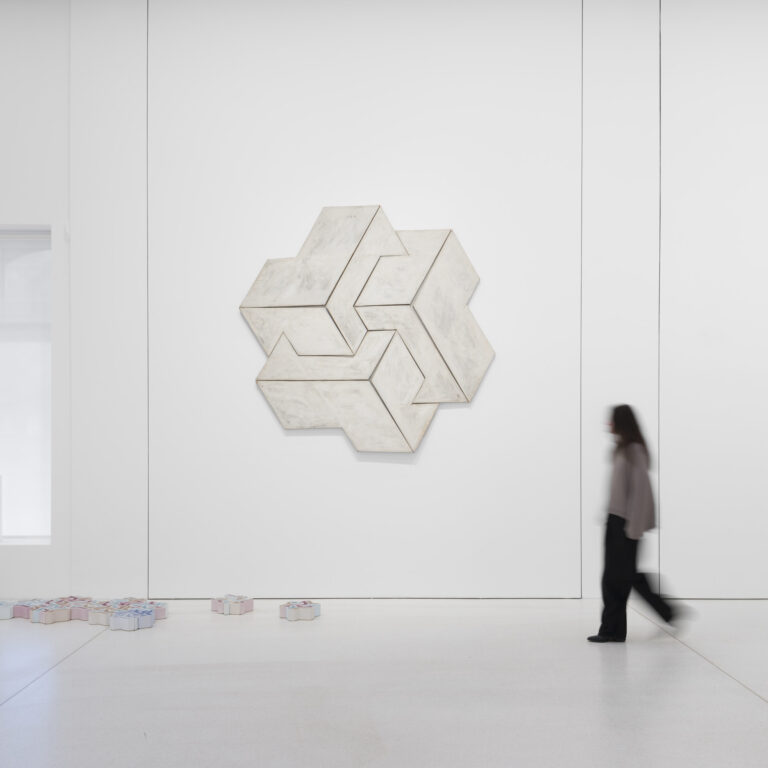
Mihai Olos
The Knot
Galeria Plan B, Berlin 2026
Photo: Trevor Good