Shahin Afrassiabi
FRANCIS - Paintings Drawings Sculptures, 2023-2025
13 FEB until 28 MAR 2026
Opening – 13 FEB 2026, 6-9 pm
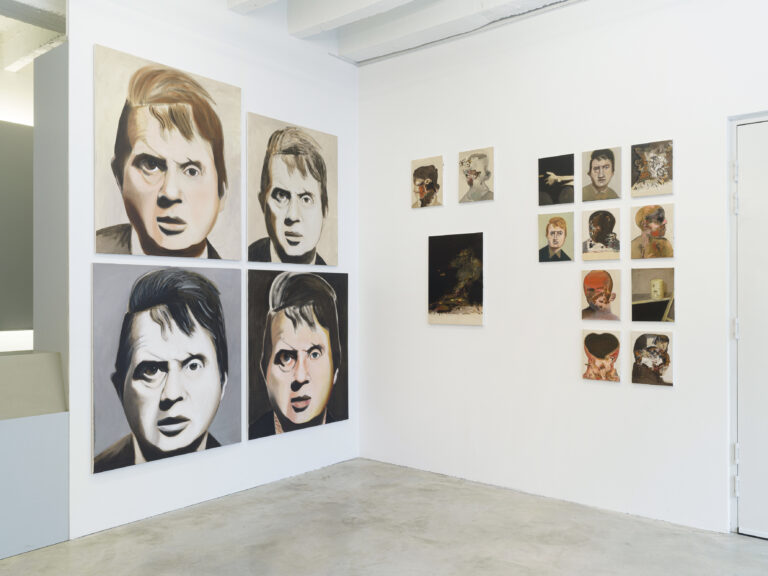
Exhibition view.
Courtesy Soy Capitán, Berlin. Photo: Roman März
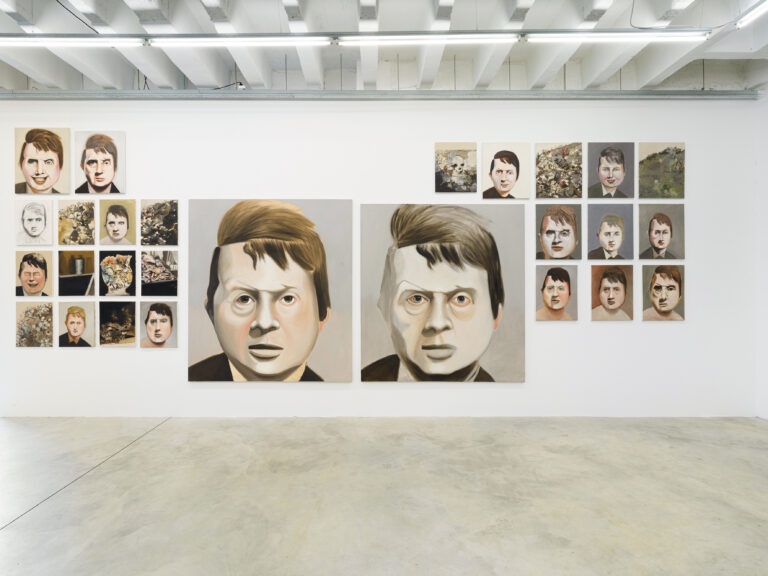
Exhibition view.
Courtesy Soy Capitán, Berlin. Photo: Roman März
Over several years, you have worked extensively with a single, iconic photograph depicting Francis Bacon in his studio – taken in 1971 by Francis Goodman and now held in the National Portrait Gallery – resulting in a large number of paintings. In the exhibition FRANCIS alone, you present more than seventy works that unfold from this one image. At what point did you sense that this engagement was developing its own momentum and expanding far beyond a single project?
Let me first say that the word project doesn’t really apply here. I feel a project is something an architect does. A project has a beginning and an end. It belongs to practices (in this context ‘practice’ is another word I have a problem with) engaged in directed research whose outcomes are answerable to hierarchical client structures. I don’t work like this. I sensed from the beginning, when I decided to use this image as source material, that it could be rich with possibilities resonant for painting. At that stage the thing that appealed to me most was the ambiguity or openness of the gesture. What does it mean to paint Francis Bacon? I had no idea. Other painters had painted him. They had painted his portrait. I however am not painting his portrait. These are variations on a theme. There are repeated motifs like the form of the hair etc. In this sense they relate more to orthodox icons. This was one outcome I hadn’t really anticipated. Later I shifted focus onto the pile of debris in Bacon’s studio. I painted a few approximate likenesses of this detail but quickly realised it could be translated in different ways. This is where the paintings I call ‘earthscapes’ came from. These paintings are inferences from and interpretations of the pile of debris. Later again out of this group of paintings emerged a new series of heads and the painting of the burning olive tree.
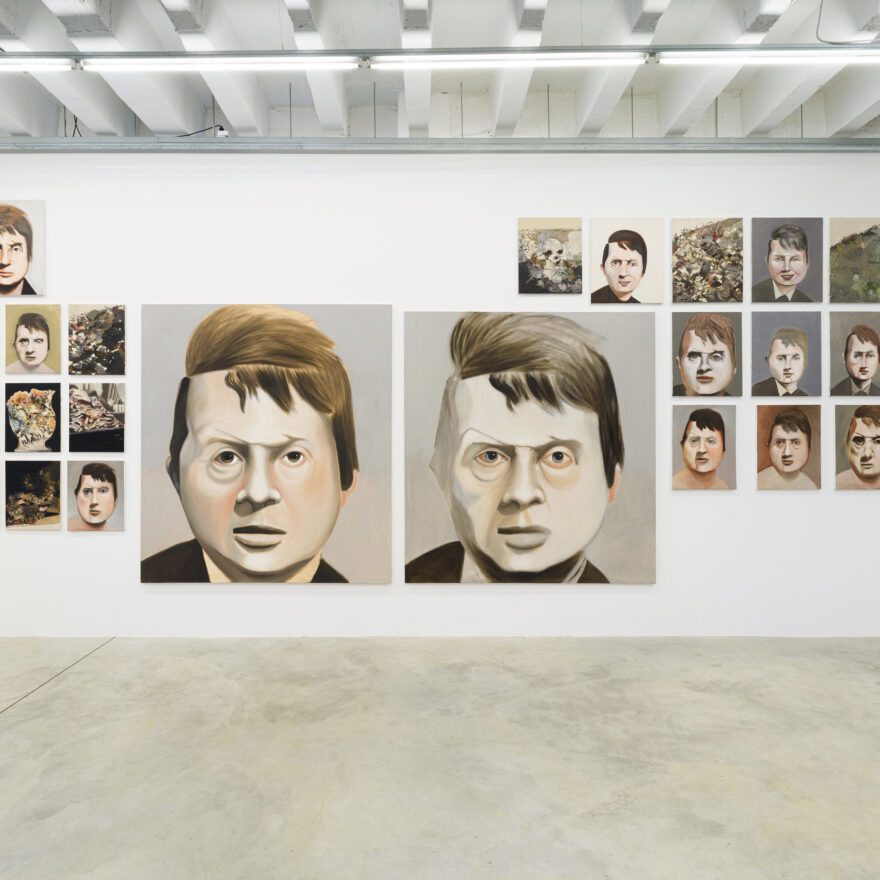
The installation is strikingly dense: many works are present simultaneously and partially overlap, without a single painting being emphasised as a focal point or a clear visual axis emerging. Instead of a linear sequence, clusters and visual echoes take shape. What role does this form of presentation play for you, and to what extent is it integral to understanding the body of work as a whole?
Yes, there is no hierarchy or privileged focus as such. Initially I intended to show only the Bacon heads but it felt like self-censorship. I was asked to show a few of the Bacon heads on their own in Brussels anyway. So here in this exhibition I took the opportunity to show as many of the paintings together as possible. This is important for apprehending the impulse behind the work. It is about what can be inferred from a single image, in this case the photograph in question. Not just any image but this one. At some point the photograph of Bacon, once seen like this, becomes a vehicle of infinite permutations of expression; this is a dramatic metamorphosis humorous and absurd but also tragic. It is open and expansive. In this instance I wanted to create an immersive experience to try and convey this feeling I had about these works. The show in Brussels demonstrates an alternative way of seeing the heads. The complexity that arises from both these shows appeals to me. It feels right.
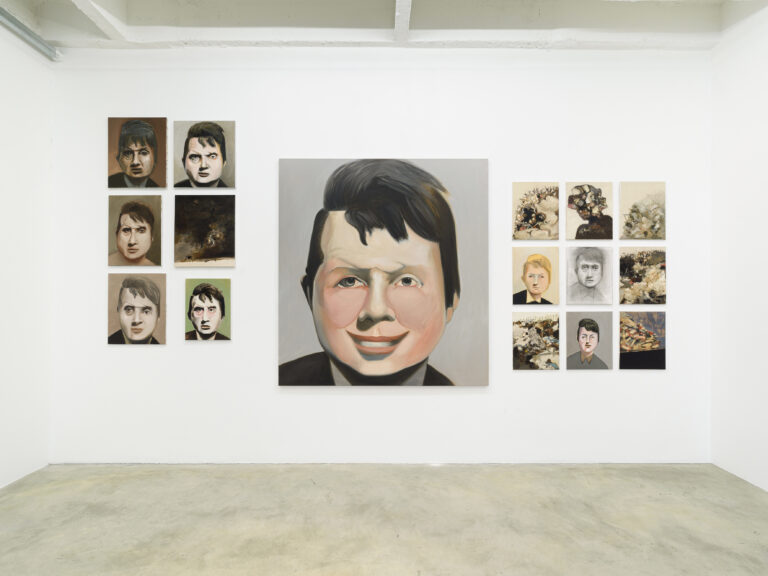
Exhibition view.
Courtesy Soy Capitán, Berlin. Photo: Roman März
Was the selection of this photograph intentional from the outset, or did its significance emerge in the process?
Thinking about art and painting specifically I imagined that a painting is much like a face. That idea led me to thinking about painting faces. I was looking through a book documenting the history of Vogue magazine and in amongst all the pictures of models and celebrities was this rather amusing photograph of Francis Bacon looking awkward, a little uncomfortable but hopeful nevertheless. These were my first impressions in any case. It seemed the perfect candidate. Naturally I had some ideas about why I wanted to work with that image and as I went along those ideas broadened to encompass things I hadn’t foreseen. By the end some of the paintings turned out very far from the photograph though they still belong to the same period of time when I was thinking about Bacon in his studio and by extension what I knew about his work and his story. I should mention the fact that the photographer’s name was also Francis played a significant part in my choice.
The repetitive structure of the series evokes a manic intensity often associated with Francis Bacon. Was this quality intentional, and how consciously did you integrate or respond to this aspect of his practice?
If by intentional you mean planned from the outset then the answer is not. You cannot plan for these things. In any case the repetition is illusory. The paintings are not the same. Whatever intensity you might perceive in these works cannot be the same as anything associated with Bacon. For a start laughter plays a huge part in my approach. I was given to sudden fits of laughter when I was making this work. It was non-stop comedy. However even though my paintings look nothing like his we employ the same technique of addition and subtraction. At the start there is an idea of what is to be done but the final image emerges from chaos. I find the expression or it finds me and at some point I have to accept what I find because I reach a limit. Only in this sense I am intentionally looking for some kind of intensity. In the end of course it is a subjective thing. For Bacon painting was the expression of a physical act; however I cannot make such a claim.
The paintings oscillate between deliberate painterly decisions and moments that feel unstable or unresolved. How do you think about gesture and control in this series?
Resolution or completeness are purely subjective in all painting. One has to see these qualities in painting as belonging to the syntax of the works, what the painter wanted to show. Everything in these pictures is deliberate. The paintings are made over a long period of time with numerous edits and overpainting. Although sometimes things come together quickly (I still haven’t worked out why this happens). The idea, in this case the photograph, is a device that triggers the process. I don’t want to know beforehand what I am going to end up with. In fact it is not possible to know. I want to embrace the sense of discovery and surprise otherwise there is no point. It‘s about the kind of energy that this creates in the work. I believe this quality can be communicated. It is worth thinking about where this instability you refer to comes from. Is it in the paintings as moments and gestures like you say or inherent in the idea of one painter confronting another, art confronting itself.
Do you understand the works as being in correspondence with one another, or as autonomous, self-contained pieces?
For me making an exhibition has always been about presenting an idea. Correspondence and autonomy are not mutually exclusive. Clearly there is a correspondence. This correspondence takes different forms. Sometimes its about colour or style, other times about something else. Every variation on the portrait of Bacon reveals some new possibility of what a face can represent. I don’t want to force the relationships in the installation of this exhibition. You might notice that the paintings are hung according to their dimensions, a pragmatic solution. Sometimes the relations are obvious at other times they are not. I wanted to create a layered experience where things come together and fall apart all the time without a centre. I think contemporary audiences are attuned to this kind of experience. Altogether this is a collection of works that came from an interest in exploring the notion of Art, incidentally the motivation behind all my work to date, and in painting itself. Bacon and the photograph are a vehicle to give the process a direction and a focus; an artist everyone recognises. He is a well known figure whose work has been well documented and still being discussed. In a way we can say he embodies an idea of art in general and painting specifically as well as what it means to be an artist. He is also a divisive figure, loved and despised.
– A conversation between Shahin Afrassiabi, Luisa Del Prete and Elif Akinci in January 2026.