

Andreas Eriksson in dialogue with Kim Chong Hak
painting the path
11 SEP 2026—6 MAR 2027
Opening – 10 SEP 2026, 6-10 pm
At Christinenstrasse 18–19
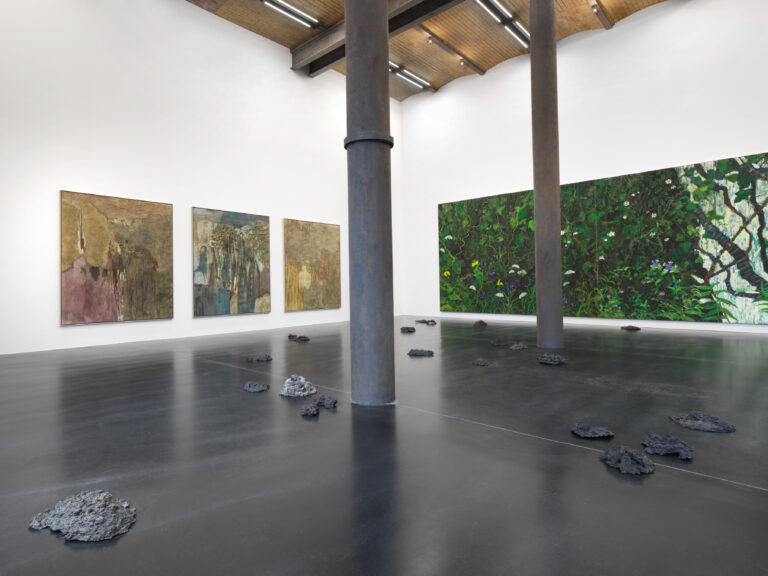
installation view:
andreas eriksson in dialogue with kim chong hak, painting the path, September 11, 2026 – March 6, 2027, neugerriemschneider, Berlin
© the artists / VG Bild-Kunst Bonn.
Courtesy the artists and neugerriemschneider, Berlin.
Photo: Jens Ziehe, Berlin
painting the path, a dialogue between Kim Chong Hak and Andreas Eriksson, brings together new and recent work in painting by the two artists at neugerriemschneider. Featuring pictorial and sculptural pursuits uniquely attuned to the rhythms of the natural world, the exhibition traces the organic through methodologies born of divergent generational, political, geographic and cultural realities. Kim and Eriksson, who arrive at their isolated landscapes from similar sensibilities, each possess a keen eye for their environments’ subtleties, leading nuanced navigations of figuration and abstraction. With emotionally imbued approaches, they have become the de-facto chroniclers of the respective mountains that they call home: Eriksson’s Kinnekulle in Sweden, where he established his studio in 2002, and Kim’s Seoraksan in South Korea, where he has lived and worked since 1979. Each at pivotal points in their trajectories, Eriksson and Kim movingly capture the phenomena – spectacular and ordinary, overt and tacit – of their ever-changing surroundings. Here, watershed compositions stand in juxtaposition, acting in concert as revelatory lenses through which to view one another.
At the foundation of Eriksson’s practice stands the countryside that envelops his home and studio in rural Sweden, and his avid, ever-evolving exploration of it. Integral to this process is a heightened attention that allows details, scenarios, peculiarities and moments of chance to all become fodder for introspective exchanges. In new painted work, large-scale canvases mimic the grandiose proportions of his subjects, while smaller, intimate panels reflect a fascination for the world’s minutiae. Here, in conceptual distillations of natural phenomena, his practice sees new direction – one that is no longer constrained by the graphite guidelines that blueprint his previous work. A referential quality too remains absent from these latest images, giving way to a responsive approach in which paint informs itself, becomes sculptural and takes on the character of the artist’s tools. Eriksson, acutely studied in paints and their unique properties, conforms his methods to his materials’ behavior – the time it takes to dry, how it adheres to its surface, its susceptibility to external forces. The artist’s signature fields of color give way to an unburdened handling of medium, eliding precedent, while his increasing use of synthetic pigments continues this development: Moved across the canvas, they emerge from gentle organic earth tones into striking palettes. painting the path also features Eriksson’s A Second Time (2003 – 2007), and selections of his Molehill (2009 – ongoing) and Content is a Glimpse (2008 – ongoing) sculptures – cast-bronze impressions that accompany his painted work in capturing nature’s fleeting moments.

Kim Chong Hak, Landscape, 2019, acrylic on canvas, 8 parts, overall: 290 x 1800 cm. © Kim Chong Hak. Courtesy the artist and neugerriemschneider, Berlin
Over the past six decades, Kim has established himself as one of South Korea’s most esteemed painters, creating works that pay tribute to and revere holistic experiences of seasons as they pass and recur, shaped by time and recorded on canvas. A deeply pensive, historically charged approach takes on an exuberant edge as Kim’s considerations of nature’s splendor meet their physical representations – often with energetic coloration or in pared-down near-monochrome punctuated by focused linework. Born in the north of Japanese-occupied Korea in 1937, Kim came of age amid a reality in which land and landscape themselves were sites of discord. Upon his relocation to Seoraksan’s mountainside by way of Tokyo, Seoul and New York, these elemental scenes were cast as key subjects of the artist’s practice. Featuring in varying scopes and scales, this thematic engagement observes Kim break from and simultaneously acknowledge the past. His passion for collecting antiques and folk art, including the hand-carved ducks gifted at traditional Korean weddings, “kirogi,” two of which are on view here, is instrumental in this operation. Similarly vital are his early experiments with minimalism, abstraction, calligraphy, poetry and conceptualism, and his involvement with the elemental, material-forward mono-ha movement. Allowed to accrue to a figural mode, these influences give rise to a handling of paint as emotive as it is lyrical, ephemeral as it is grounded. His monumental Landscape (2019) unfolds across 18 meters, wrapping around a corner to profoundly panoramic effect. It encapsulates and exemplifies this ongoing pursuit, its edges thicketed and seemingly infinite in depth, while its foreground teems with untamed wildflowers in splendid bloom – its center tempting the promise of never-ending flora.
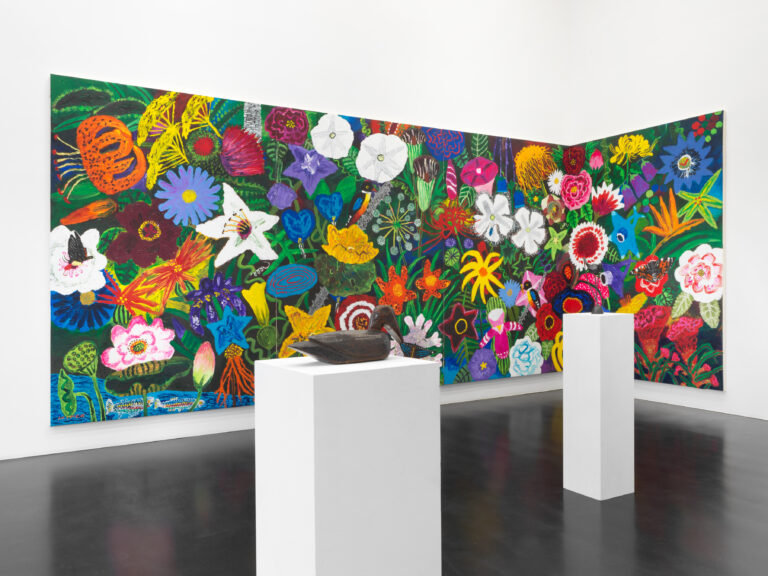
installation view:
andreas eriksson in dialogue with kim chong hak, painting the path, September 11, 2026 – March 6, 2027, neugerriemschneider, Berlin
© the artists / VG Bild-Kunst Bonn.
Courtesy the artists and neugerriemschneider, Berlin.
Photo: Jens Ziehe, Berlin
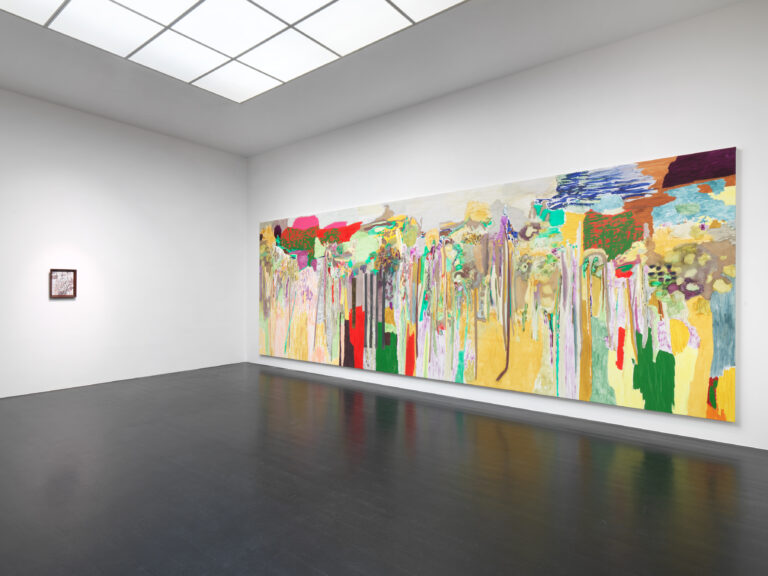
installation view:
andreas eriksson in dialogue with kim chong hak, painting the path, September 11, 2026 – March 6, 2027, neugerriemschneider, Berlin
© the artists / VG Bild-Kunst Bonn.
Courtesy the artists and neugerriemschneider, Berlin.
Photo: Jens Ziehe, Berlin
painting the path witnesses the lengthy walks that inspire many of Eriksson’s and Kim’s compositions. Embarked on without pre- determined motives, these solitary hikes are sessions as crucial to the work-creation process as the act of painting or sculpting itself. Along wooded trails, liberated from the impositions of society, the artists gather impressions left by nature. The resulting works are transcendental conceptions of their surroundings, rendered as unique systems of evaluation. Perspectives, brought together here, merge and diverge as the two artists cast one another in new, transformative light.
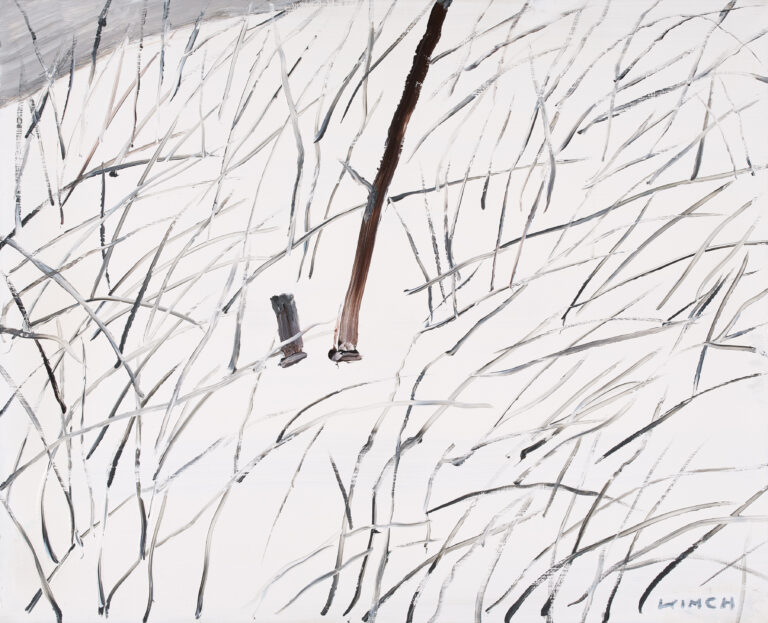
Kim Chong Hak, Untitled, 2017, acrylic on canvas, 53 x 65.1 cm. © Kim Chong Hak. Courtesy the artist and neugerriemschneider, Berlin
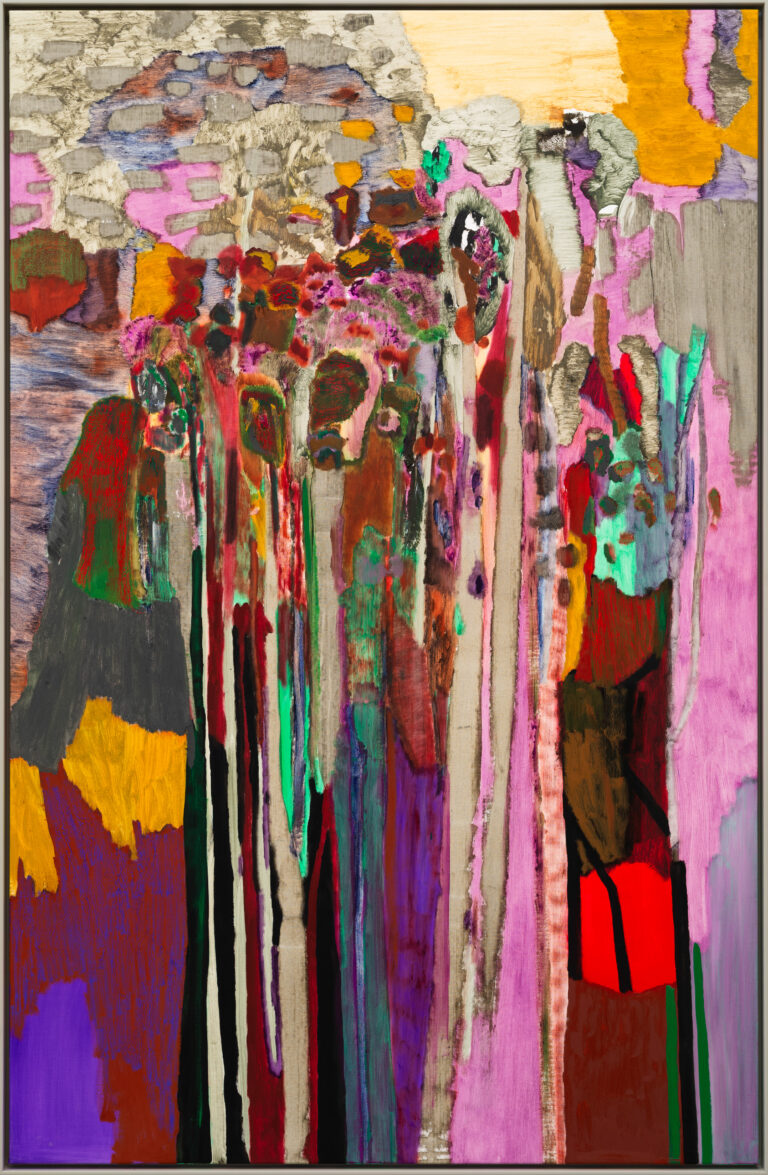
Andreas Eriksson, Stalk II, 2025 – 2026, egg-oil-tempera and oil on canvas, 188.5 x 123.5 cm. © Andreas Eriksson / VG Bild-Kunst, Bonn. Courtesy the artist and neugerriemschneider, Berlin
Opening to coincide with painting the path, Barbara Wien presents Horizontal Fold – a solo exhibition by Eriksson highlighting the integral nature of publishing to his practice. Paintings, photographs, silkscreen prints, cast-bronze sculptures and textiles accompanyan installation of Eriksson’s artist’s books (until December 24). Eriksson is also the subject of Soleil et Lune. Andreas Eriksson in dialogue with Ivan Aguéli at Institut suédois, Paris (October 20, 2026 – January 10, 2027). Kim is the subject of a presentation at Gangneung Museum of Art Sorol (July 22 – October 25, 2026) and the large-scale survey Kim Chong Hak, Painter of Seoraksan at the Phoenix Museum of Art (September 9, 2026 – February 21, 2027), following its premiere at the High Museum of Art. Andreas Eriksson (b. 1975) has been the subject of international solo exhibitions, including those at Murin-an, Kyoto (2024); OōEli, Hangzhou (2024); Lillehammer Art Museum, Lillehammer (2024); Lidköpings Konsthall and Vänermuseet, Lidköping (2023); Thielska Galleriet, Stockholm (2023); De 11 Lijnen, Oudenburg (2021); Skissernas Museum, Lund (2021); Nordiska Akvarellmuseet, Skärhamn (2020); Braunsfelder, Cologne (2019); Bonniers Konsthall, Stockholm (2014); Centre PasquArt, Biel (2014); Reykjavík Art Museum, Reykjavík (2014); and mumok – Museum moderner Kunst Stiftung Ludwig Wien, Vienna (2008). Eriksson has participated in the 30th Bienal de São Paulo (2012) and was selected to represent Sweden at the 54th Venice Biennale’s Nordic Pavilion (2011). Eriksson lives and works in Medelplana, Sweden.
Kim Chong Hak (b. 1937) has been the subject of international solo exhibitions, including Painter of Seoraksan, High Museum of Art, Atlanta (2025); Highlighting Contemporary Artist III, Busan Museum of Art, Busan (2020), Carte blanche à Kim Chong Hak, Musée national des Arts asiatiques – Guimet, Paris (2018); A Key to Creation, Seoul Museum of Art, Seoul (2015); and Retrospective, National Museum of Contemporary Art, Korea, Gwacheon (2011). Kim has participated in the 13th and 12th Bienal de São Paulo (1975, 1973) and the 4th Biennale de Paris (1965). Kim lives and works in Seoul.
the warmth we carry
With works by Ai Weiwei, Pawel Althamer, Thomas Bayrle, James Benning, Billy Childish, Olafur Eliasson, Cevdet Erek, Andreas Eriksson, Noa Eshkol, Mario García Torres, Thilo Heinzmann, Udomsak Krisanamis, Sharon Lockhart, Antje Majewski, Mike Nelson, Jorge Pardo, Tobias Rehberger, Tomás Saraceno, Simon Starling, Thaddeus Strode, Rirkrit Tiravanija, Haegue Yang
21 NOV 2026 until 13 FEB 2027
Opening – 20 NOV 2026, 5-8 pm
At Linienstraße 155, 10115 Berlin
In the warmth we carry, a group exhibition at neugerriemschneider, contemplation and considered connection counter a blanketing seasonal chill. Here a selection of rarely exhibited works, both placed in thematic relation and hung as a frieze, guides the eye along a spatial, metaphoric horizon. Its works, in reciprocated, ongoing dialogues, open themselves to associative readings, the relationships between them becoming mirrors of their viewers – a collective public brought together in the spirit of enduring exchange.
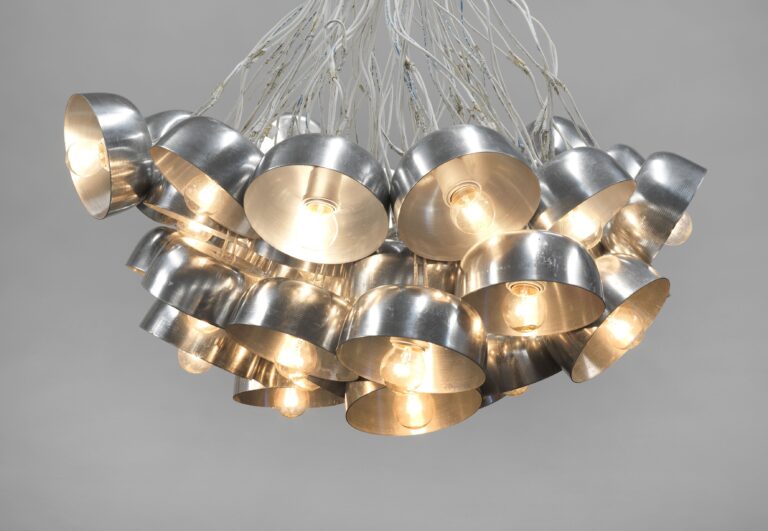
Udomsak Krisanamis,
Chandelier, 2006,
aluminum bowls, light fixtures, light bulbs,
ca. 125 x ⌀ 70 cm
© Udomsak Krisanamis.
Courtesy the artist and neugerriemschneider, Berlin.
Photo: Jens Ziehe, Berlin
The gallery’s main space plays host to a conversation between the multi-part groupings that line its walls and sculptures, suspended and free-standing. Udomsak Krisanamis’ Chandelier (2006) – a complex of the aluminum bowls omnipresent in the artist’s native Thailand, clustered to an overhead fixture – acts as a catalyst for explorations of light as an artistic medium. Olafur Eliasson takes up this pursuit with Striped eye lamp (2005), probing perceptions of light, color and space by way of color-effect filter glass, while Mario García Torres’ La política de la aceptación (The Politics of Acceptance) (2020) employs a lampshade as the canvas for painted abstraction. In Haegue Yang’s Mesmerizing Pagoda Lantern – Cabbage-Butterfly Aquatic Ultramundane Flowers (2023) and Jorge Pardo’s Untitled (2009), light takes layered paths: for Yang in work rooted in the richly decorated lanterns of shamanist and Buddhist afterlife rituals, and for Pardo in the vertical slats of polycarbonate that, arranged radially, become a full-length portrait of a member of the artist’s studio. The body takes on further form in small-scale narrative sculptures. To this end, Andreas Eriksson’s bronze Content is a Glimpse 93 (2024) memorializes a bird after it suffered a collision with his studio’s window. Thomas Bayrle’s Parkhaus Köln [Ausg.
B] (2009) blurs the lines between publication and sculpture with a signature representation of roadways and infrastructure. Baradziejki (2025), a ceramic work by Pawel Althamer, finds its source closer to home, in a late-1940s photograph of his mother and her six sisters in Warsaw.
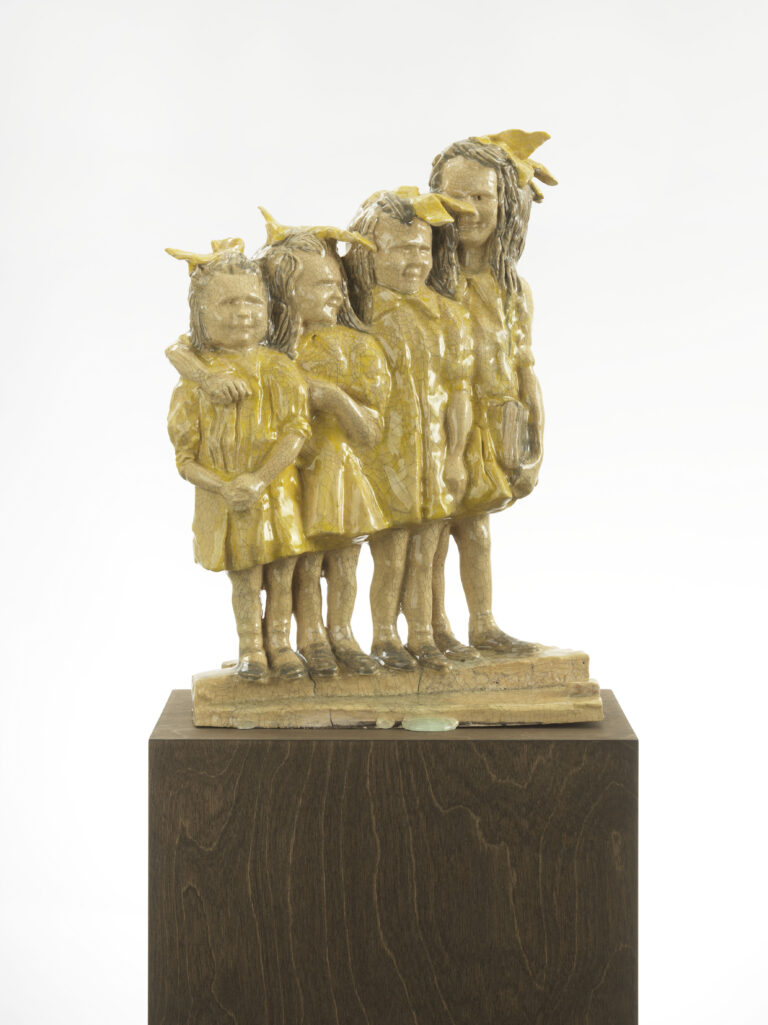
Pawel Althamer,
Baradziejki, 2025,
glazed ceramic,
50 x 32 x 19 cm.
© Pawel Althamer.
Courtesy the artist and neugerriemschneider,
Berlin.
Photo: Jens Ziehe, Berlin
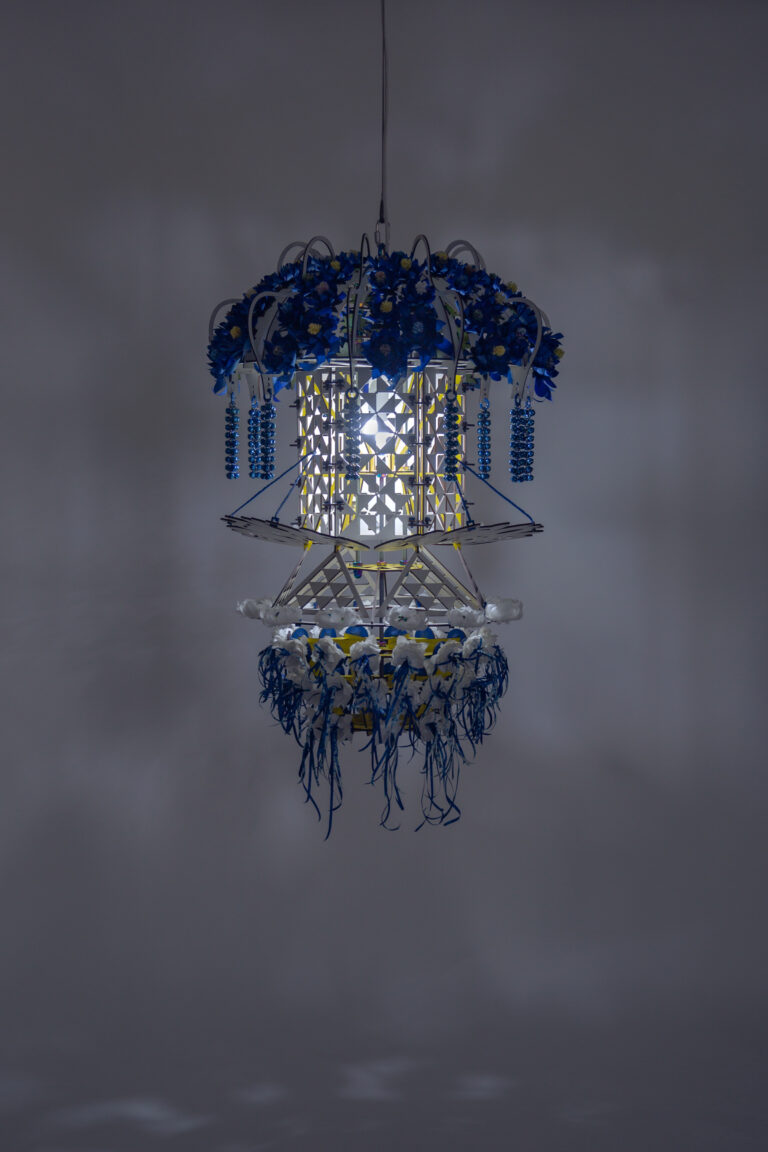
Haegue Yang,
Mesmerizing Pagoda Lantern – Cabbage-Butterfly Aquatic Ultramundane Flowers, 2023,
birch plywood, wood stain,
stainless-steel fully threaded bolt, stainless-steel components, steel wire rope, led bulb, cable, hanji, powder-coated stainless steel
and pvd-coated stainless steel bells, split rings, leather cord,
116 x 70 x 70 cm.
© Haegue Yang.
Courtesy the artist and
neugerriemschneider, Berlin
Bridging the space’s sculptural complex and its wall-mounted procession, Althamer’s Nowolipie Group (2022) features clay portraits of members from the eponymous group – an artistic workshop founded and led by Althamer for people with multiple sclerosis. The eight silkscreen prints of Eriksson’s Snowfall in Reverse (2022) at first glance appear as abstractions in binaries of black and white, yet reveal their underlying coloration upon closer inspection. Thaddeus Strode poses philosophical queries with minimal approaches in drawings from his landscapes on the drift/pelican thoughts (all 2010) series, while Rirkrit Tiravanija’s demonstration drawings (all 2007) – each commissioned from students and young artists from Thailand – trace the history of civil activism by reproducing in graphite photographs of protests published by the International Herald Tribune.
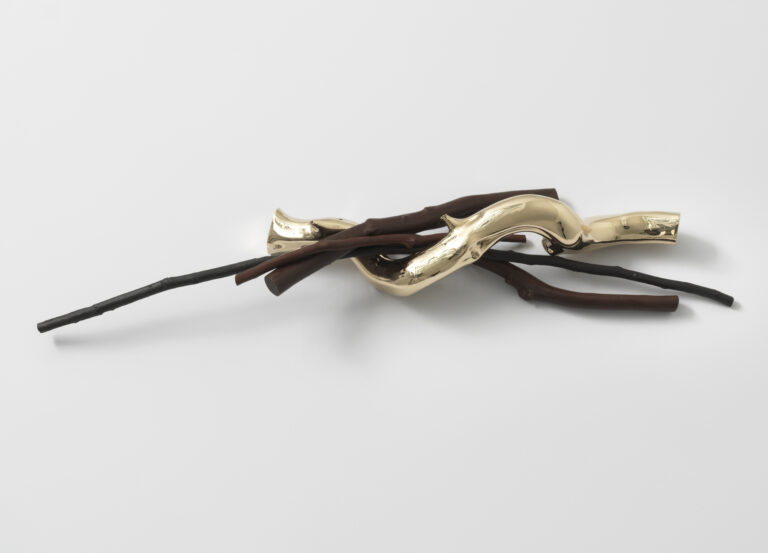
Sharon Lockhart,
A Bundle and Five Variations: Variation I, Five Bronze Sticks, 2018,
bronze, 5 parts,
overall: 10.5 x 94 x 20.5 cm.
© Sharon Lockhart.
Courtesy the artist and neugerriemschneider, Berlin.
Photo: Jens Ziehe, Berlin
The worn baseball cap mounted in Mike Nelson’s Trophy Head (LAND BELOW THE WIND) (2022) links the presentation’s spaces, gesturing to a monumental wall carpet by Noa Eshkol as it stretches towards sculptures by Ai Weiwei, Billy Childish and Tobias Rehberger, as well as Osage Orange IV (2026), an artistic exploration by Antje Majewski of the complex history of colonization, indigenous culture and environmental destruction in the United States. James Benning’s three-part After Missouri Pettway (2013) juxtaposes the legacies of the Black quilt artists of Gee’s Bend and that of Piet Mondrian’s neoplasticism, while light reappears in two sculptures by Simon Starling. With Italian design as a point of departure, the paired elements unite a concentrated collection of works by Olafur Eliasson, Cevdet Erek, Thilo Heinzmann, Sharon Lockhart, Tomás Saraceno, Thaddeus Strode and Rirkrit Tiravanija, gathered in an inviting evocation of the warmth we carry’s call to new, nearer perspectives.