

Inscape
With works by Kea Bolenz, Caroline Douville, Gala Lillian Glotzbach, Ant Łakomsk, Antonia Nannt, Josephine Rothäuser, Klaudia Schifferle, Aline Schwibbe
3 JUL until 1 AUG 2026
Kraupa-Tuskany Zeidler is pleased to announce Inscape , a group exhibition curated by the gallery team, presenting established and emerging artists working across various media.
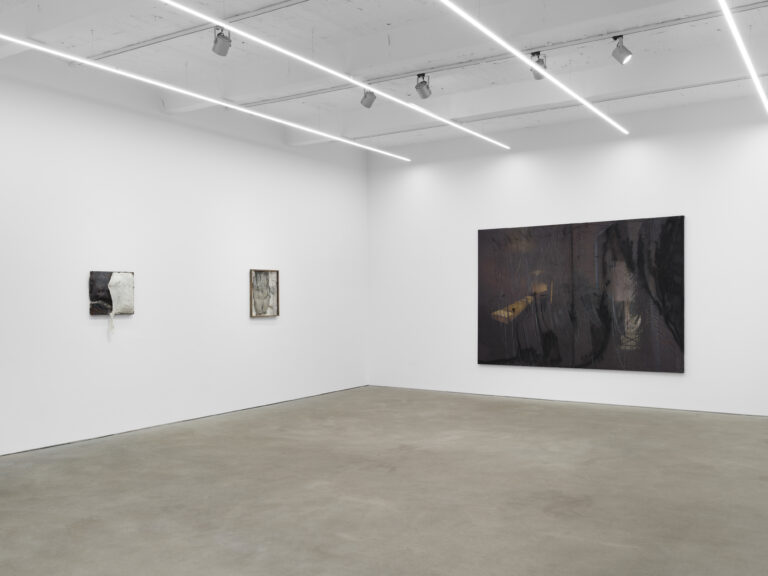
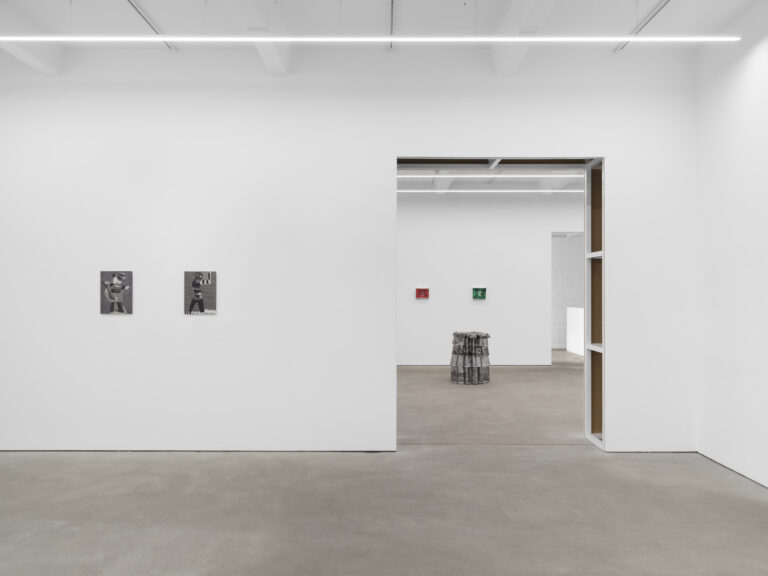
Installation view
Ph: Marjorie Brunet Plaza
Courtesy the artist and Kraupa—Tuskany Zeidler Berlin and Munich
The word inscape enters the English language in two registers, from two distinct moments. The Victorian poet Gerard Manley Hopkins derived it from the medieval philosopher Duns Scotus’s concept of haecceitas, or thisness: the irreducible inner form through which each individual thing enacts its own identity, in all that it assimilates and carries within. This form is not static but performed; continuously expressing the selfhood that lives within. Later the term was adopted by the Chilean surrealist Roberto Matta, who used it to describe his paintings of the late 1930s: works he called psychological morphologies, explorations of the mind conceived as a three-dimensional space, a landscape one could enter and depict.
Inscape, then, is both portmanteau and proposition: the interior treated as terrain, the psyche as a geography with its own topography, its own shadow and unmapped expanse. The works in the exhibition come together in response to this proposition, presenting interior landscapes that are plural by nature, at times intentionally unresolved and ambiguous.
Space, in this sense, is understood as the product of simultaneous and intersecting stories: never singular, never settled. It is shaped by those who inhabit it, pass through it, are excluded from it, or claim it on their own terms. To map a space is therefore to map a set of relations: between bodies and boundaries, between presence and absence, between what is permitted and what is withheld. Borrowing from psychogeography the understanding that space is navigated through the psyche rather than through strictly cartesian parameters, the exhibition suggests that space is never neutral but shaped by gender and power long before the body arrives in it.
JOSEPHINE ROTHÄUSER’s (b. 2001, lives and works in Berlin) multi-media textile works o.T. (2025) and Die Hand (2026) emerge through the ongoing cycles of destruction and reconstruction that take place within a material search for satisfaction. Through willful interventions and constant repair, a body-adjacent practice emerges, inscribed with traces of process and references to spatial and temporal conditions. Drapings, gravity, and tension connect the works to their physical environment while simultaneously demarcating them from it. What results is a manifestation of traces which behave like a staged coincidence within their surroundings.
ALINE SCHWIBBE (b. 1988, lives and works in Berlin) draws from fragmented memories and elusive dreamscapes to evoke narratives that are cyclical, refusing chronological legibility and linear resolution. Schwibbe’s works are multi-layered: photographs or film stills are printed onto plush velvet, then worked over with oil pastel and spray lacquer, while the velvet’s nap is disrupted to reveal the fabric’s materiality. This layering strengthens the illusion of depth and suggests that parts have been concealed to remain inaccessible to the viewer, just as memory itself resists full retrieval, surfacing only in fragments. In Weathers (2025) Schwibbe layers drawings and lacquer applied through lace as a stencil to partially cover the underlying image of a window, keeping the viewer in the dark of the implied interior. Schwibbe’s works in the exhibition show spaces that are void of human subjects. The traces of their inhabitants, such as a flickering light in Brutal Darling (2025) or the empty bed and closed gate in The Chain Night (2024), remain static while the overlaid drawings, restless and almost violent, appear like spectres mediating between realms.
Der Mitschnacker ist die Nächstenliebe (2025) and Heterosexuality 2 (2026) extend KEA BOLENZ’s (b. 1998, lives and works in Berlin) graphite practice into densely packed, swarming compositions where bodies are never singular but always in contact, excess and collapse. Limbs spread, mouths gape, breasts, butts and sexual organs surface among more abstract organic protrusions with no clear hierarchy of foreground or background, no single body granted priority over the crowd it penetrates and is penetrated by. Der Mitschnacker ist die Nächstenliebe gathers its figures around a cluster of faces and tangled, nursing bodies that seem to feed on one another, an economy of closeness that collapses care into appetite. The title’s pairing of ‘Mitschnacker’ (a co-conspirator, one who talks along, suggestively close) with ‘Nächstenliebe’ (love of one’s neighbour, a Christian charity) sharpens that ambivalence between the erotic and the pastoral. Heterosexuality 2 foregrounds an oversized pair of bare haunches and genitals at the centre of the scene, around which smaller bodies, animal and human, multiply and orbit, groping, climbing, and copulating; the dominant form reads as a sexual hub the surrounding figures are drawn toward and absorbed into.
CAROLINE DOUVILLE (b. 1993, lives and works between Berlin and Montreal) researches Afro-descendant culture and its influence on popular culture, attempting to demystify the cognitive processes by which members of the diaspora interrogate and connect to their distant identity. Douville is particularly interested in how the internet acts as a tool to facilitate this research by providing access to a vast range of content, and the ways in which images are contextualised online. The works in the exhibition take as their references online imagery collected as part of the artist’s research into the voodoo traditions of Haiti, and consequently the zombie as a motif and sociocultural phenomenon. Haiti December 24th 1945 (2023) takes an image published on the Daily Mail website depicting a Mambo (voodoo priestess) at a ceremony, taken by a photographer usually known for celebrity photography. In contrast, the image shown in Preparing the poison (2025) derives from an academic source: an article from the 1980s, researching the substance which Haitian voodoo practitioners made to zombify people. Both canvases are encased in steel frames, evocative of electronic devices, and how they can act as a window to another dimension or time.
In ANT ŁAKOMSK’s paintings (b. 2001, lives and works in Warsaw), female figures frequently find themselves suspended in uncertain circumstances. Łakomsk also often borrows from art historical moments: in Bela (2026), a self portrait of the Hungarian artist Béla Czene from the 1930s is subverted, her gaze redirected by the mediation of a mirrored reflection in a wardrobe. The result is one of ambiguity: the painting’s subject at once meets the eye of the observer but also implies that the figure’s gaze is on herself in the reflection. It is such fleeting but intense moments that Łakomsk frequently captures in her compositions, situated as always within her characteristically ephemeral and desaturated universe.
GALA LILLIAN GLOTZBACH’s (b. 2001, lives and works in Berlin) figures likewise usually appear in the singular, at once present and dissolving. By frequently depicting her subjects in atmospheres of decay and vulnerability, the paintings reflect on the lingering physical and psychological effects of colonial histories, and the consequent feeling of alienation — the quiet dissonance of navigating spaces where one is present yet unseen. The paintings hold an emotional charge: a backdrop of a highway serves as both setting and metaphor in good girl gone silent (2025), a place of perpetual movement evoking profound melancholy as well as the tension of transition. Meanwhile, Let me rest (2026) depicts a female figure draped over a decaying building, in stark contrast to the woman’s own carefully crafted appearance, creating a dialogue between construction and decay.
ANTONIA NANNT’s (b. 1995, lives and works in Berlin) work explores femininity through the lens of the historically charged interior. The sculptures, Yes, I married a decorator too… , (2024) and ‘when a table pretends to be something else, kitsch appears…’/ delight in tragic objects/ memory-fetish/ recherche du temps perdu (2026) merge the functionality of the table with the symbolism of the skirt, investigating the relationship between function, ornament and socially constructed notions of femininity. Drawing on forms and motifs from historical decorative arts, the works consider ornament as a vehicle for cultural expectations and social representation. Madame Déficit, La Capricieuse, Raine Déchue, Miss Extravaganza (2026) extends this exploration through welded inscriptions of Marie Antoinette’s nicknames, referencing a figure who continues to serve as a projection surface for ideas of femininity, power and representation. Together with phrases embedded in the welded seams of the table skirts such as ‘delight in tragic objects’, the work references an interior object suspended between utility and disguise, its function concealed beneath layers of steel ruffles and lace. Oscillating between memory, fetish and ornament, these historically charged forms transform the decorative into objects where nostalgia, desire, and cultural projections converge, reflecting on the ambivalent role of domesticity in shaping gendered identities.
MetalGirls I and MetalGirls II extend KLAUDIA SCHIFFERLE’s (b. 1955, lives and works in Zurich) restless, intuitive language into photographic collages, continuing her practice of fragmenting the figure and letting it reassemble in unstable, hybrid forms. The female body is built: limbs, torsos, and mechanical fragments are layered and collaged into figures that are part anatomy, part machine. Metallic surfaces, chrome, riveted plating, striped industrial textures, fuse with skin. The logic behind these figures carries the imprint of collage’s own history as a DIY-punk craft: a method connected to scarcity and speed. Grounded in the late-1970s Zurich punk and post-punk scene, Schifferle is deeply embedded in this way of working. In MetalGirls I , a torqued, planted stance and a faceless, helmeted head turn the figure into something closer to armature than portrait, a body braced for impact or already mid-transformation. MetalGirls II leans further into collapse and excess: a gaping, toothy mouth and disjointed, doll-like limbs push the figure toward caricature.
– Emanuela Anders, Sigrid Hermann, Luzie Naters, Isabelle Thul