

Walter Dahn
Let's Get Married, Let's Get Lost
11 SEP – 24 OCT 2026
Opening – 10 SEP 2026, 6–10 pm
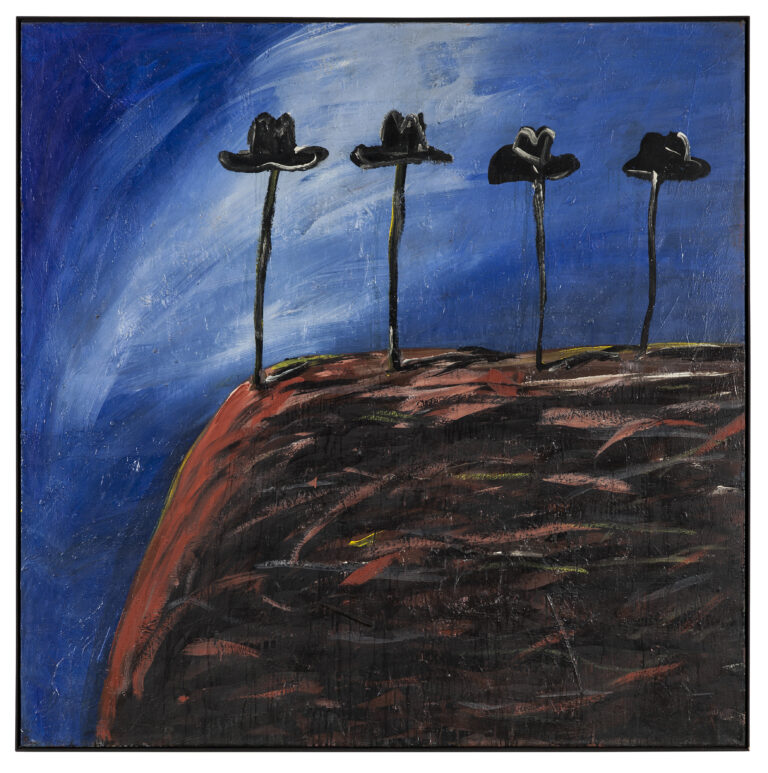
Walter Dahn
Vier für ein Ave Maria, 1982
Dispersion on nettle cloth
250 × 250 cm | 98 3/8 × 98 3/8 inches
© Estate of Walter Dahn / VG Bild-Kunst, Bonn, 2026
Courtesy Sprüth Magers
Photo: Timo Ohler
In the 1980s, Walter Dahn first gained recognition in Cologne as a pioneer of the “Bad” Painting movement and as a founding member of the Mühlheimer Freiheit, a group of neo-expressionist artists known for their rebellious, punk-inflected attitude. During this period, Dahn’s practice centered on a critical reassessment of painting as a medium. Incorporating references to contemporary music and popular culture, his works evoke a broad array of associations, prompting existential and historical questions that aim at deconstructing the visual ideologies of everyday life. Sprüth Magers is pleased to present a survey exhibition of Dahn’s work on the occasion of Berlin Art Week. The first show since his passing in 2024, the presentation offers a renewed look at his practice.
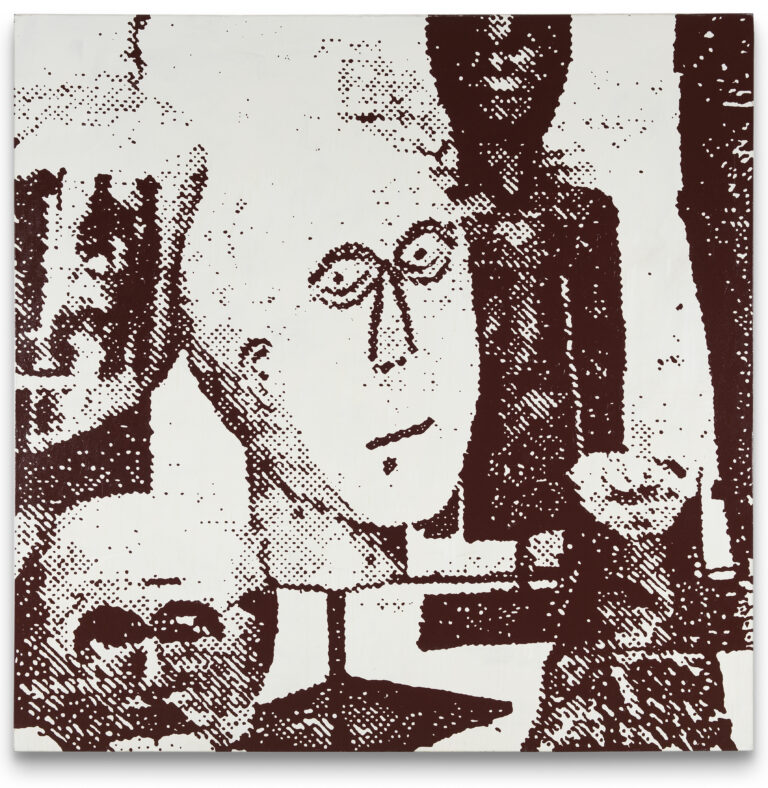
Walter Dahn
Untitled (Ex Voto), 1987
Oil on canvas
230.2 × 230.5 cm | 90 5/8 × 90 3/4 inches
© Estate of Walter Dahn / VG Bild-Kunst, Bonn, 2026
Courtesy Sprüth Magers
Photo: Timo Ohler
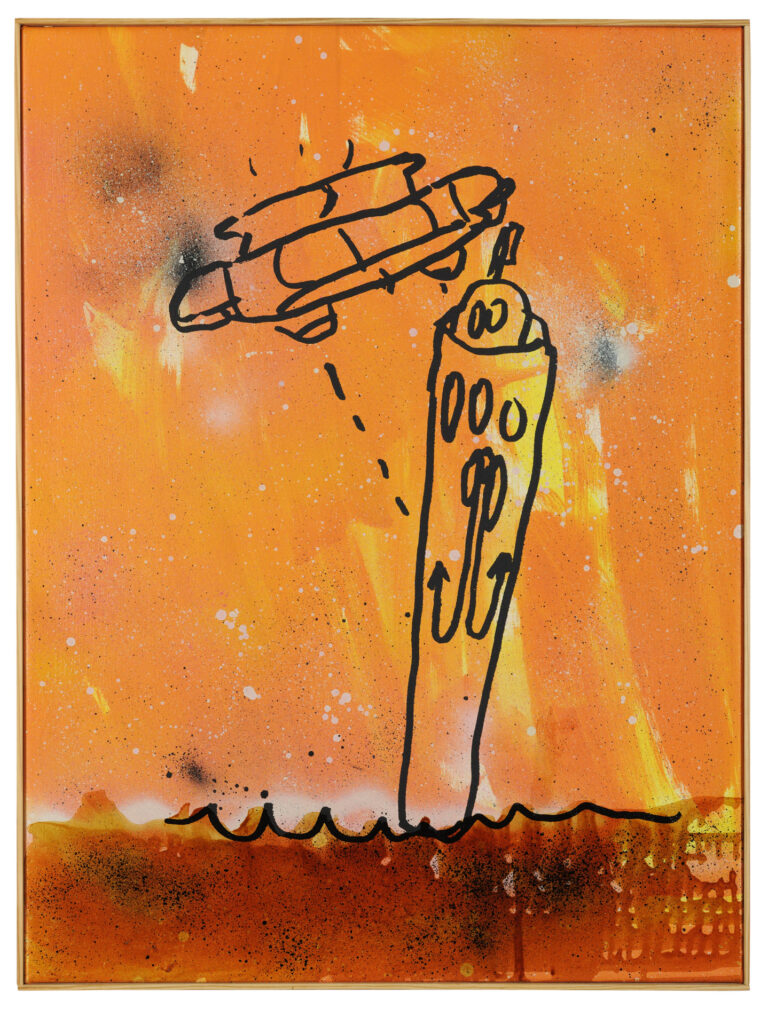
Walter Dahn
Ufo, 1985
Spraypaint and acrylic on canvas
80 × 60 cm | 31 1/2 × 23 5/8 inches
© Estate of Walter Dahn / VG Bild-Kunst, Bonn, 2026
Courtesy Sprüth Magers
Photo: Timo Ohler
Walter Dahn (1954–2024) lived and worked in Cologne. Selected solo exhibitions include Haus Mödrath, Kerpen (2024), Kestnergesellschaft, Hannover (2019), Kunstmuseum Basel (2017), Kunstverein Sankt Pauli, Hamburg (2007), Kunstverein Krefeld (2005), Stedelijk Museum, Amsterdam (1997), Kunsthalle zu Kiel (1994), Van Abbemuseum, Eindhoven and Museum für Gegenwartskunst, Basel (both 1989), Museum Folkwang, Essen, Kaiser Wilhelm Museum, Krefeld and Kunstmuseum Hannover (all 1986) and Rheinisches Landesmuseum Bonn (1985). Recent group exhibitions include Nouveau Musée National de Monaco (2024), Kunstmuseum Bonn (2022), Kunsthalle Mannheim (2021), Hamburger Bahnhof, Berlin and Von der Heydt Museum, Wuppertal (both 2020).
Jean-Luc Mylayne
Reflection
11 SEP – 24 OCT 2026
Opening – 10 SEP 2026, 6–10 pm
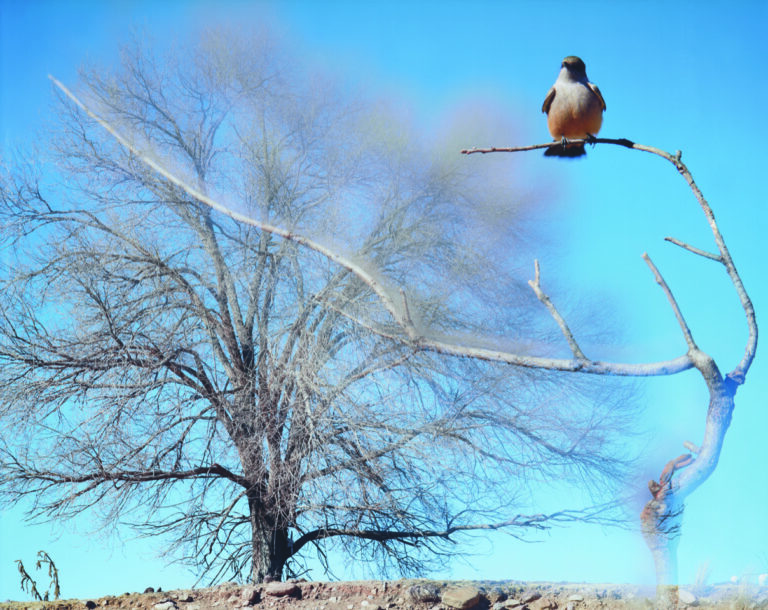
Jean-Luc Mylayne
N°561, Janvier Février 2008, 2008
C-print
186 × 231 cm | 73 1/4 × 91 inches (framed)
Copyright Jean-Luc Mylayne
Courtesy Sprüth Magers
Jean-Luc Mylayne has devoted his life to philosophical questions about our place on Earth—questions for which birds and their natural habitats serve as both subject and symbol, and through which he probes what it means to be human alongside nature. Made in close collaboration with his life partner, Mylène, each photograph is the result of months of patient work, a sustained investigation into temporality, perception and community.
Sprüth Magers is pleased to present Reflection, a solo exhibition of Mylayne’s work, on the occasion of Berlin Art Week. The majority of the images on view were conceived during a residency in Marfa, Texas, where Mylayne was drawn to the intense shades of blue found in the water and sky, and sometimes in the birds themselves. N°498 – 499, Janvier Février Mars 2007 (2007), a diptych depicting two birds observing an expansive landscape, is exemplary in this regard. Within its abrupt transitions from blurred to sharp detail, there is no single point of focus. Without a one-point perspective to organise the depicted landscape, the viewer’s eye is compelled to move searchingly through sudden shifts in spatial registers. This dynamic quality is achieved using lenses of varying focal lengths that are specifically built for the artist’s purposes, lending the image a certain painterly character.
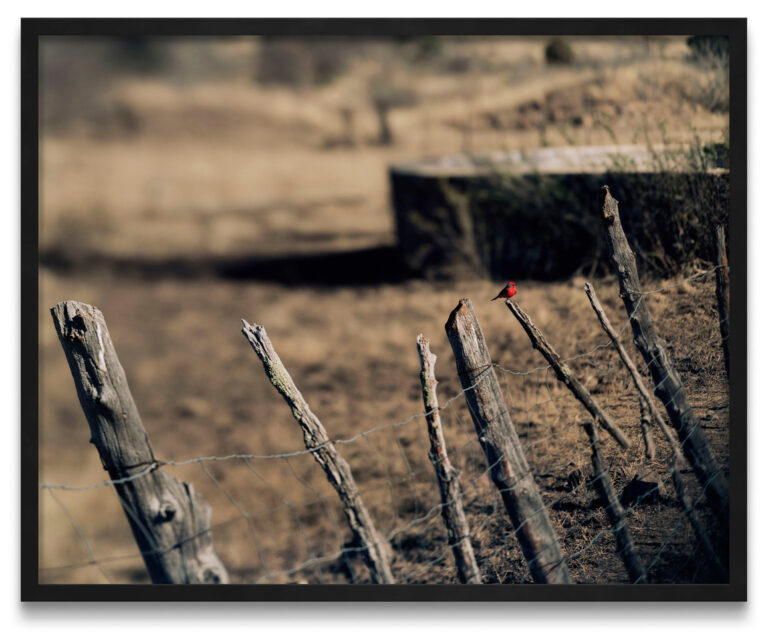
Jean-Luc Mylayne
N° 353, Novembre Décembre 2005, 2005
C-print
123 × 153 cm | 48 3/8 × 60 1/4 inches (framed)
Copyright Jean-Luc Mylayne
Courtesy Sprüth Magers
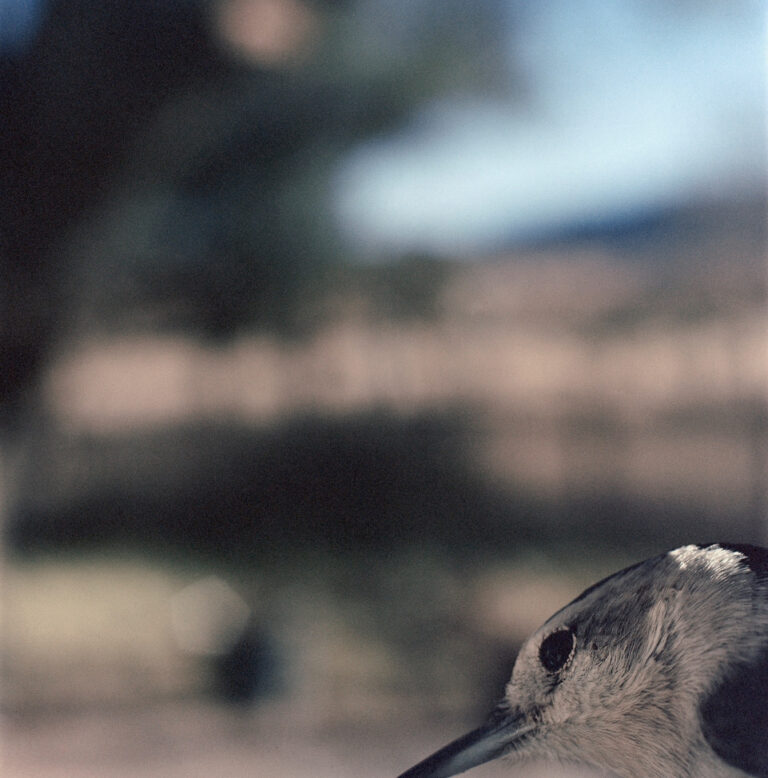
Jean-Luc Mylayne
N° 577, Février Mars 2008, 2008
C-print
103 × 103 cm | 40 1/2 × 40 1/2 inches (framed)
Copyright Jean-Luc Mylayne
Courtesy Sprüth Magers
Mylayne’s titles follow an invariable, archival logic: numbered chronologically and stating only the months and year of production, they make no reference to location or species. Time, they insist, is the fundamental dimension of his work, not the creatures within it. As critic Lynne Cooke has observed, he “abjures a romantic identification with his appealing subjects” while also refraining from casting human and animal as opposites within their shared domain.[1] Reflection, the title of this exhibition, speaks to the contemplation that Mylayne’s work invites, centred around the question how human beings might truly coexist with the natural world.
Jean-Luc Mylayne (*1946, Marquise, France) lives and works in the world. Selected solo exhibitions include Kestnergesellschaft, Hannover (2020), Fondation Vincent Van Gogh, Arles, France, Aargauer Kunsthaus, Aarau, Switzerland, Long Museum, Shanghai (all 2018–19), The Art Institute of Chicago, The Arts Club of Chicago, Lurie Garden, Millennium Park, Chicago (all 2015), Museo Nacional Centro de Arte Reina Sofía, Madrid (2010), Musée d’Art Contemporain de Lyon (2009), Parrish Art Museum, Southampton, New York (2007–09), Lannan Foundation, Santa Fe, New Mexico (2004, 2005, 2010), Musée des Arts contemporains, Grand-Hornu (2004), Musée d’Art Moderne de la Ville de Paris (1995), Musée d’Art Moderne et Contemporain, Saint-Étienne (1991). Significant group exhibitions include Hayward Gallery, Southbank Centre, London (2020), S.M.A.K., Ghent (2017), 54th La Biennale di Venezia (2011), Neues Museum Weserburg, Bremen (1998), 10th Biennale of Sydney (1996), Kunsthaus Zürich, Zurich (1995).
[1] Lynne Cooke, „Jean-Luc Mylayne: Between Contingency and Calculation,“ in Jean-Luc Mylayne: Into the Hands of Time, exh. cat. (Madrid: La Fábrica/Museo Nacional Centro de Arte Reina Sofía, Palacio de Velázquez, 18 November 2010–4 April 2011), 11–20, here 20.
Salvo
La città
11 SEP – 24 OCT 2026
Opening – 10 SEP 2026, 6–10 pm
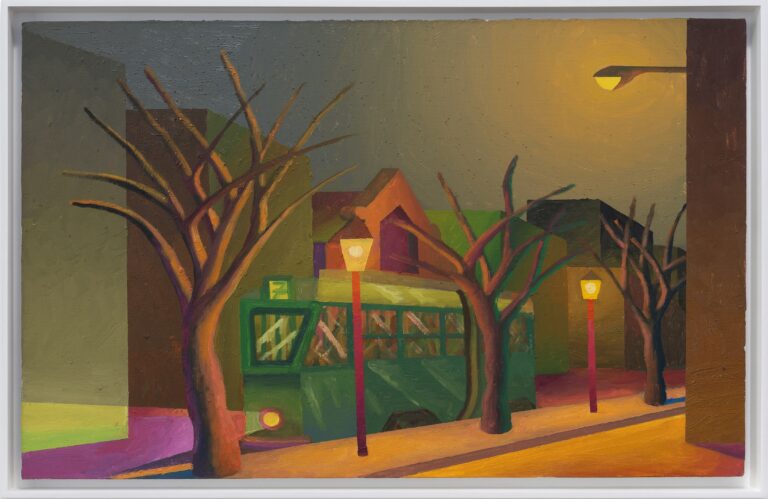
Salvo
La città, 2013
Oil on canvas
38 × 60 cm | 15 × 23 5/8 inches
41.2 × 63.2 × 4 cm | 16 1/8 × 24 7/8 × 1 5/8 inches (framed)
© Archivio Salvo
Courtesy Archivio Salvo and Sprüth Magers
Photo: Kris Emmerson
Salvo was an Italian Conceptual artist in dialogue with the burgeoning Arte Povera movement before his practice dramatically shifted in 1973, when he turned decisively to figurative painting. In his singular body of landscapes, Salvo returns again and again to the same archetypal locations—Mediterranean landscapes, Classical ruins, factory districts, snowy mountainscapes and villages—each holding a universal familiarity. Through this gesture of repetition and refinement, the specific geographies of these recurring motifs dissolve, pushed to a point of “maximum tension” until they break free. What remains are pretexts for experiments in colour, form and light. On the occasion of Berlin Art Week 2026, Sprüth Magers is pleased to present La città, an exhibition of paintings that dwell in the city. The presentation in the Berlin gallery’s Window space, visible from the street outside, unfolds as a journey from the desolate outskirts to the pulse of the city centre.
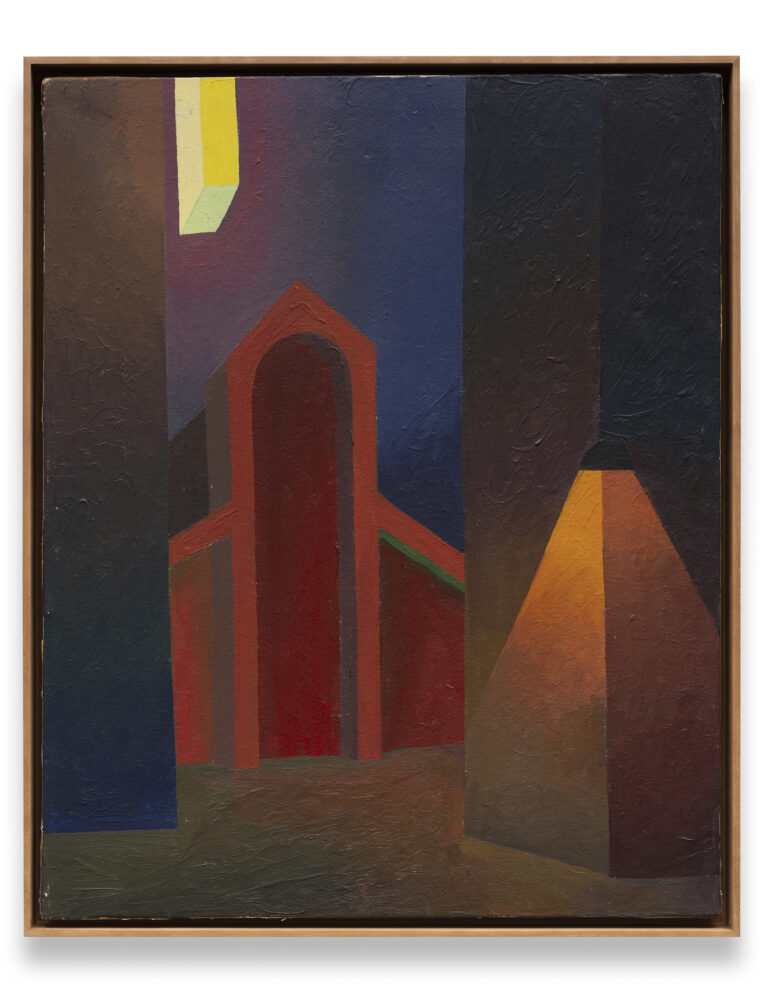
Salvo
Untitled, 1988
Oil on canvas
50 × 40 cm | 19 3/4 × 15 3/4 inches
52.1 × 42.2 × 4 cm | 20 1/2 × 16 5/8 × 1 5/8 inches (framed)
© Archivio Salvo
Courtesy Archivio Salvo and Sprüth Magers
Photo: Timo Ohler
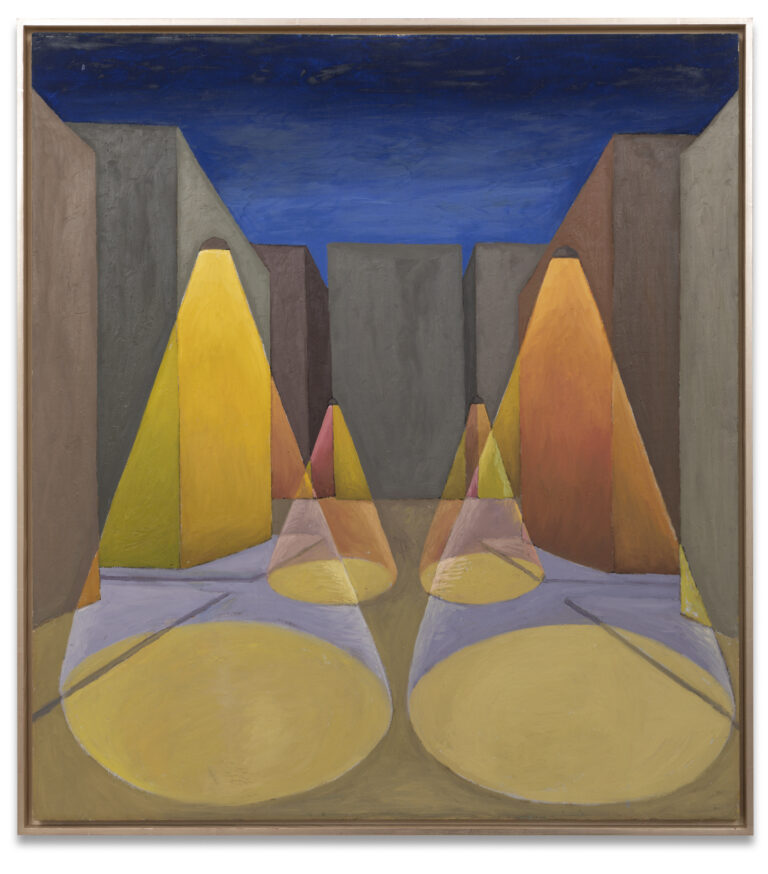
Salvo
Untitled, 1980
Oil on wood
101 × 90 cm | 39 3/4 × 35 3/8 inches
© Archivio Salvo
Courtesy Archivio Salvo and Sprüth Magers
Photo: Sebastiano Pellion di Persano
The passage of time is traceable in the gradient hues of sunset giving way to the total darkness of night, when artificial light comes into play: electric neon signs, cone-shaped beams pouring from streetlamps, the soft glow of a tram carriage, the galvanic glare of a pinball machine. All coalesce into leaping, translucent fields of psychedelic colour that illuminate the cubic forms of Salvo’s architecture—buildings pared down to basic geometric shapes. Some paintings of the urban periphery depicting anonymous facades reduce figuration so far that they teeter on the edge of pure abstraction, held back from the brink by Salvo’s optical precision of light, their austerity carrying echoes of Giorgio de Chirico’s metaphysical landscapes. These sparse canvases stand in sharp contrast to works like Al cinema (1988) or Al bar (1981), which bristle with activity and narrative, the flow of figures and vehicles animating the city’s communal spaces with a theatricality the peripheral works withhold.
This heightened treatment of the cityscape lays bare further art-historical debts, among them the street scenes of Ottone Rosai and El Greco’s phantasmal figures. La città, above all, celebrates Salvo’s fascination with the city as motif—and, within it, the nocturnal as the condition that enables the interplay between architectonic form and his articulation of light, refracted into ever-deeper registers of colour.
Salvo (1947–2015) lived and worked in Turin. Solo exhibitions include Pinacoteca Agnelli, Turin (2025), Museum of Contemporary Art, Rome (2022), Museo d’Arte della Svizzera Italiana, Lugano (2017, with Alighiero Boetti), Museo d’Arte Contemporanea, Lissone (2015), Galleria d’Arte Moderna e Contemporanea, Turin (2007), Galleria d’Arte Moderna e Contemporanea, Bergamo (2002), Musée d’Art Contemporain, Nîmes and Museum Boijmans van Beuningen, Rotterdam (both 1988), Kunstmuseum Lucerne (1983),Mannheimer Kunstverein and Museum Folkwang, Essen (both 1977). In addition to participating in Documenta 5 (1972) and the 1976 and 1988 editions of Biennale di Venezia, recent group exhibitions include Kröller-Müller Museum, Otterlo, The Netherlands (2023), Kunsthaus Glarus, Switzerland (2022), Castello di Rivoli, Turin (2021) and Menil Drawing Institute, Houston (2020).