

Jessica Rankin
The Weight of Light
14 MAR until 20 JUN 2026
carlier | gebauer, Berlin, is pleased to announce the solo exhibition The Weight of Light by New York–based painter Jessica Rankin, presenting seven new works.
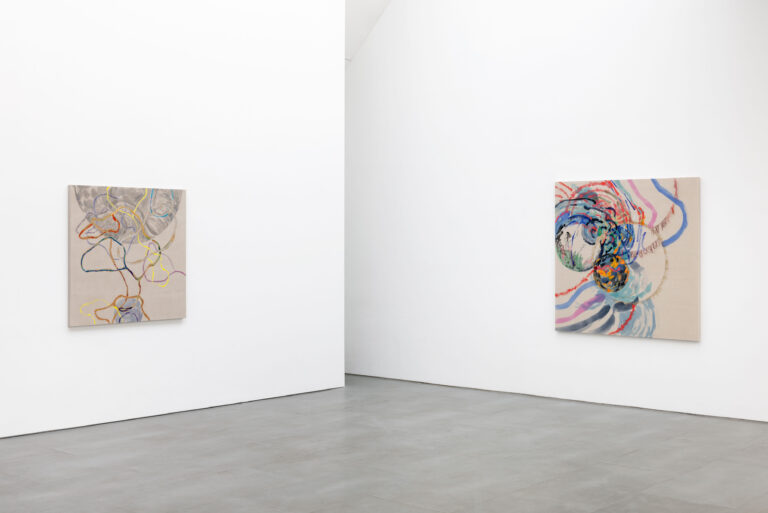
Jessica Rankin,
The Weight of Light,
exhibition view at carlier | gebauer, Berlin, 2026
Courtesy of the artist and carlier | gebauer, Berlin/Madrid
Photo © Andrea Rossetti
Known for her distinctive application of yarn and paint on canvas, Rankin renounces in her work notions of mastery over a medium in favour of an intuitive, playful approach, where paint behaves like thread and thread like paint. Veering between the disciplines, Rankin creates a visual back and forth between paint and thread, between painting and writing. Neither having trained as a painter nor embroider, and thus relinquishing mastery as a form of command over the medium, Rankin gains a freedom in her process. Reflection upon the work is part of its creation or follows afterwards, Rankin herself refers to her process “as making in a state of trepidation”.
Jessica Rankin
“Her Gathered Beams” (M) Milton, 2026
Acrylic and embroidery on linen
152,4 x 213,3 x 3,8 cm
Courtesy of the artist and carlier | gebauer, Berlin/Madrid
Photos © Andrea Rossetti
Jessica Rankin
“Her Gathered Beams” (M) Milton, 2026
Acrylic and embroidery on linen
152,4 x 213,3 x 3,8 cm
Courtesy of the artist and carlier | gebauer, Berlin/Madrid
Photos © Andrea Rossetti
The compositions spill over the edge of the canvas, onto which Rankin stitches text fragments.
These references are folded away, inviting the viewer to step closer and around the canvas, positioning them in relation to the work. These text fragments, as well as the titles of her large-scale paintings often quote poems from Rankin’s personal canon, thus unravelling a net of deeply intimate and personal references. These references in turn pose questions about art making and art history, lineage and visibility rendered through the lens of poetry, unfolded across a canvas. Rankin considers herself as an “earnest artist”, who does not approach her work with an ironic distance, but rather a certain scepticism.
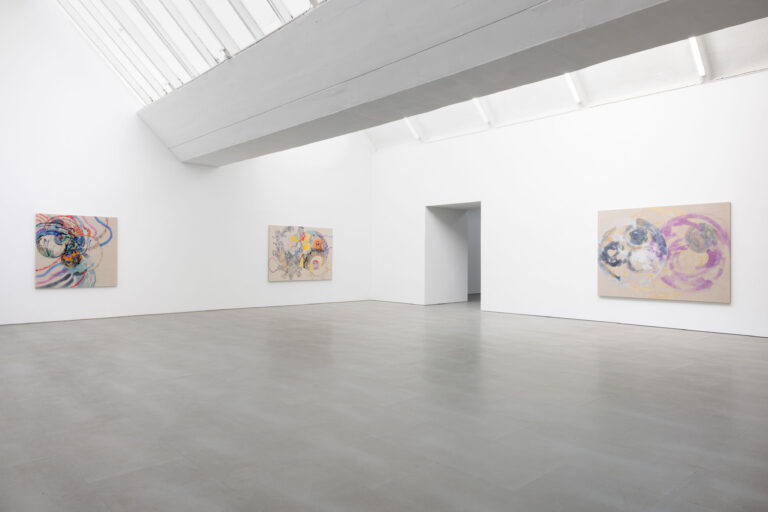
Jessica Rankin,
The Weight of Light,
exhibition view at carlier | gebauer, Berlin, 2026
Courtesy of the artist and carlier | gebauer, Berlin/Madrid
Photo © Andrea Rossetti
With the poet Ada Limón, whose poem Fifteen Ball of Feathers Rankin quotes in the paintings Watery Extension of Time (AL) and Small Susurrations (AL) the artist shares her exploration of the excitement and passion of being human, living life day by day. Like ripples of water, like powerful rays of sun, like it’s reverberations in the retina, these concentring compositions convey the wonder before the multitude of human experiences, as well as before nature and the natural environment. In her work, Limòn, touches upon topics of her heritage, which Rankin continues throughout the exhibition in a twofold way. Loop up the Sky Swooping (JR) quotes Mainland Eyes, a poem by the artists mother Jennifer Rankin, an acknowledged poet herself. About this poem, Martin Duwell writes in 2026: “The impression given is that a scene is being painted and some humans are located within it, doing the usual uninteresting things that humans do. The poet’s real interest is in the sky and its inhabitants, the birds, and in this sense Mainland Eyes is an introduction to one of Rankin’s continuing interests. There are birds in an extraordinary number of her poems, birds which, unlike bees and other insects, show no great interest in the earth”. In Her Gathered Beams (M) Rankin extracted this fragment from John Milton’s Paradise Lost, with which Milton aimed to achieve writing the first biblical epic in English, focusing on the so-called elevated subjects of love and heroism. Instead of telling a tale of a heroic subject, Rankin introduces a radiant heroine to this story, who instead of conquering gathers. One can think here along the lines of Ursula K. Le Guin’s Carrier Bag Theory of Fiction. Finally, with Whistle Anciently (AN), taken from the poem For the Ride Rankin reflects alongside Alice Notley on the solitary conditions of art making, filling the linen canvas with ribbon likes shapes, flowing alongside each other, while rarely intertwining or overlapping.
Anna Bella Geiger
Typus Terra Incognita
14 MAR until 20 JUN 2026
carlier | gebauer, Berlin, is pleased to announce Typus Terra Incognita, Anna Bella Geiger’s first solo exhibition in Germany. This show spans more than 50 years of Geiger’s artistic production, bringing together seminal historical works as well as recent ones.
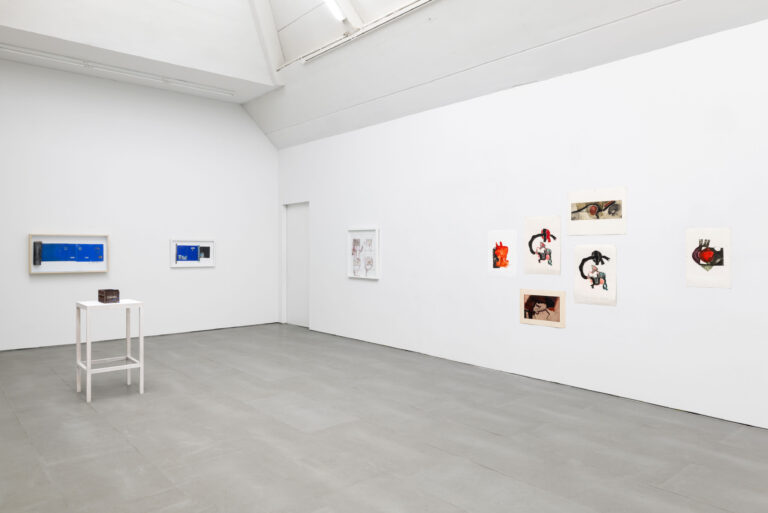
Anna Bella Geiger,
Typus Terra Incognita,
exhibition view at carlier | gebauer, Berlin, 2026
Courtesy of the artist and carlier | gebauer, Berlin/Madrid
Photo © Andrea Rossetti
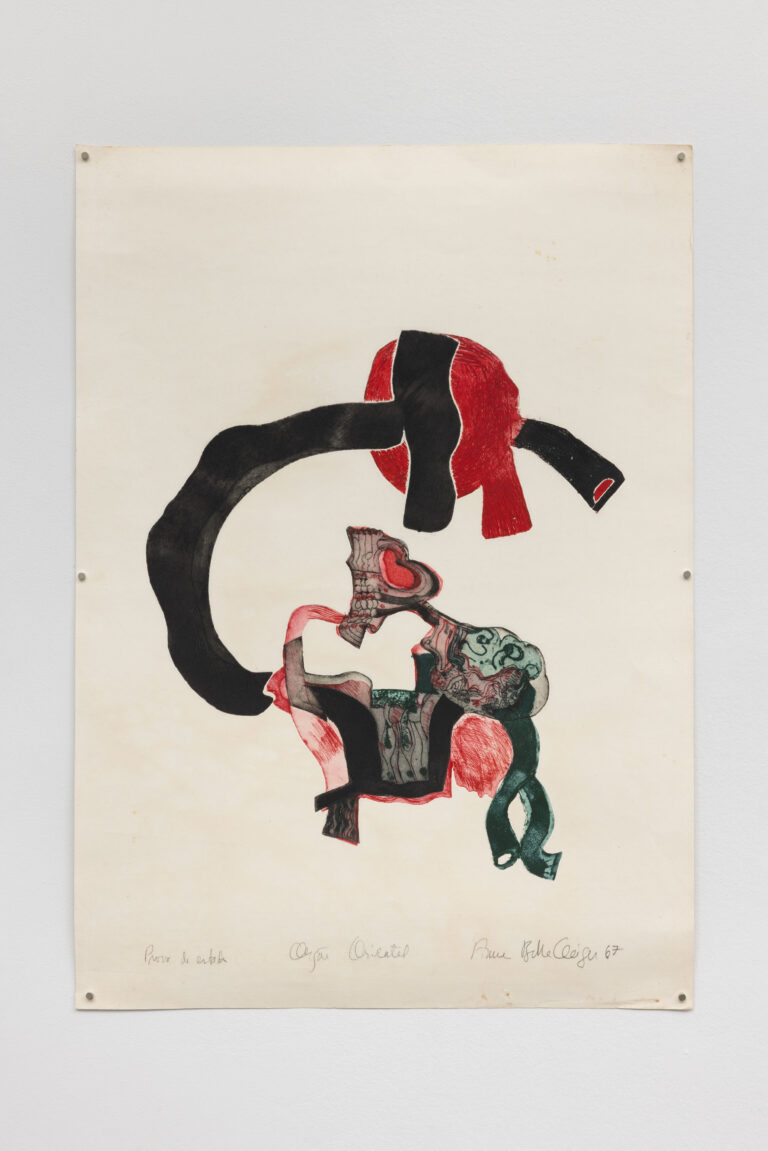
Born in 1933 in Rio de Janeiro, Geiger remains since the beginning of her career and until the present day as one of Brazil’s pioneering artists. She studied drawing and painting with Fayga Ostrower, whose teachings and works—expressions of her „respect for art as the eternal language of humanity“— were influential for a generation of Brazilian artists. Turning early on to abstraction in her work, in 1954 Geiger was already invited to participate in the First National Exhibition of Abstract Art. Geiger does not confine herself to the medium of painting, she continues to push her practice to draw from technical innovations as well as systems alien to art. Her oeuvre spans video, painting, drawing, engraving, textile, embroidery, collage, photography and installation. However, as Estrella de Diego, the Spanish art critics and curator, notes, Geiger does not abandon any of her media, she rather alternates from one to another. Even to the first drawing and etching, Geiger returns during what she calls her visceral phase. The medium she employs is merely a tool to explore the political dimensions of the world, as well as her interest in anthropology and geography. The map emerges as a sort of leitmotif in the practice, sometimes making appearances as neat miniatures, sometimes as deconstructed and distorted fragments. With this alteration Geiger’s precisely opens up the space, by transforming representations of space, to question cartography as a transparent, verified knowledge. To map is to name, thus expressing a mode of knowledge production full of hegemonic implications. Historically the domain of the man, the explorer cum colonizer, map making and the map itself seek to inscribe themselves upon a heterogenous reality, establishing one perspective dominant over others. Mapping implies also omission and erasure. Geiger counters these with her intuitive, poetic approach, a form of “geopoetics”. Her maps become expressive containers, relinquishing the quest for objectivity and omnipotence, in favor of a subversive, situated and even personal knowledge. Rather than representations these maps can be described as translations, which challenge the notions of control and command representation carries with it.
Anna Bella Geiger
Untitled, 1998 / 1999
from the series Rolinhos
Lead, drawing, and engraving on parchment paper
3 x 32,2 x 6 cm
Photo © Roberto Ruiz
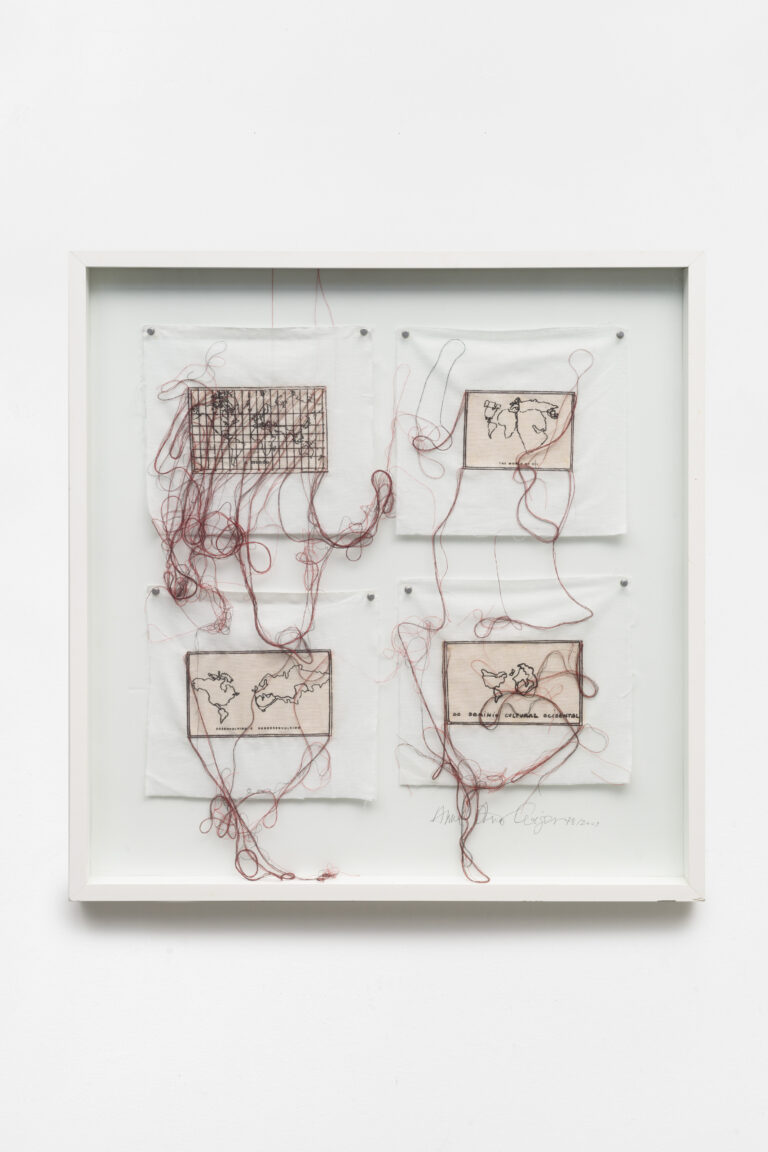
Anna Bella Geiger
Variáveis, 1978-2009
Serigraphy and machine embroidery on linen
83,5 x 81 x 5 cm
Photo © Roman März
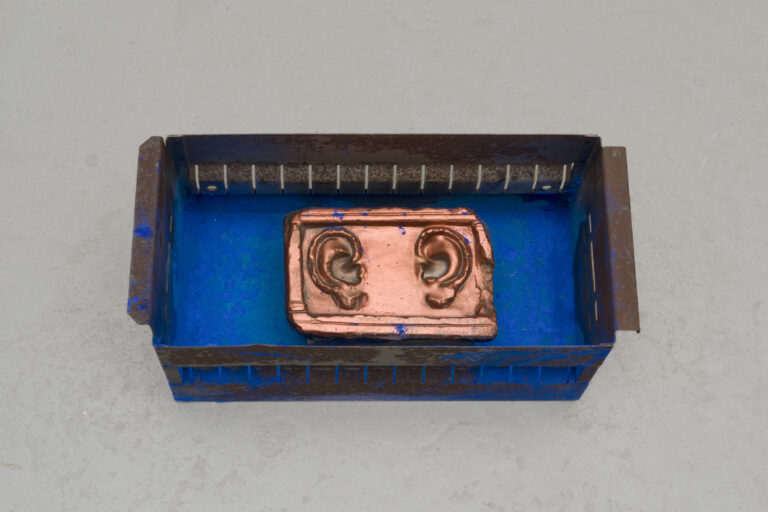
Anna Bella Geiger
OHREN ATHENA NºII, 1997
from the series Borderline
Iron file drawer, mold taken from the original at the Temple of Athena on the Acropolis in copper pigment and cobalt blue pigment provided by Yves Klein
13,5 x 32,5 x 15 cm
Photo © Roman März
In the series Scrolls (Rollos), and Little Scrolls (Rollinhos), created in the 1990s, Geiger continues what can be essentially described as an epistemological approach and analysis. These sculptures, which simultaneously function as graphic objects, resemble the oldest forms of knowledge preservation and transfer, the scroll. In The Book of Ester we encounter another form of knowledge organization, indexation and classification, as the scroll is made up by pages from an antique encyclopedia. Ambitiously aimed at a total reconstruction of knowledge on particular subjects as sciences, arts, and occasionally all human knowledge, encyclopedias can be viewed as maps of knowledge. Geiger deconstructs these by making the pages unreadable, only leaving visible certain elements, such as the syllables “ester”. The knowledge contained in the encyclopedia becomes therefore fractured, and almost as with automatic writing, another meaning emerges as from the subconscious of the text. Further, these scrolls are not presented fully unrolled, rather they show that they also hide. The transparency of knowledge is once more revealed as ephemeral in itself. Instead of rejecting this, Geiger fully embraces these uncertainties as a method in her ever changing, innovative life’s work. The exhibition is supported by The Brazilian Embassy and the Guimarães Rosa Institute in Berlin.
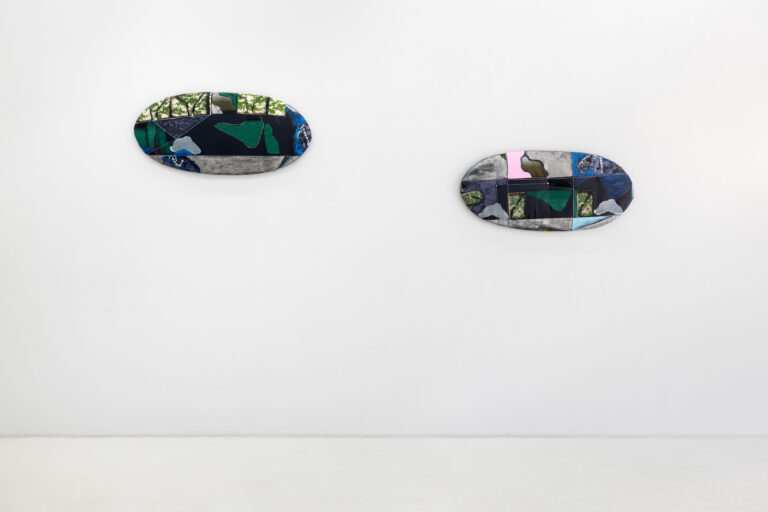
Anna Bella Geiger,
Typus Terra Incognita,
exhibition view at carlier | gebauer, Berlin, 2026
Courtesy of the artist and carlier | gebauer, Berlin/Madrid
Photo © Andrea Rossetti