

Carriers
With works by Mariechen Danz, Friedrich Einhoff & Xie Lei
27 FEB until 11 APR 2026
Opening – 27 FEB 2026, 6-9 pm
What becomes visible when a body is depicted, shaped, or fragmented? Bodies are not self-contained entities. They exist in continuous relation to their environments. They preserve experiences and memories in dreams, gestures, routines, scars. They function as a threshold between interior and exterior, between individual experience and social structures, between past and present.
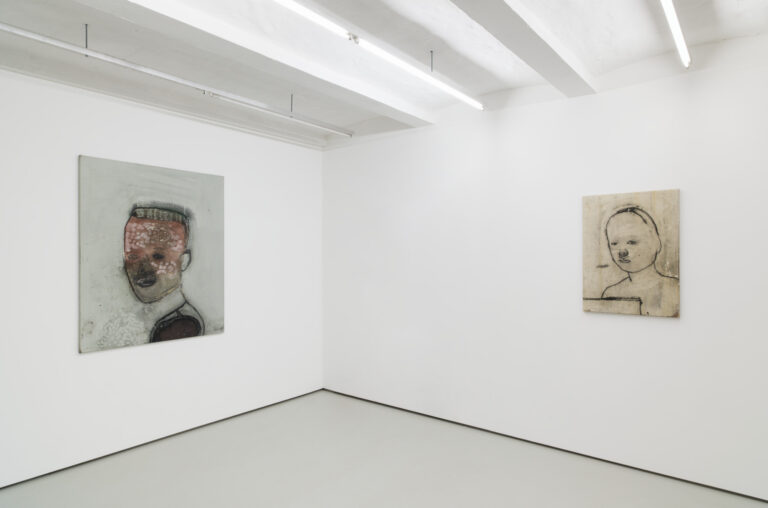
Mariechen Danz, Friedrich Einhoff, Xie Lei, Carriers, installation view alexander levy, Berlin, photo: Marcus Schneider, courtesy of the artists, alexander levy, Berlin
Carriers brings together three artistic positions that examine the body as a repository and projection surface for memory, authority, and transformation. Mariechen Danz, Friedrich Einhoff, and Xie Lei each analyze how experience becomes inscribed within our bodies.
Xie Lei’s paintings operate in the liminal space between dream state and consciousness. His figures appear suspended, without identifiable settings or narrative anchoring. They are anonymous. What matters is not who they are, but the state in which they exist. Xie Lei is interested in intense states of human sensation such as pain and pleasure, and the ambiguity of human relationships. Falling is a recurring motif, a symbol of a psychological state situated between loss of control, gravity, and transition. This experience is intensified in the works from the series Premonition, on view upstairs. Individual figures appear upside down within the pictorial space – their faces are distorted, their mouths agape; whether from pain or pleasure remains unresolved. The works resemble studies: suggestive, concentrated, and without narrative structure. The brushwork seems to merge the pictorial with the figures themselves. The heads are frozen in motion, yet all the while blurred. The effect is ghostly, as if they had just materialized only to dissolve again. These figures can be read as embodiments of inner states. They appear as residual afterimages of unknown individuals: fragments of a memory without origin.
Mariechen Danz’s work centers the body as a place of knowledge production. It serves as a starting point for critically reflecting on hierarchical knowledge systems, their historical context, and social structures. The alphabet, cartography, and scientific models act as reference points. At the same time, Danz interrogates the supremacy of hegemonic and Western production of knowledge. She widens our understanding towards other forms of knowledge, be these physical, oral, or mystical. Upstairs, one encounters Common Carrier Case (X Votive / starmap / I-a), a human-like silhouette made of perforated aluminum. Its shape is derived from a costume pattern developed by Danz. The light that streams through the perforations casts a shadow on the wall that resembles a constellation. Transparent organs protrude from the flat, cool body on long and curved poles. As they emerge out of the wall, architecture itself becomes a part of the anatomy.
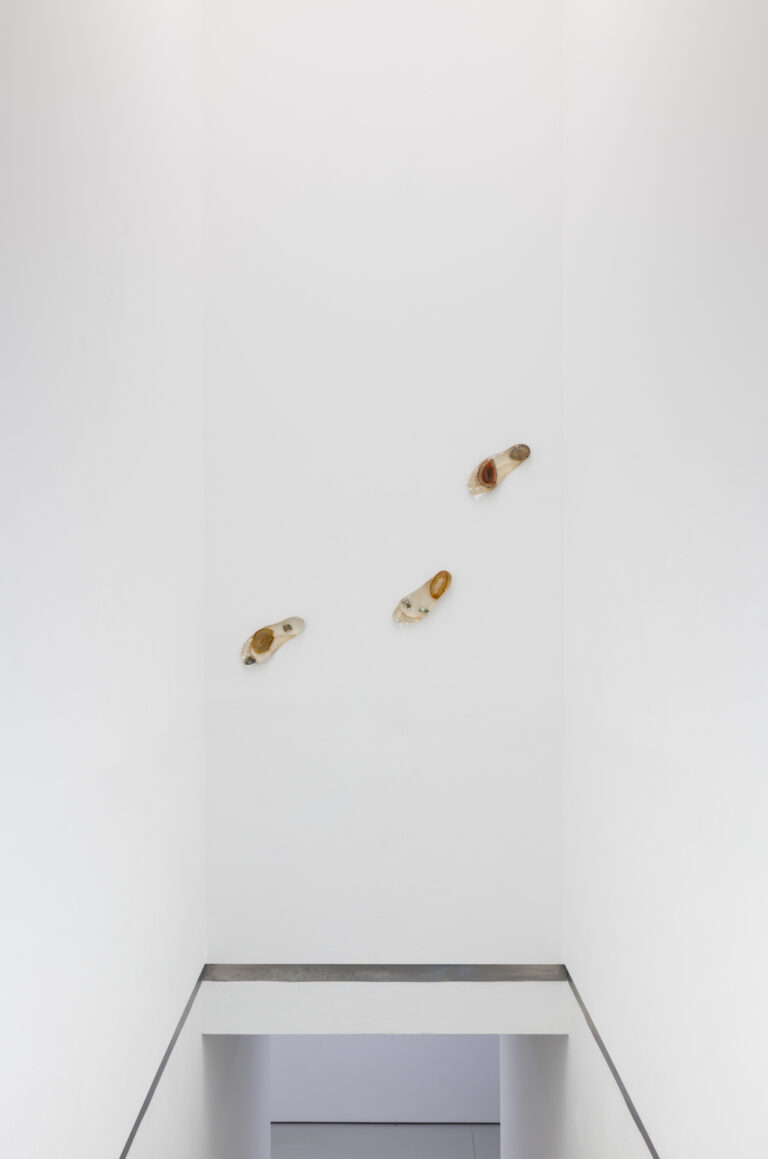
Mariechen Danz
Possible Paths (fossil), 2021
Semi-precious stones, fossils, resin
3 x 10 x 26 cm (each)
Photo: Marcus Schneider
Courtesy of the artist and alexander levy, Berlin
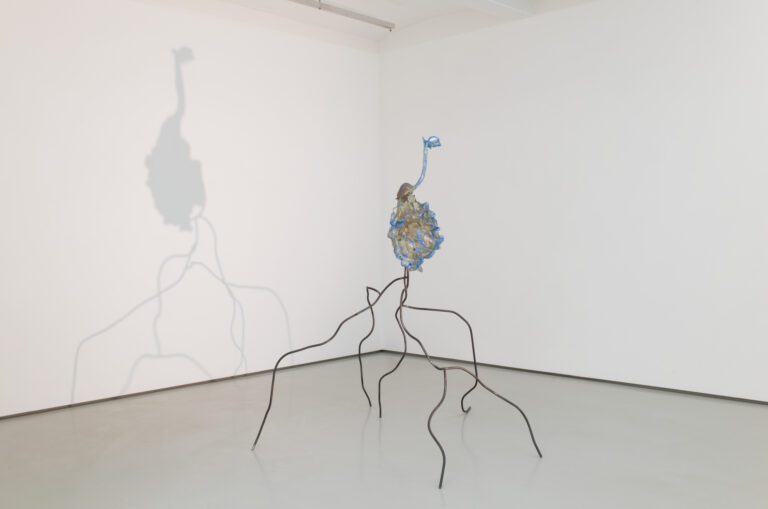
Mariechen Danz
Digestive System 3D, 2021
Marble eggs, resin, pigment, steel
148 x 134 x 140 cm
Photo: Marcus Schneider
Courtesy of the artist and alexander levy, Berlin
The casts of human lungs are composed of polyurethane and contain ammonites and fossils, bearing traces of different times and places. They refer to the overlap of anatomy with history and geology. Positioned outside the body, the organs evidence the interaction between the internal and external, and illustrate the ongoing processes of transformation, transmission, and inscription. The forms are based on medical teaching models, which Danz repeatedly “operates” on and updates. In this way, they function as carriers of history, politics, culture, and socialization.
A path of cast footprints containing minerals and gemstones leads to the lower floor. They indicate the direction of movement and orientation, while also serving as a materialization of corporeal traces. Once downstairs, one encounters the work Digestive System 3D from the Fossalizing Organs series, a digestive system on a branched root-like stand with two marble eggs implanted in it. The internal structures of the body are exposed and made visible, and expanded by an immanent fossilization process.
Danz’s work reveals how knowledge is not only transmitted in writtings, models, or maps, but also remains inscribed in the body. Her practice is cartographic, it maps experience, evidencing that epistemic systems are historically, hierarchically, and socially shaped. On the lower floor, we encounter Friedrich Einhoff’s fissured figures. The focus is not on individual persons but anonymized figures that serve as representatives for human existence. The spaces in which they appear are also indeterminate. The use of acrylic paint mixed with sand, soil, and ash creates rough, membrane-like surfaces which extend the figures‘ skin in texture and transparency. The background appears like a fissured landscape, interweaving figure and space.
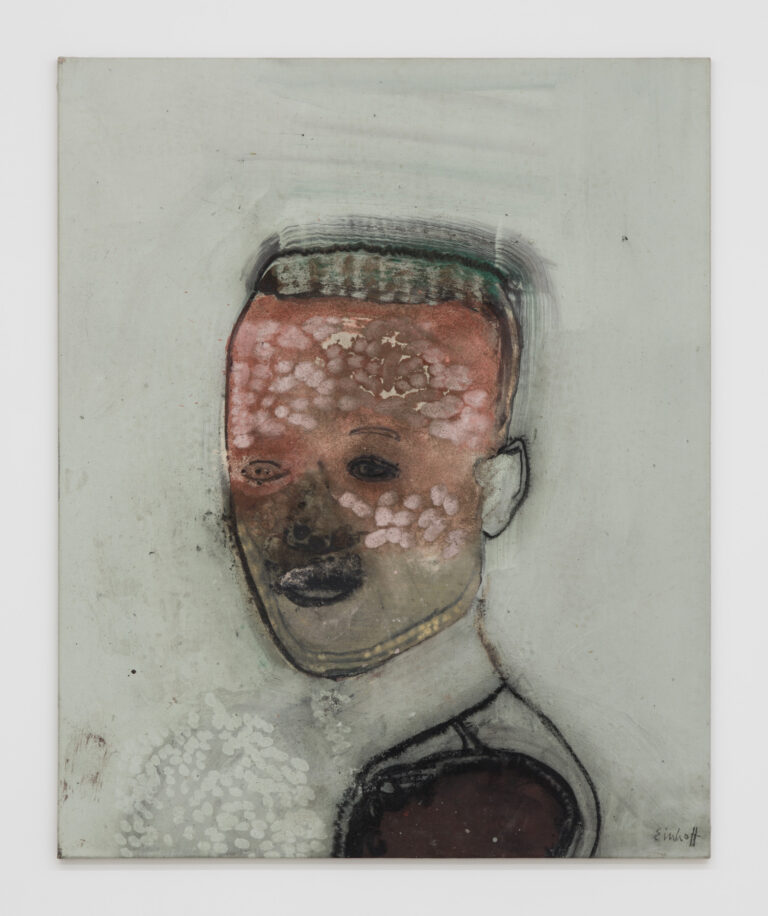
Friedrich Einhoff
Kopf mit Haut und Haar, 2002
Acrylic, charcoal and sand on canvas
135 x 110 cm
Photo: Marcus Schneider
Courtesy of the artist and alexander levy, Berlin
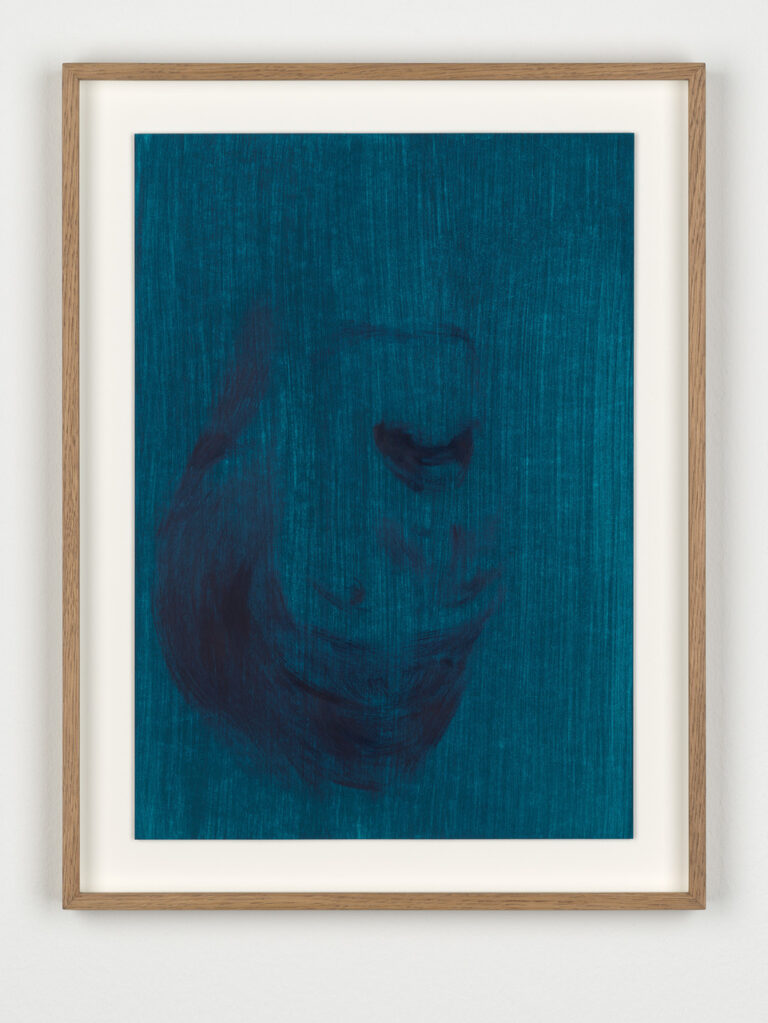
Xie Lei
Premonition VIII, 2025
Oil on paper
42 x 30 cm
Courtesy of the artist, alexander levy, Berlin, Sies and Höke, Düsseldorf
The bodies are mostly reduced to torso or head and bear traces of experience, injury, and time. Delicate, fragile lines are repeatedly traced, reworked, and partially erased, creating an entanglement between body and environment: strokes drift across their heads into the foreground and back again; inside and outside interweave. Withdrawn, their postures are uninviting while simultaneously conveying the presence of an inner life expanding into space. The figures appear suspended, in a silent pathos of isolation. The aura surrounding them arises from the materiality of the surface and the movement of boundaries. Einhoff’s figures make perceptible the continuous inscription of experience into the body.
Text by Lydia Ahrens